
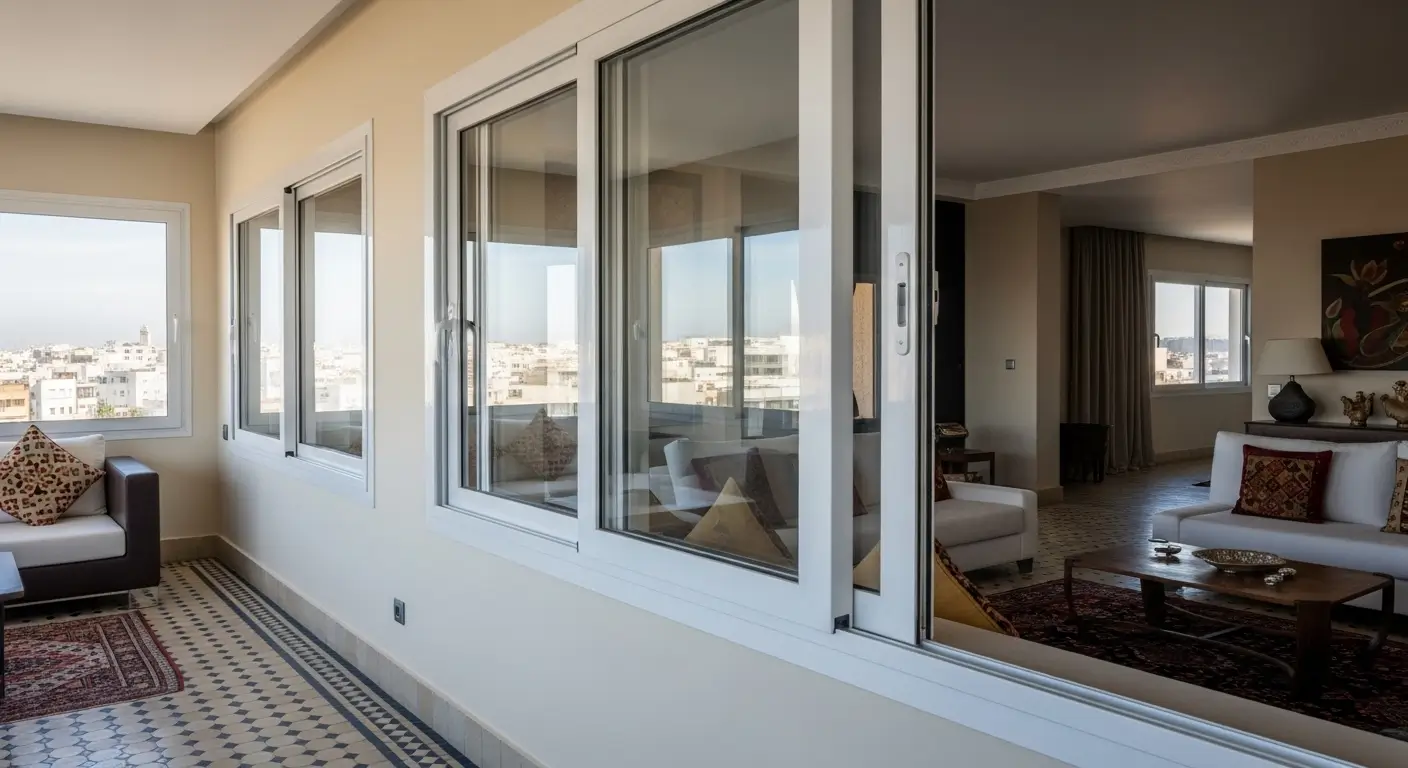
Planning a home renovation or building project in Morocco? One of your biggest questions is probably: “How much will aluminum windows and doors actually cost?” You’re not alone. Thousands of Moroccan homeowners search for aluminum joinery prices every month, only to find vague answers or outdated information that doesn’t help them budget properly.
The truth is, aluminum joinery prices in Morocco range from 900 to 2,000 DH per square meter depending on quality, glazing type, and location. But that’s just the starting point. Installation, thermal performance, and hidden costs can significantly impact your final bill.
This guide gives you everything you need to know about aluminum joinery prices in Morocco. You’ll learn exact price ranges for windows, doors, and installations, understand what drives costs up or down, and discover how to get the best value without compromising quality. Whether you’re in Casablanca, Marrakech, Tangier, or Agadir, you’ll know exactly what to budget.
Table of Contents
How Much Does Aluminum Joinery Cost in Morocco? [Quick Answer]
Let’s start with the numbers you need right now.
Average Price per Square Meter
Aluminum joinery in Morocco follows three main price tiers:
- Economy tier: 900-1,200 DH/m²
- Mid-range quality: 1,200-1,600 DH/m²
- Premium/European brands: 1,600-2,000+ DH/m²
These prices typically include the aluminum frames and basic hardware. The final cost depends heavily on your choices for glazing, thermal performance, and installation.
What’s Included (and What’s Not)
Here’s where many Moroccan buyers get confused: always ask if the price includes “pose comprise” (installation included).
Some suppliers quote material-only prices, while others include installation. A window quoted at 1,200 DH/m² material-only might actually cost 1,500 DH/m² with professional installation. This single misunderstanding can blow your budget by 20-30%.
Before accepting any quote, clarify:
- Is installation included?
- What about delivery?
- Are removal of old windows and cleanup included?
- What warranty covers the work?
| Price Component | Typical Cost | Usually Included? |
|---|---|---|
| Aluminum frame | 600-1,200 DH/m² | Yes |
| Glazing | 300-800 DH/m² | Yes |
| Hardware | Included in frame | Yes |
| Installation | 150-300 DH/m² | Sometimes |
| Delivery | 300-1,200 DH total | Rarely |
| Old window removal | 50-100 DH/unit | Rarely |
Aluminum Joinery Price List by Product Type
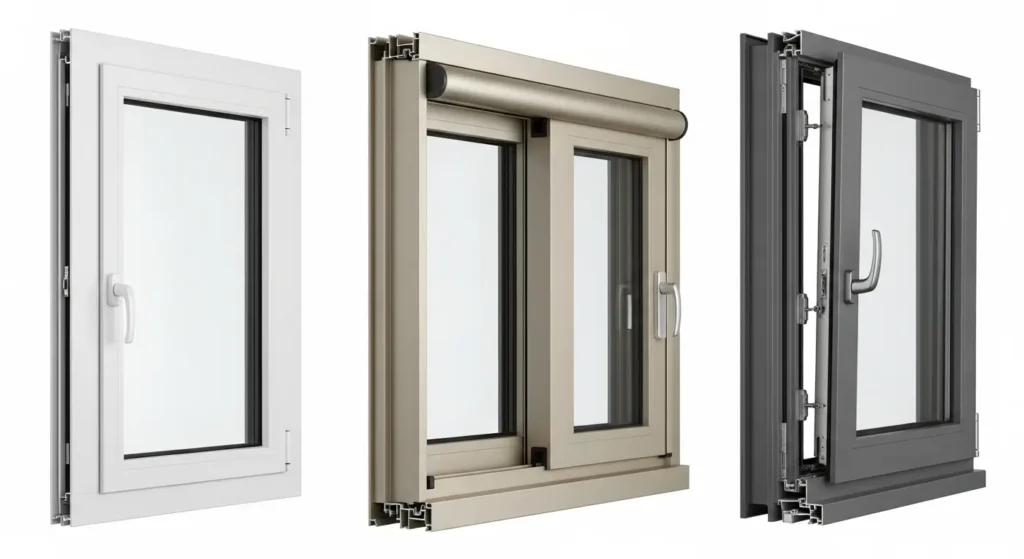
Different products have different price ranges. Here’s what you’ll pay for each type of aluminum joinery in Morocco.
Windows (Fenêtres)
Fixed windows: 800-1,400 DH/m² These are the most affordable option since they don’t open. Perfect for areas where you need light but not ventilation.
Sliding windows: 1,000-1,600 DH/m² The most popular choice in Morocco. They save space and work well for most homes. The sliding mechanism adds to the cost compared to fixed windows.
Tilt-and-turn windows: 1,200-1,800 DH/m² These versatile windows can open two ways: tilted at the top for ventilation or swung open like a door. More expensive due to complex hardware.
Bay windows: 1,400-2,200 DH/m² Large window systems that extend outward from your home. Higher cost reflects the size and structural requirements.
Doors (Portes)
Entry doors: 2,500-6,000 DH per unit Your front door price depends on size, security features, and design complexity. Basic models start around 2,500 DH, while high-security doors with decorative glass can exceed 6,000 DH.
Interior aluminum doors: 1,800-3,500 DH per unit Less common than entry doors but growing in popularity for modern homes. Lighter and less expensive than exterior doors.
Patio/sliding doors: 3,000-7,000 DH per unit Large sliding glass doors connecting your interior to outdoor spaces. Price varies dramatically based on size—a small single door costs 3,000-4,000 DH, while a wide double sliding system can reach 7,000 DH.
Double door systems: 5,000-10,000 DH per set Matching pair of doors for grand entrances. Premium security and aesthetic features drive the higher cost.
Specialized Products
Roller shutters (volets roulants): 600-1,200 DH/m² Manual shutters cost 600-800 DH/m², while motorized versions run 900-1,200 DH/m². Many Moroccan homes add these for security and temperature control.
Glass roofs/verandas: 1,800-3,500 DH/m² Aluminum-framed glass roofing systems for patios and terraces. Complex installations requiring structural support cost more.
Partitions: 800-1,500 DH/m² Interior glass partitions with aluminum framing. Popular for modern office-style home layouts.
Guardrails/railings: 700-1,400 DH per linear meter Balcony and staircase railings. Price depends on design complexity and height.
Commercial facades: 1,500-3,000+ DH/m² Large-scale curtain wall systems for commercial buildings. Prices vary based on project size and specifications.
| Product Type | Price Range | Best For |
|---|---|---|
| Fixed windows | 800-1,400 DH/m² | Light without ventilation |
| Sliding windows | 1,000-1,600 DH/m² | Most homes (space-saving) |
| Tilt-and-turn | 1,200-1,800 DH/m² | Versatile ventilation |
| Entry doors | 2,500-6,000 DH/unit | Security + aesthetics |
| Patio doors | 3,000-7,000 DH/unit | Indoor-outdoor connection |
| Roller shutters | 600-1,200 DH/m² | Security + insulation |
Glazing Options: Why Your Glass Choice Matters (40-50% of Total Cost)
Many Moroccan buyers focus only on the aluminum frame, but here’s the truth: your glass choice represents 40-50% of your total window cost and has the biggest impact on comfort.
Types of Glazing and Their Prices
Simple glazing: Adds 300-500 DH/m² Single-pane glass. The cheapest option but poor for temperature control and noise reduction. Not recommended for living spaces in Morocco.
Double glazing standard: Adds 600-900 DH/m² Two glass panes with an air gap between them. This is the minimum you should consider for Moroccan homes. Provides decent insulation against heat and cold.
Acoustic glazing: Adds 800-1,200 DH/m² Specially designed to block noise. Essential if you live near busy roads, mosques, or commercial areas. The extra cost pays off in peace and quiet.
Security/anti-effraction glazing: Adds 900-1,500 DH/m² Laminated glass that resists breaking. Recommended for ground-floor windows and entry doors. Deters break-ins and provides peace of mind.
Energy-efficient/low-E glazing: Adds 1,000-1,600 DH/m² Advanced glass with a special coating that reflects heat. Keeps homes cooler in summer and warmer in winter. The premium cost delivers long-term energy savings.
Which Glazing Do You Really Need?
Your glazing choice should match your specific situation:
For most Moroccan homes: Double glazing standard is the sweet spot. It handles Morocco’s temperature swings (hot summers, cold winters in many regions) without breaking the budget.
If you live in noisy areas: Acoustic glazing is worth every dirham. Living near Avenue Mohammed V in Casablanca or Jemaa el-Fnaa in Marrakech? The noise reduction will transform your quality of life.
For ground-floor homes or security concerns: Anti-effraction glazing on vulnerable windows provides real protection. It won’t stop a determined thief, but it makes break-ins much harder and louder.
For extreme climates or energy savings: Low-E glazing makes sense in Marrakech’s intense summer heat or Ifrane’s cold winters. Calculate the payback period based on your energy bills.
Don’t Cheap Out on Glass: Here’s Why
Saving 300-500 DH per square meter on simple glazing instead of double glazing seems smart—until you live with the consequences:
- Comfort: Simple glazing transfers heat and cold directly. Your home becomes an oven in summer and an icebox in winter.
- Energy bills: Poor insulation means your air conditioning and heating work overtime. You’ll spend the savings within 2-3 years.
- Noise: Traffic, neighbors, street vendors—everything comes through clearly with single-pane glass.
- Condensation: Simple glazing in Moroccan coastal cities like Tangier or Casablanca develops condensation that can damage walls and frames.
Quality glazing is not an upgrade—it’s a requirement for comfortable living in Morocco.
| Glazing Type | Price Premium | Best Use | Key Benefit |
|---|---|---|---|
| Simple glazing | +300-500 DH/m² | Storage rooms only | Lowest cost |
| Double glazing | +600-900 DH/m² | All living spaces | Temperature control |
| Acoustic glazing | +800-1,200 DH/m² | Noisy locations | Noise reduction |
| Security glazing | +900-1,500 DH/m² | Ground floor, doors | Break-in resistance |
| Low-E glazing | +1,000-1,600 DH/m² | Extreme climates | Energy savings |
What Is Thermal Bridge Breaking and Do You Need It in Morocco?
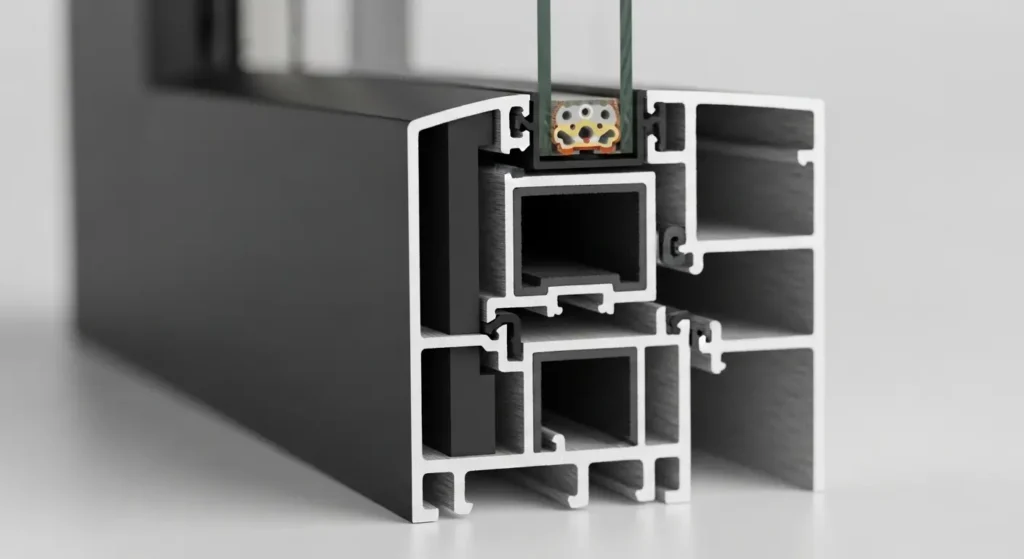
This technical term confuses many Moroccan buyers, but understanding it can save you from years of discomfort.
Understanding Rupture de Pont Thermique
A thermal bridge is a path that allows heat to transfer through your window frame. Standard aluminum conducts heat very efficiently—which is exactly what you don’t want in a window frame.
Without thermal bridge breaking: Your aluminum frame becomes ice-cold in winter and burning hot in summer. Heat flows right through the metal, making your windows the weak point in your home’s insulation.
With thermal bridge breaking (rupture de pont thermique): A non-conductive material (usually polyamide) separates the interior and exterior parts of the aluminum frame. This breaks the heat transfer path.
Think of it like this: Your window has two aluminum profiles (inside and outside) with a plastic strip in between. Heat can’t jump across the gap, so your interior frame stays comfortable while the exterior handles the weather.
Why It Matters in Morocco’s Climate
Many Moroccans think thermal performance only matters in cold climates. Wrong. Morocco’s climate extremes make thermal bridge breaking essential:
Summer in Marrakech or Agadir: Exterior temperatures hit 40-45°C. Without thermal break, your interior window frames become radiators, heating your home even with AC running.
Winter in Ifrane, Midelt, or the Atlas region: Temperatures drop below freezing. Standard aluminum frames frost over and transfer cold directly into your living space.
Coastal humidity in Casablanca or Tangier: Temperature differences cause condensation on cold frames. This leads to mold, water damage, and deteriorating window surrounds.
Price Impact of Thermal Performance
Standard aluminum (no thermal break): Base price You’ll find these in economy offerings. They’re fine for storage rooms or garages—not for living spaces.
Thermal break aluminum: Adds 200-400 DH/m² This should be your minimum standard for any window in your home. The extra cost is non-negotiable for comfort.
High-performance thermal break: Adds 400-600 DH/m² Premium systems with wider thermal breaks and better insulation values. Worth it for extreme climate zones or energy-conscious builders.
Long-Term Savings vs. Upfront Cost
Let’s do the math for a typical Moroccan home:
Standard home: 50m² of windows Thermal break premium: 300 DH/m² × 50m² = 15,000 DH extra
Energy savings: Reduced AC and heating typically saves 20-30% on energy bills Average Moroccan home energy cost: ~3,000-5,000 DH annually Annual savings with thermal break: ~600-1,500 DH
Payback period: 10-25 years
But here’s what the numbers don’t show: 10-25 years of improved comfort, no condensation problems, and better resale value. Moroccan home buyers increasingly recognize quality thermal performance, making it a wise investment even beyond energy savings.
Moroccan Manufacturers vs. European Brands: Which Should You Choose?
One of the biggest decisions you’ll face: Should you buy locally-made aluminum joinery or pay premium prices for European imports?
Moroccan Aluminum Joinery Brands
Morocco has a mature aluminum joinery industry producing quality products at competitive prices.
Quality levels available:
- Entry-level: Basic profiles, standard hardware, acceptable quality
- Mid-range: Good thermal break systems, decent hardware, reliable performance
- Premium local: Comparable to European quality at 20-40% less cost
Price advantages: Moroccan manufacturers save you 20-40% compared to European brands with similar specifications. For a whole-house project, this means savings of 15,000-40,000 DH.
When local manufacturers are the smart choice:
- Standard residential projects
- Mid-range to upper-mid-range homes
- Budget-conscious quality buyers
- Projects where specifications are more important than brand names
Top Moroccan brands to consider: Leading local manufacturers include Aluminium du Maroc, Afric Industrie, and Maroc Aluminium. Many use European technology and profiles while manufacturing locally, giving you excellent value.
European Brands in Morocco
European aluminum systems represent the premium segment of the Moroccan market.
Common European brands available:
- German systems (Schüco, Reynaers)
- French systems (Technal, WICONA)
- Spanish systems (Cortizo, EXLABESA)
Price premiums: European brands cost 30-60% more than equivalent Moroccan products. A window that costs 1,200 DH/m² in Moroccan manufacture might cost 1,800-2,000 DH/m² in European brands.
When European brands make sense:
- Ultra-premium residential projects
- Commercial projects with specific technical requirements
- Coastal projects requiring maximum corrosion resistance
- Projects where brand prestige matters to the owner
- Specifications requiring certified performance data
Reality check: For most Moroccan homeowners, European brands offer marginal performance improvements at substantial cost premiums. Unless you have specific technical requirements or unlimited budget, Moroccan manufacturers using quality profiles deliver better value.
Quality Indicators to Look For (Regardless of Origin)
Don’t choose based on origin alone. Look for these quality markers:
1. Certifications and standards:
- ISO certifications for manufacturing
- European profile standards (even for Moroccan brands)
- Local building code compliance
2. Aluminum profile thickness:
- Minimum 1.4mm for residential windows
- 1.6mm or higher for doors and high-traffic items
- Thicker profiles last longer and perform better
3. Hardware quality:
- German or Italian hardware brands (even on Moroccan frames)
- Smooth operation—test before buying
- Multiple locking points on doors (minimum 3 points)
- Adjustable hinges and rollers
4. Warranty offerings:
- Minimum 5 years on frames
- 2-5 years on hardware
- 10+ years on quality installations
- Clear warranty terms in writing
| Factor | Moroccan Brands | European Brands |
|---|---|---|
| Price | 900-1,600 DH/m² | 1,600-2,000+ DH/m² |
| Quality range | Entry to premium | Premium only |
| Availability | Excellent | Limited dealers |
| Lead time | 2-4 weeks | 4-8 weeks |
| After-sales service | Good (local) | Variable |
| Best for | Most residential projects | High-end/commercial |
Installation Costs: What You Need to Know
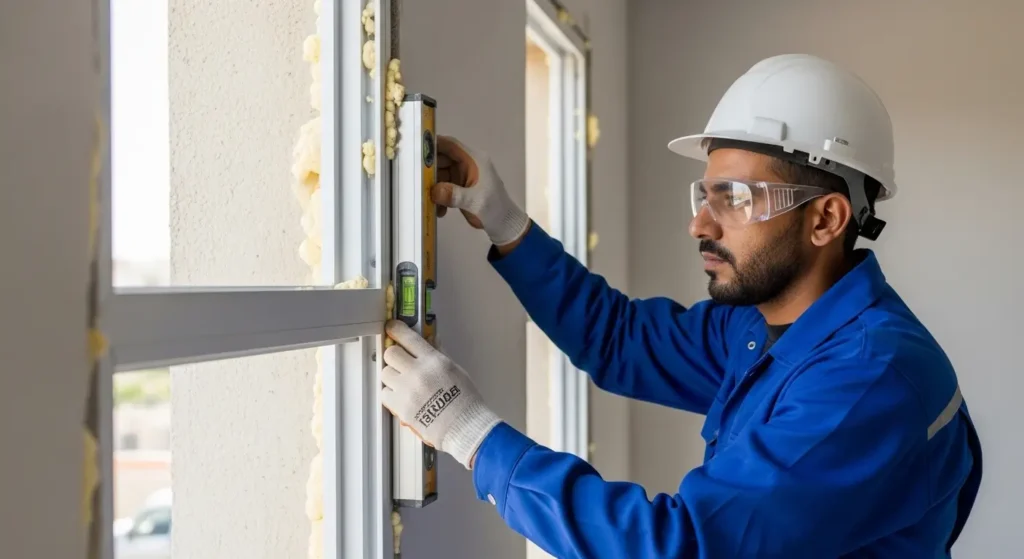
The quality of installation matters as much as the quality of your windows and doors. Poor installation ruins even the best aluminum joinery.
Average Installation Prices
Per square meter: 150-300 DH This is the most common pricing method. A 10m² window project costs 1,500-3,000 DH for installation alone.
Per window unit: 200-500 DH Some installers charge by the window regardless of size. Small windows might cost the same as large ones—ask about the pricing structure.
Complex installations: 300-600 DH extra per unit Difficult access, unusual shapes, structural modifications, or special waterproofing requirements increase installation costs.
Typical installation timeline:
- Single window: 2-4 hours
- Whole apartment (5-7 windows): 1-2 days
- Villa (10-15 windows): 2-3 days
Pose Comprise vs. Material Only
This is the #1 source of confusion and disputes in Morocco’s aluminum joinery market.
“Pose comprise” (installation included): The supplier provides everything: materials, delivery, removal of old windows, installation, sealing, cleanup, and warranty. You pay one price for the complete job.
“Material only” (sans pose): You receive the windows and doors. Everything else—transportation, removal, installation, finishing—is your responsibility or requires separate contracts.
The problem: Many suppliers advertise attractive prices that are material-only. Buyers assume installation is included, then get shocked when they learn they need to pay 25-30% more for installation.
Questions to ask every supplier:
- “Does this price include installation?” (Get a yes or no)
- “What exactly is included in the installation?”
- “Are delivery and old window removal included?”
- “Who provides the warranty—manufacturer, installer, or both?”
What Professional Installation Should Include
When you pay for installation, you should receive:
1. Removal of old joinery: Careful removal of existing windows/doors without damaging surrounding walls. Disposal of old materials off-site.
2. Preparation: Cleaning of the opening, repairing minor defects, ensuring the opening is square and level.
3. Installation: Precise positioning, shimming, leveling, and securing the new joinery according to manufacturer specifications.
4. Sealing and insulation: Proper foam insulation around the frame perimeter, waterproof sealing on the exterior, airtight sealing on the interior.
5. Hardware adjustment: Fine-tuning of all moving parts, ensuring smooth operation, adjusting locking mechanisms.
6. Cleanup and waste removal: Removing all debris, packaging, and old materials. Leaving the site clean.
7. Testing and walkthrough: Demonstrating proper operation, showing you maintenance requirements, explaining warranty coverage.
8. Warranty on installation work: Minimum 1-year warranty on installation workmanship, separate from product warranty.
DIY Installation: Can You Do It Yourself?
Short answer: You can, but you shouldn’t.
When DIY might make sense:
- You’re a professional builder with experience
- You’re installing in a workshop or storage building (not living space)
- You have proper tools and assistance
- You’re comfortable voiding manufacturer warranties
Why professional installation protects your investment:
Proper sealing: Amateur installation often leaks. Water infiltration causes wall damage, mold, and deteriorated frames. Repair costs far exceed installation savings.
Thermal performance: Gaps around the frame destroy the benefits of thermal break systems and quality glazing. You paid for efficiency—poor installation wastes that investment.
Operation and longevity: Improperly leveled windows don’t operate smoothly and wear out hardware prematurely. Doors that aren’t plumb bind and scrape.
Warranty protection: Most manufacturers void warranties if installation isn’t performed by certified installers. You could lose thousands in warranty coverage to save hundreds on installation.
Safety and building codes: Improper installation can create safety hazards and code violations, especially for upper-floor windows and glass doors.
The math: Installation typically costs 15-20% of the total project. For most homeowners, this is not the place to save money.
Aluminum Joinery Prices by Moroccan City
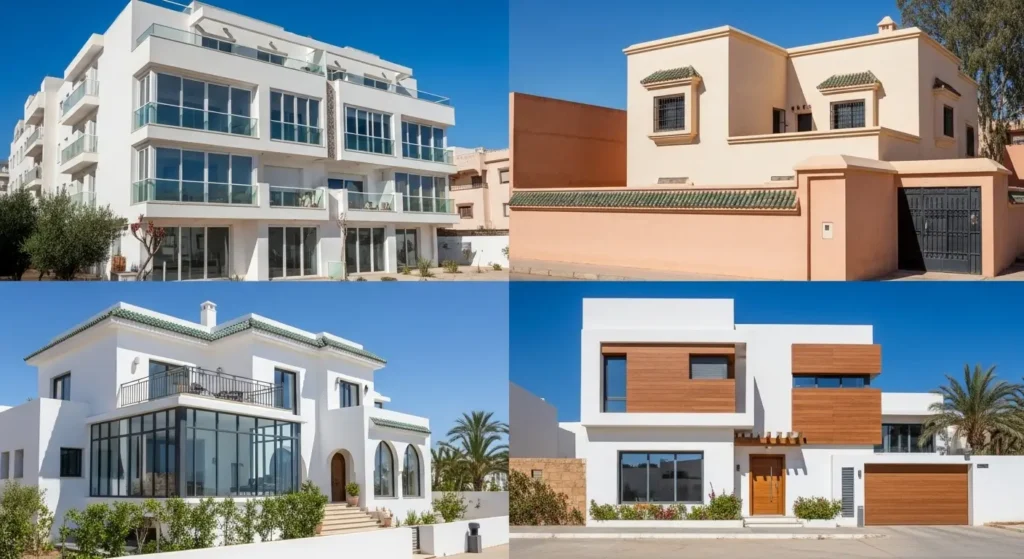
Where you live in Morocco significantly affects how much you’ll pay for aluminum joinery.
Why Prices Vary by Location
Distance from manufacturing centers: Most aluminum joinery manufacturers operate in the Casablanca-Rabat axis. The farther you are from these centers, the more you pay for transportation.
Local market competition: Cities with many suppliers have competitive pricing. Smaller cities with few suppliers often have higher prices.
Regional demand factors: Tourist zones and affluent areas command premium pricing. Industrial cities with price-sensitive markets have more competitive rates.
Transportation and logistics: Aluminum joinery is bulky and fragile. Long-distance delivery adds 5-15% to costs.
City-by-City Price Guide
Casablanca & Rabat
Price range: 900-1,800 DH/m²
These economic centers offer the most competitive pricing in Morocco. For detailed information about suppliers and services in Casablanca, visit our menuiserie aluminium à Casablanca guide.
Advantages:
- Widest selection of suppliers
- Shortest lead times
- Best negotiating leverage
- Easy access to samples and showrooms
What to expect: Standard quality aluminum joinery runs 1,000-1,400 DH/m² installed. Premium European systems cost 1,600-1,800 DH/m². Find trusted suppliers in the capital through our menuiserie aluminium à Rabat directory.
Marrakech
Price range: 950-1,850 DH/m²
Morocco’s tourist capital has strong demand and many suppliers, keeping prices relatively competitive despite distance from manufacturers.
Considerations:
- Growing local manufacturing
- Strong competition in the market
- Moderate transportation costs
- Premium pricing in exclusive neighborhoods (Palmeraie, Hivernage)
What to expect: Slightly higher than Casablanca (5-8% premium on average), but wide selection and competitive market.
Tangier
Price range: 920-1,820 DH/m²
Northern location provides unique advantages: proximity to European suppliers and growing local industry. Learn more about aluminum joinery options in menuiserie aluminium à Tanger.
Advantages:
- Access to Spanish products
- Competitive local manufacturers
- Good market competition
- Moderate pricing
What to expect: Comparable to Casablanca for local products. European imports may be slightly cheaper due to proximity to Spain.
Agadir
Price range: 1,000-2,050 DH/m²
The tourist zone premium is real in Agadir. Expect to pay 10-15% more than Casablanca for equivalent products.
Why it costs more:
- Tourist destination pricing
- Distance from manufacturing centers
- Affluent customer base
- Premium market positioning
What to expect: Standard quality that costs 1,200 DH/m² in Casablanca runs 1,350-1,400 DH/m² in Agadir. The premium is consistent across all quality levels.
Money-saving tip: Some Agadir residents order from Casablanca or Marrakech suppliers. Transportation costs still leave you ahead if the order is large enough (typically 15m² or more).
Fès & Meknès
Price range: 970-1,950 DH/m²
Distance from coastal manufacturing centers adds 8-12% to costs.
Considerations:
- Fewer suppliers than major cities
- Transportation surcharges
- Less competitive market
- Smaller local manufacturing
What to expect: Budget 10% more than you would pay in Casablanca. Lead times may also be longer (3-5 weeks vs. 2-3 weeks).
Other Cities
Oujda, Essaouira, Tetouan, Al Hoceima, Nador, Errachidia:
Expect regional variations of 5-15% above Casablanca baseline pricing. Factors include:
- Distance from manufacturers
- Local market size
- Competition levels
- Transportation infrastructure
General rule: Add 100-150 DH/m² for every 300km from Casablanca-Rabat area.
| City | Price Range (DH/m²) | vs. Casablanca | Key Factor |
|---|---|---|---|
| Casablanca/Rabat | 900-1,800 | Baseline | Manufacturing hub |
| Marrakech | 950-1,850 | +5-8% | Distance + tourism |
| Tangier | 920-1,820 | Similar | European access |
| Agadir | 1,000-2,050 | +10-15% | Tourist premium |
| Fès/Meknès | 970-1,950 | +8-12% | Distance penalty |
What Affects Aluminum Joinery Prices? (7 Key Factors)
Understanding price drivers helps you make informed decisions and negotiate effectively.
1. Size and Dimensions
Square meter pricing decreases with volume:
- Single window (2m²): 1,400 DH/m²
- Five windows (10m²): 1,250 DH/m²
- Whole house (30m²): 1,100 DH/m²
Suppliers offer volume discounts because larger orders improve their efficiency. Don’t buy windows one at a time—package your entire project for better pricing.
Custom sizes vs. standard sizes: Standard sizes come from existing molds and production runs, keeping costs down. Custom dimensions require special fabrication, adding 10-20% to costs.
Standard window sizes in Morocco:
- 60 × 60 cm
- 80 × 100 cm
- 100 × 120 cm
- 120 × 140 cm
If your openings match or are close to these dimensions, you’ll pay less than custom sizes.
2. Aluminum Profile Quality
Not all aluminum is equal. Profile quality dramatically affects performance and price.
Profile thickness:
- Economy (1.2mm): Adequate for protected locations, shorter lifespan
- Standard (1.4mm): Recommended minimum for residential windows
- Premium (1.6-2.0mm): Doors, high-traffic areas, long-term durability
Thicker profiles cost 15-25% more but last significantly longer and perform better.
Alloy composition: Quality alloys resist corrosion better—critical in Morocco’s coastal regions. Marine-grade aluminum costs 10-15% more but won’t deteriorate in salty air.
Surface treatment:
- Powder coating (standard): Good protection, wide color range
- Anodizing (premium): Superior corrosion resistance, natural metallic look, 15-20% more expensive
- Wood-grain finishes: Aesthetic premium, 20-30% higher cost
3. Design Complexity
Simple designs cost less: A basic sliding window is straightforward to manufacture and install.
Complex configurations add cost:
- Multiple opening sections: +15-25%
- Special shapes (arched, circular, triangular): +30-50%
- Integrated blinds or shutters: +25-40%
- Custom grilles or decorative elements: +20-35%
Every complexity adds labor time in manufacturing and installation.
4. Hardware and Accessories
Hardware quality ranges from basic to premium, with corresponding price differences.
Lock quality:
- Basic single-point lock: Standard
- Multi-point locking (3-5 points): +150-300 DH per door
- High-security anti-theft locks: +400-800 DH per door
Handle styles and finishes:
- Standard handle: Included
- Premium handles (stainless steel, brass): +100-250 DH per handle
- Designer handles: +300-600 DH per handle
Hinge quality and type:
- Standard hinges: Included
- Adjustable hinges: +50-100 DH per window
- Concealed hinges: +150-250 DH per window
Roller systems for sliding doors:
- Basic rollers: Standard
- Premium ball-bearing rollers: +200-400 DH per door
- Heavy-duty rollers for large doors: +500-1,000 DH
5. Color and Finish Options
Standard colors (white, beige, gray): No extra cost These common colors are always in stock and require no special processing.
Custom RAL colors: +10-20% Any specific color requires custom powder coating, adding 100-300 DH/m² to costs.
Wood-grain finishes: +15-30% Popular in Morocco for traditional aesthetics. The premium is 200-450 DH/m² depending on complexity.
Metallic finishes (bronze, champagne, anthracite): +20-40% Premium finishes that resist showing dirt and scratches. Expect to pay 250-600 DH/m² more.
Dual-color options: +25-50% Different colors on interior and exterior faces. Beautiful but expensive—adds 300-700 DH/m² to standard pricing.
6. Order Quantity
Buying in volume gives you negotiating power.
Typical discount structure:
- 1-3 windows: Full retail price
- 4-7 windows: 5-8% discount
- 8-12 windows: 10-12% discount
- Whole house (15+ windows): 12-15% discount
- Large projects (30+ windows): 15-20% discount
Example: A single window at 1,400 DH/m² might drop to 1,200 DH/m² when you order 10 windows. That’s a 5,000 DH savings on a 25m² project.
Negotiation tip: Even if you’re replacing windows in phases, negotiate based on the total eventual quantity. Some suppliers will honor the volume price if you commit to future purchases.
7. Supplier Type
Where you buy affects what you pay.
Manufacturers (best prices): Buying directly from the factory eliminates middleman markup. Expect savings of 15-25% compared to retail. However, manufacturers may have minimum order quantities and longer lead times.
Distributors (moderate pricing): Authorized distributors mark up 10-15% over factory prices but provide showrooms, samples, and customer service. Good balance of price and service.
Retailers (highest markup): Storefronts in commercial areas mark up 20-35% over factory prices. You pay for convenience, small-order flexibility, and immediate service.
Direct import (variable): Some buyers import directly from Europe or Turkey. Can save money on premium systems but adds complexity: customs, shipping, no local warranty support, and risk of receiving incompatible products.
Best approach for most buyers: Use distributors for quality brands. They offer competitive pricing with better support than direct factory purchases.
How to Calculate Your Total Project Cost
Stop guessing. Here’s how to accurately budget your aluminum joinery project.
Step-by-Step Cost Calculation
Step 1: Measure all openings
Measure each window and door opening:
- Width (in meters)
- Height (in meters)
- Calculate area (width × height)
Pro tip: Measure the rough opening (wall-to-wall), not the existing window. Add 2-3cm margin for installation.
Step 2: Choose product types for each opening
Decide what goes in each location:
- Living room: Sliding windows
- Bedrooms: Tilt-and-turn windows
- Kitchen: Fixed window
- Entry: Security door
- Patio: Large sliding door
Step 3: Select glazing type
Match glazing to the room’s needs:
- Living areas: Double glazing minimum
- Noisy street-facing rooms: Acoustic glazing
- Ground floor: Security glazing consideration
- Extreme sun exposure: Low-E glazing
Step 4: Add installation costs
Use 150-300 DH/m² as your estimate. If the supplier quotes “pose comprise,” this is already included.
Step 5: Include additional fees
- Delivery: 300-1,200 DH (varies by distance and order size)
- Old window removal: 50-100 DH per unit
- Wall repairs and finishing: 800-2,000 DH total
- VAT (20%): Applied to total
Real Example: 3-Bedroom Villa in Casablanca
Let’s calculate costs for a typical villa project:
Windows:
- 6 sliding windows (1.2m × 1.4m each = 10.08m²): 1,200 DH/m² = 12,096 DH
- 2 tilt-and-turn windows (1m × 1.2m each = 2.4m²): 1,400 DH/m² = 3,360 DH
- 2 small fixed windows (0.6m × 0.8m each = 0.96m²): 1,000 DH/m² = 960 DH
Doors:
- 1 main entry door with security features: 5,500 DH
- 1 large patio sliding door (2.5m × 2.2m): 6,800 DH
Materials subtotal: 28,716 DH
Installation (13.44m² × 200 DH/m²): 2,688 DH Delivery: 800 DH Old window removal (10 units × 75 DH): 750 DH
Subtotal before VAT: 32,954 DH VAT (20%): 6,591 DH
TOTAL PROJECT COST: 39,545 DH
Real Example: 2-Bedroom Apartment Renovation
A more modest project in Rabat:
Windows:
- 4 sliding windows (1m × 1.2m each = 4.8m²): 1,150 DH/m² = 5,520 DH
- 1 kitchen fixed window (0.8m × 1m = 0.8m²): 950 DH/m² = 760 DH
Doors:
- 1 balcony sliding door (1.6m × 2.2m): 4,200 DH
Materials subtotal: 10,480 DH
Installation (5.6m² × 180 DH/m² + 250 DH for door): 1,258 DH Delivery: 400 DH Old window removal (5 units × 60 DH): 300 DH
Subtotal before VAT: 12,438 DH VAT (20%): 2,488 DH
TOTAL PROJECT COST: 14,926 DH
Hidden Costs to Budget For
Smart budgeting includes a contingency for unexpected expenses:
Removal and disposal of old joinery: 500-1,500 DH Some suppliers include this, others don’t. Clarify before signing.
Wall repairs and finishing: 800-2,000 DH Installing new windows often reveals damaged plaster, paint touch-ups, or minor structural repairs.
Unexpected structural issues: Buffer 10% Old buildings sometimes have uneven openings, rot, or other problems discovered during installation.
Delivery fees: 300-1,200 DH Distance, accessibility, and order size affect delivery costs.
Additional hardware or features: 500-1,500 DH Once you see the windows, you might upgrade locks, add security features, or change hardware finishes.
Realistic budgeting formula: Quoted price + 15-20% buffer = Actual expected cost
This buffer prevents budget overruns and unpleasant surprises.
How to Get the Best Value for Money
Getting the best deal isn’t about finding the cheapest price—it’s about maximizing long-term value.
Where to Invest Your Money
1. Thermal performance (always worth it)
The 200-400 DH/m² premium for thermal bridge breaking pays off immediately in comfort and long-term in energy savings. This is non-negotiable for quality installations.
2. Quality installation (non-negotiable)
The 150-300 DH/m² you spend on professional installation protects thousands of dirhams in materials and ensures 15-25 years of trouble-free operation.
3. Good glazing (40-50% of comfort)
Double glazing is the minimum standard. The upgrade from simple to double glazing (300-400 DH/m² additional) is the best money you’ll spend on your windows.
4. Durable hardware (daily use item)
You’ll operate your windows and doors thousands of times. Cheap hardware fails within 2-3 years. Quality hardware (100-250 DH extra per unit) lasts the lifetime of the window.
Where You Can Save Safely
1. Standard colors vs. custom finishes
White, beige, and gray cost nothing extra. Custom colors add 10-40% for purely aesthetic reasons. Unless color is critical to your design, stick with standards.
2. Moroccan brands for most applications
For standard residential projects, quality Moroccan manufacturers deliver 85-95% of European brand performance at 60-75% of the cost. Save 8,000-20,000 DH on a villa project.
3. Timing your purchase (off-peak seasons)
Construction activity in Morocco peaks in spring and summer. Buying in fall or winter often yields better prices and faster service as suppliers compete for business.
4. Bulk ordering for multiple units
Order all your windows at once, even if you’re installing in phases. Volume discounts of 10-15% save thousands on large projects.
Where NOT to Cut Costs
1. Thermal bridge breaking
Saving 200-400 DH/m² on this feature guarantees years of discomfort and higher energy bills. False economy.
2. Installation quality
Hiring the cheapest installer to save 100-150 DH/m² risks water damage, poor operation, and voided warranties. The savings evaporate quickly.
3. Structural aluminum thickness
Thin profiles (1.2mm) save 10-15% upfront but degrade faster, operate poorly, and need replacement years earlier. Buy 1.4mm minimum.
4. Security features on entry points
Your front door and ground-floor windows deserve quality locks and security glazing. This isn’t the place to save 500-1,000 DH.
Long-Term Cost Considerations
Think beyond the installation invoice:
Durability: 15-25 year lifespan Quality aluminum joinery lasts 20-25 years. Economy products fail in 10-15 years. Spending 20% more upfront for twice the lifespan is excellent value.
Maintenance costs (minimal for quality aluminum) Unlike wood (repainting every 3-5 years) or uPVC (discoloration), quality aluminum needs only occasional cleaning. No ongoing maintenance costs.
Energy savings over time Thermal break windows reduce energy consumption by 15-25%. On a 4,000 DH annual energy bill, that’s 600-1,000 DH saved every year for 20+ years.
Resale value impact Quality aluminum joinery is a selling point for Moroccan homes. Buyers recognize and value thermal performance, security features, and premium brands.
Total cost of ownership formula: Purchase price + (annual energy cost × 20 years) + maintenance = True cost
Cheap windows cost more over their lifetime.
How to Get Accurate Quotes from Suppliers
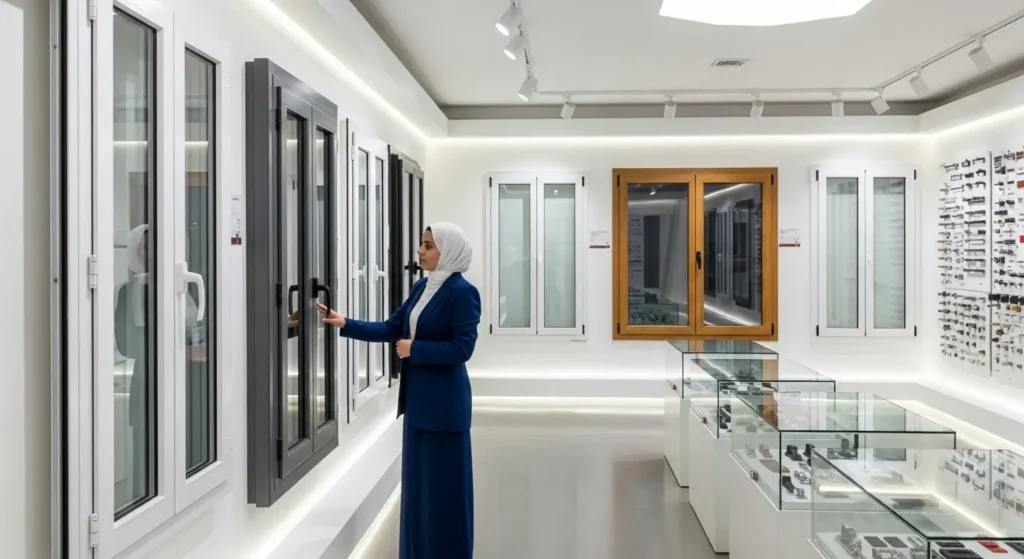
The quality of your quote determines the quality of your project. Here’s how to get quotes you can actually use.
Information to Provide
Suppliers need specific details to quote accurately:
1. Exact measurements Provide width × height in centimeters for each opening. Use the format: “120cm × 140cm” not “approximately 1.2m.”
2. Product types needed Specify for each opening: sliding window, fixed window, tilt-and-turn, entry door, patio door, etc.
3. Preferred glazing options State whether you want simple, double, acoustic, or security glazing. If unsure, ask for pricing on multiple options.
4. Color/finish preferences Standard colors or custom? Wood-grain finish? Provide RAL numbers if you have specific colors in mind.
5. Installation requirements Do you want installation included? Do they need to remove old windows? Any special access considerations (high floor, narrow entrance)?
6. Timeline expectations When do you need the windows delivered? Installed? Rush orders cost more—be realistic about timing.
Questions to Ask Every Supplier
Don’t accept a quote without these answers:
1. “Is installation included in this price?” The most important question. Get a clear yes or no, then verify what installation includes.
2. “What type of thermal break is used?” Standard thermal break, high-performance, or none? This affects long-term satisfaction.
3. “What glazing is included at this price?” Assume nothing. Confirm whether it’s simple, double, or upgraded glazing.
4. “What warranty do you offer?” How many years on frames? On glazing? On hardware? On installation? Get it in writing.
5. “What brand/origin of profiles?” Moroccan manufacturer? European brand? Hybrid? Brand matters for parts availability and resale value.
6. “When can you deliver and install?” Confirm realistic timelines. Promises of “next week” installation often indicate low-quality rushed work.
7. “What payment terms do you accept?” Typical terms are 30-50% deposit, balance on completion. Avoid suppliers demanding 100% upfront.
8. “Can you provide references or photos of recent projects?” Quality suppliers gladly share previous work. Reluctance is a red flag.
How to Compare Quotes Properly
You’ve received three quotes. Now what?
Create a comparison spreadsheet:
| Item | Supplier A | Supplier B | Supplier C |
|---|---|---|---|
| Total price | 35,000 DH | 32,000 DH | 38,500 DH |
| Includes installation? | Yes | No | Yes |
| Thermal break? | Standard | None | High-performance |
| Glazing type | Double | Simple | Double |
| Brand/origin | Moroccan | Moroccan | European |
| Warranty (years) | 5 | 2 | 10 |
| Timeline | 4 weeks | 2 weeks | 6 weeks |
Apples-to-apples comparison:
The cheapest quote (32,000 DH) doesn’t include installation (+3,000 DH) or thermal break (inferior product). Actual cost is 35,000 DH for lower quality.
The most expensive quote (38,500 DH) includes high-performance thermal break, European brands, and 10-year warranty. Better long-term value.
Red flags in pricing:
- 20%+ below market average: Usually indicates compromised quality, missing components, or inexperienced installers.
- Vague line items: “Windows and installation: 40,000 DH” with no breakdown. Demand detailed itemization.
- Pressure tactics: “This price expires tomorrow!” Quality suppliers don’t rush you.
- No written quote: Verbal quotes lead to disputes. Get everything in writing.
Why the cheapest quote is rarely the best:
In Morocco’s aluminum joinery market, you get what you pay for. The lowest bidder often:
- Uses thinner aluminum profiles
- Skips thermal bridge breaking
- Provides simple instead of double glazing
- Employs inexperienced installers
- Offers minimal warranty
- Substitutes inferior hardware
Saving 15% upfront often costs 30-40% more in problems, repairs, and early replacement.
Why extremely high quotes may not be justified:
Some suppliers target uninformed buyers with premium pricing on standard products. European brands cost more, but 2× local product pricing requires justification through superior specifications, not just brand names.
Typical Quote Timelines
Initial quote (basic/verbal): 1-3 days Quick ballpark numbers based on your description. Useful for budgeting but not for decision-making.
Detailed quote after site visit: 3-7 days Supplier visits your home, measures openings, discusses requirements, and provides itemized written quote. This is the quote you use for decisions.
Production time: 2-4 weeks Manufacturing custom aluminum joinery takes time. Rush orders cost 10-20% more and often sacrifice quality control.
Installation scheduling: 1-2 weeks notice Quality installers book weeks in advance. Last-minute availability might indicate low demand for good reasons.
Common Mistakes When Buying Aluminum Joinery in Morocco
Learn from others’ expensive errors.
Mistake #1: Choosing Based Only on Price
The error: Accepting the cheapest quote without understanding what’s included or excluded.
The consequences:
- Inferior materials that fail prematurely
- Poor installation causing leaks and damage
- Missing thermal break leading to discomfort
- Weak hardware that breaks within months
- No meaningful warranty when problems arise
The cost: Saving 5,000 DH upfront, then spending 15,000 DH on repairs, replacements, and energy waste over five years.
The fix: Compare value, not just price. A middle-range quote from a reputable supplier usually delivers the best long-term results.
Mistake #2: Ignoring Thermal Performance
The error: “I don’t need thermal bridge breaking—I’ll save the 300 DH/m².”
The consequences:
- Uncomfortably hot interior frames in summer
- Ice-cold frames in winter
- Condensation leading to mold and water damage
- Higher air conditioning and heating costs
- Reduced home comfort year-round
The cost: A 40m² project saves 12,000 DH by skipping thermal break, then wastes 800-1,200 DH annually in extra energy costs for 20 years. Total loss: 4,000-12,000 DH plus years of discomfort.
The fix: Thermal bridge breaking is not optional in Morocco’s climate. It’s the foundation of window performance. Budget for it from the start.
Mistake #3: Not Clarifying What’s Included
The error: Assuming “1,200 DH/m²” is the final price for installed, working windows.
The consequences:
- Discovering installation costs 3,000 DH extra
- Learning delivery isn’t included (another 800 DH)
- Finding out old window removal is separate (750 DH)
- Realizing the quote was for simple glazing, not double glazing (add 4,000 DH)
The cost: A project budgeted at 30,000 DH actually costs 42,000 DH. Construction stops while you scramble for additional funds.
The fix: Ask explicitly: “What exactly is included in this price?” Get itemized quotes in writing with clear inclusions and exclusions.
Mistake #4: Skipping the Site Visit
The error: Providing rough measurements over the phone and ordering without a professional site assessment.
The consequences:
- Windows don’t fit the openings
- Structural issues discovered during installation
- Additional work required (wall modifications, lintel repairs)
- Delays while custom solutions are fabricated
- Unexpected costs of 3,000-8,000 DH
The cost: Time, money, and stress dealing with problems that should have been identified before ordering.
The fix: Insist on a site visit before finalizing the quote. Professional suppliers measure openings, assess structural conditions, and identify potential challenges before manufacturing begins.
Mistake #5: Not Checking Supplier Credibility
The error: Choosing based on a Facebook ad or a guy who “knows a guy” without verifying reputation.
The consequences:
- Fly-by-night operators who disappear after payment
- Poor quality materials and workmanship
- No recourse when problems arise
- Voided warranties due to non-authorized installers
- Losing your entire investment to fraudulent suppliers
The cost: Total project loss: 25,000-60,000 DH gone with no windows to show for it.
The fix: Verify supplier credibility:
- Check business registration
- Visit their showroom or workshop
- Ask for references and contact previous customers
- Search online reviews
- Verify they’re authorized dealers if claiming brand names
- Confirm physical address (not just a phone number)
- Start with a small project before committing to large orders
Mistake #6: Ordering Without Seeing Samples
The error: Choosing colors, finishes, and hardware from a catalog without seeing physical samples.
The consequences:
- Color doesn’t match expectations (“white” varies significantly)
- Finish quality disappoints (photos hide imperfections)
- Hardware feels cheap or operates poorly
- Glass tint differs from what you imagined
- Overall aesthetic doesn’t match your home
The cost: Living with windows you don’t like for 20+ years, or paying to replace them (entire project cost repeated).
The fix: Visit showrooms and examine actual products:
- Feel the hardware operation
- See colors and finishes in natural light
- Check the weight and quality of materials
- Open and close display windows
- Compare different quality levels side-by-side
If the supplier can’t provide samples, find another supplier.
Mistake #7: Poor Installation Choice
The error: Hiring the cheapest installer to save 2,000-3,000 DH on a 35,000 DH project.
The consequences:
- Improper sealing causing water infiltration
- Windows not level leading to operation problems
- Gaps destroying thermal performance
- Damage to walls during installation
- Voided manufacturer warranties
- Repair costs exceeding initial savings
The cost: Water damage to interior walls: 5,000-15,000 DH in repairs. Window replacement due to voided warranty: another 25,000-35,000 DH.
The fix: Installation quality determines 50% of window performance. Pay for professional installation by certified installers. The 15-20% of project cost this represents is insurance for your investment.
Myths About Aluminum Joinery Pricing in Morocco
Separate fact from fiction in Morocco’s aluminum joinery market.
Myth #1: “All Aluminum is the Same Quality”
The myth: “Aluminum is aluminum. Why pay more for the same material?”
The truth: Aluminum profiles vary dramatically in thickness (1.2mm to 2.0mm+), alloy composition, thermal break systems, and surface treatment. These differences create 40-60% price ranges and determine whether your windows last 10 years or 25 years.
Impact on you: Buying cheap “aluminum” windows with 1.2mm thin profiles saves money upfront but costs more in premature replacement, poor operation, and energy waste.
What to do: Demand specifications: profile thickness, thermal break type, alloy grade, and surface treatment. Compare these specs across quotes, not just prices.
Myth #2: “European Brands Are Always Better”
The myth: “If it’s not from Europe, it’s inferior quality.”
The truth: Morocco has mature aluminum joinery manufacturers using European technology, profiles, and quality control. Many Moroccan brands deliver 90-95% of European brand performance at 60-70% of the cost. European brands make sense for specific technical requirements or ultra-premium projects, but for most Moroccan homes, quality local manufacturers offer superior value.
Impact on you: Spending 15,000-30,000 DH extra on European brands for a standard villa delivers marginal performance improvements that most homeowners never notice.
What to do: Evaluate based on specifications and certifications, not origin. Many Moroccan manufacturers use European profile systems—you get European quality with local support and pricing.
Myth #3: “You Don’t Need Thermal Break in Morocco”
The myth: “Thermal break is for cold countries. Morocco doesn’t get that cold.”
The truth: Thermal bridge breaking matters in hot climates as much as cold ones. Summer temperatures in Marrakech, Agadir, and interior cities regularly exceed 40°C. Without thermal break, your interior aluminum frames become heat radiators, making your home uncomfortable and increasing air conditioning costs. Morocco’s temperature extremes (hot summers, cold winters in many regions) make thermal break essential, not optional.
Impact on you: Skipping thermal break to save 200-400 DH/m² guarantees uncomfortable living conditions and wastes 500-1,000 DH annually in energy costs.
What to do: Budget for thermal bridge breaking from the start. Consider it a base requirement, not an upgrade.
Myth #4: “Installation Doesn’t Matter Much”
The myth: “The windows are good quality, so installation is just putting them in the holes.”
The truth: Installation quality determines 50% of window performance. The best aluminum joinery in Morocco performs poorly if installed incorrectly. Proper sealing prevents water infiltration. Correct leveling ensures smooth operation. Adequate insulation maintains thermal performance. Professional installation protects your investment and validates warranties.
Impact on you: Poor installation on 40,000 DH worth of premium windows creates the same problems as cheap windows: leaks, drafts, operation issues, and early failure.
What to do: Budget 15-20% of project cost for professional installation. Verify installer credentials and check references. Don’t hire based on price alone.
Myth #5: “The Bigger the Discount, the Better the Deal”
The myth: “This supplier offered 30% off! That’s the best value in Morocco.”
The truth: Realistic discounts in Morocco’s aluminum joinery market range from 5-15% for volume orders. Discounts exceeding 20% usually indicate:
- Inflated initial pricing
- Inferior materials being substituted
- Missing components (thermal break, quality glazing, hardware)
- Desperate suppliers with quality or financial problems
Impact on you: A 30% discount on a 40,000 DH project (saving 12,000 DH) seems amazing—until you discover you received simple glazing instead of double (actual value 6,000 DH less), no thermal break (4,000 DH less), and thin profiles (3,000 DH less). You overpaid instead of saving.
What to do: If a discount exceeds 15%, ask what changed from the original specification. Get the exact products, brands, and specs in writing. Verify that discounted pricing still includes all essential features.
Frequently Asked Questions About Aluminum Joinery Prices
How much does a standard aluminum window cost in Morocco?
A typical aluminum window measuring 1.2m × 1.4m (1.68m²) costs between 1,680 DH and 3,360 DH depending on quality level and what’s included.
Economy option: 1,680-2,016 DH (1,000-1,200 DH/m²) gets you basic aluminum with simple or standard double glazing, minimal thermal break, and standard hardware. Suitable for budget-conscious projects or non-critical locations.
Mid-range quality: 2,016-2,688 DH (1,200-1,600 DH/m²) delivers good thermal break systems, quality double glazing, reliable hardware, and Moroccan brand profiles. This is the sweet spot for most Moroccan homes—balancing quality and value.
Premium option: 2,688-3,360 DH (1,600-2,000 DH/m²) provides high-performance thermal break, premium glazing (acoustic, security, or low-E), European brand profiles, and superior hardware. Worth it for demanding applications or energy-conscious builders.
Installation adds: 250-500 DH per window (150-300 DH/m²) if not included in the quoted price.
Bottom line: Budget 2,200-2,800 DH per standard window installed for quality that will satisfy you for 20+ years.
Is installation usually included in the quoted price?
No standard practice exists in Morocco—some suppliers include installation (“pose comprise”) while others quote material-only pricing. This inconsistency causes more confusion than any other aspect of aluminum joinery buying.
What you need to know:
Approximately 60% of Moroccan suppliers quote material-only prices. Their advertised or initial quote doesn’t include installation, delivery, or removal of old windows. Installation adds 20-30% to the material cost.
Approximately 40% of suppliers quote “pose comprise” pricing. Their price includes materials, delivery, installation, and sometimes old window removal. This is the true final cost.
The problem: Unless you ask explicitly, you can’t tell which type of quote you’re receiving. This leads to budget overruns and disputes.
The solution:
- Ask every supplier: “Does this price include installation?”
- Demand a clear yes or no answer
- Get written quotes that itemize: materials, installation, delivery, and other services
- Compare quotes on the same basis (all with installation or all without)
Typical installation costs when quoted separately:
- Per square meter: 150-300 DH
- Per window unit: 200-500 DH
- Whole project: 15-25% of material cost
Red flag: If a supplier won’t clarify or gives vague answers about installation inclusion, find another supplier.
What’s the difference between 900 DH/m² and 2,000 DH/m² aluminum joinery?
The price difference reflects substantial quality variations across multiple factors:
Aluminum profile quality (200-400 DH/m² difference):
- 900 DH/m²: Thin profiles (1.2-1.3mm), basic alloys, minimal corrosion protection
- 2,000 DH/m²: Thick profiles (1.6-2.0mm), premium alloys, marine-grade treatment
Thermal performance (200-400 DH/m² difference):
- 900 DH/m²: No thermal break or basic thermal break
- 2,000 DH/m²: High-performance thermal break with superior insulation values
Glazing quality (300-600 DH/m² difference):
- 900 DH/m²: Simple glazing or basic double glazing
- 2,000 DH/m²: Premium double glazing, acoustic, security, or low-E options
Hardware and accessories (100-200 DH/m² difference):
- 900 DH/m²: Basic locks and handles, economy rollers/hinges
- 2,000 DH/m²: Premium multi-point locks, German/Italian hardware, smooth operation
Brand and origin (200-400 DH/m² difference):
- 900 DH/m²: Local economy brands, basic manufacturing standards
- 2,000 DH/m²: Premium Moroccan or European brands, certified quality control
Warranty and support (value difficult to quantify):
- 900 DH/m²: Limited warranty (1-2 years), questionable after-sales support
- 2,000 DH/m²: Comprehensive warranty (5-10 years), established support network
Real-world impact: The 900 DH/m² window might last 8-12 years with mediocre performance and higher energy costs. The 2,000 DH/m² window will last 20-25 years with superior comfort and lower operating costs.
The math: 50m² of windows
- Economy (900 DH/m²): 45,000 DH, replace in 10 years = 90,000 DH over 20 years + higher energy bills
- Premium (2,000 DH/m²): 100,000 DH, lasts 20+ years = 100,000 DH over 20 years + lower energy bills
Best value: Mid-range at 1,300-1,500 DH/m² delivers 85-90% of premium performance at 65-75% of the cost.
Do I really need thermal bridge breaking in Morocco?
Yes, absolutely. This is one of the most important features of your aluminum joinery, and skipping it is false economy in Morocco’s climate.
Why it matters in Morocco specifically:
Summer heat: Interior Morocco (Marrakech, Agadir interior, Fès) regularly sees 40-45°C exterior temperatures. Without thermal break, your interior aluminum frames reach 50-60°C—too hot to touch and radiating heat into your home despite air conditioning.
Winter cold: Atlas region, Ifrane, Midelt, and even interior areas of Fès and Meknès experience freezing temperatures. Standard aluminum frames become ice-cold, creating drafts and cold zones near windows.
Coastal humidity: Casablanca, Tangier, Essaouira face temperature variations between exterior and interior that cause condensation on cold frames. This moisture leads to mold, damaged walls, and deteriorating window surrounds.
Energy costs: Morocco’s electricity costs make inefficient windows expensive. Air conditioning fighting against heat-conducting frames wastes 500-1,200 DH annually.
Comfort: Even if you don’t care about energy costs, the discomfort of hot or cold frames near seating areas, beds, and workspaces degrades your quality of life.
The cost vs. value:
- Thermal break adds: 200-400 DH/m²
- Annual energy savings: 500-1,200 DH
- Payback period: 8-15 years
- Comfort improvement: Immediate and continuous
Minimum recommendation: Standard thermal bridge breaking is non-negotiable for any living space in Morocco. Consider high-performance thermal break (adding 400-600 DH/m² total) for extreme climate zones or energy-conscious projects.
When you might skip it: Storage rooms, garages, workshops, or other non-climate-controlled spaces where comfort doesn’t matter.
Are Moroccan aluminum joinery brands good quality?
Yes, Morocco has several excellent aluminum joinery manufacturers that produce quality comparable to European brands at significantly lower prices.
Morocco’s aluminum joinery industry:
Morocco has manufactured aluminum products for decades with mature quality control and modern technology. Many Moroccan manufacturers:
- Use European profile systems (same aluminum extrusions as European brands)
- Employ European machinery and production processes
- Meet international quality standards and certifications
- Provide comparable performance to European brands
Quality range available:
Entry-level Moroccan brands: Basic but functional. Suitable for budget projects with realistic quality expectations. Price: 900-1,100 DH/m²
Mid-range Moroccan brands: Solid quality, good thermal performance, reliable hardware. Best value for most residential projects. Price: 1,100-1,400 DH/m²
Premium Moroccan brands: Excellent quality competing directly with European brands. Performance differences are marginal. Price: 1,400-1,700 DH/m²
European brands in Morocco: Marginal performance improvement at 30-60% premium. Price: 1,700-2,200 DH/m²
When to choose Moroccan brands:
- Standard residential projects (90% of homes)
- Value-conscious quality buyers
- Projects where specifications matter more than brand prestige
- Any situation where 20-40% cost savings is meaningful
When European brands make sense:
- Ultra-premium residential projects with unlimited budgets
- Commercial projects with specific performance certifications required
- Extreme coastal environments requiring maximum corrosion resistance
- Projects where brand name adds resale value matching the premium
How to verify quality regardless of origin:
- Check certifications (ISO, European standards)
- Verify profile thickness (minimum 1.4mm)
- Test hardware operation (smooth, solid feel)
- Confirm thermal break specifications
- Ask for project references and visit completed installations
- Get comprehensive written warranty (minimum 5 years)
Bottom line: For most Moroccan homeowners, quality local manufacturers using good profiles and hardware deliver 90-95% of European brand performance at 60-70% of the cost. That’s exceptional value.
How long does aluminum joinery last in Morocco?
Quality aluminum joinery properly installed in Morocco lasts 15-25 years with minimal maintenance. Lifespan depends on quality, environment, and care.
Factors affecting lifespan:
Initial quality (biggest factor):
- Economy aluminum: 10-15 years
- Mid-range quality: 15-20 years
- Premium aluminum: 20-25+ years
Environmental conditions:
- Coastal areas (salt air): Reduces lifespan 10-20% without marine-grade treatment
- Interior dry climate: Extends lifespan, minimal corrosion
- Pollution exposure: Industrial areas accelerate deterioration
- Extreme temperature zones: More stress on seals and hardware
Maintenance and care:
- Regular cleaning: Annual cleaning extends lifespan
- Hardware lubrication: Annual maintenance keeps operation smooth
- Seal inspection: Addressing seal deterioration prevents water damage
- Neglect: Reduces lifespan 20-30%
Installation quality:
- Professional installation: Full lifespan potential
- Poor installation: Reduces lifespan 30-50% due to water infiltration and operational stress
Component-specific lifespans:
Aluminum frames: 20-30 years (the frame itself rarely fails) Glazing seals: 15-20 years (first component requiring attention) Hardware (locks, handles, rollers): 10-20 years depending on quality and use frequency Thermal break materials: 20-25 years (deteriorates slowly)
What “failure” means:
Aluminum joinery rarely catastrophically fails. Instead, it degrades:
- Seals leak (water infiltration)
- Hardware operates poorly (difficult opening/closing)
- Thermal performance declines (comfort and energy issues)
- Aesthetic degradation (scratches, discoloration, corrosion)
At 15-25 years, most owners replace for performance and aesthetic reasons rather than structural failure.
Maintenance requirements:
Unlike wood (repainting every 3-5 years) or uPVC (discoloration issues), aluminum requires minimal maintenance:
- Annual cleaning with mild soap
- Annual hardware lubrication
- Seal inspection every 2-3 years
- No painting, no special treatments
Compared to alternatives:
- Wood joinery: 10-15 years (high maintenance)
- uPVC: 15-20 years (discoloration, brittleness)
- Aluminum: 20-25 years (minimal maintenance)
Maximizing lifespan:
- Buy quality (1.4mm+ profiles, good thermal break)
- Choose marine-grade treatment in coastal areas
- Ensure professional installation
- Perform annual cleaning and lubrication
- Address small issues before they become big problems
Expected replacement timeline:
- Year 12-15: Possible hardware replacement or seal repairs
- Year 20-25: Full replacement consideration for most installations
- Year 25+: Premium installations with excellent maintenance
When is the best time to buy aluminum joinery in Morocco?
Fall and winter months (October through February) offer the best combination of pricing, availability, and service quality in Morocco’s aluminum joinery market.
Why off-peak seasons are better:
Construction activity patterns in Morocco:
- Peak season (March-August): New construction and renovation surge. Suppliers overwhelmed with orders, prices firm, lead times extend to 5-8 weeks, installers fully booked.
- Off-peak season (September-February): Construction slows. Suppliers compete for business, prices negotiable, lead times shrink to 2-4 weeks, installers available on short notice.
Pricing advantages (off-peak):
- More aggressive negotiation on prices (5-10% additional discount possible)
- Promotional pricing to maintain production volume
- Bundled offers (free delivery, discounted installation)
- Better payment terms
Service quality advantages (off-peak):
- More time for site visits and consultation
- Less rushed manufacturing and installation
- Better quality control with more manageable workload
- Installer attention and care (not rushing to next job)
Availability advantages (off-peak):
- Choose from more available installers (best teams, not whoever’s free)
- Flexible scheduling to match your needs
- Quick turnaround if you have urgent timeline
Month-by-month guide:
January-February (Best pricing): Lowest construction activity. Suppliers most motivated to negotiate. Excellent time to buy, though installation might wait for better weather if you’re replacing all windows at once.
March-May (Increasing activity): Construction season begins. Prices start firming, lead times extend. Still reasonable but advantages disappearing.
June-August (Peak season): High demand, firm pricing, extended lead times, installers fully booked. Avoid unless urgent.
September-October (Excellent timing): Activity declining, pricing becomes flexible, good weather for installation. One of the best times to buy.
November-December (Good value): Very competitive pricing to meet year-end targets. Good availability though some suppliers close for holidays.
Special considerations:
Ramadan timing: Construction activity slows during Ramadan regardless of season. Can find good pricing but expect slower service and extended timelines.
Religious holidays: Avoid major purchase timing around Eid al-Fitr and Eid al-Adha when businesses close and timelines extend.
Project planning: Order 6-8 weeks before you need installation to avoid paying rush premiums.
Bottom line: Plan your aluminum joinery purchase for October-November or January-February to maximize value and service quality. Avoid June-August unless you have compelling timeline reasons.
Can I install aluminum windows myself to save money?
Technically yes, but practically no for most homeowners. DIY aluminum window installation in Morocco saves 15-20% of project cost but risks 100% of your investment.
Why DIY is risky:
Professional installation costs: 150-300 DH/m² (typically 15-20% of total project) Potential cost of DIY problems: 5,000-30,000 DH in repairs, replacements, and water damage
Specific challenges of aluminum window installation:
Precision requirements: Windows must be level within 1-2mm or they won’t operate properly. Achieving this requires experience, proper tools, and measurement skills most homeowners lack.
Sealing and waterproofing: Improper sealing causes water infiltration that damages walls, creates mold, and deteriorates the installation. Professional installers know how to seal for Morocco’s climate (including heavy rain in northern regions).
Thermal performance: Gaps around the frame negate the benefits of thermal bridge breaking and quality glazing. You paid for energy efficiency—poor installation wastes that investment.
Structural considerations: Load-bearing walls, lintel support, and wall integrity require assessment. Mistakes compromise building structure.
Tools and equipment required:
- Spirit levels (multiple sizes)
- Shims and packers
- Proper installation foam
- Waterproofing materials
- Power tools (drill, saw)
- Measuring and marking tools
Most homeowners don’t have these tools, and buying them approaches installation cost savings.
When DIY might make sense (rare circumstances):
You’re a professional builder or tradesperson with installation experience and proper tools.
You’re installing in a workshop, garage, or storage building where minor imperfections don’t affect living comfort and mistakes aren’t costly.
You’re installing very simple fixed windows in non-critical locations (though even simple installations require proper sealing).
You have expert help from a friend or relative who’s a professional installer willing to supervise.
Risks of DIY installation:
Warranty voids: Most manufacturers void product warranties if installation isn’t performed by certified professionals. Your 5-10 year warranty becomes worthless.
Water damage: Poor sealing causes leaks. Water damage to interior walls costs 5,000-20,000 DH to repair—far exceeding installation savings.
Operational problems: Improper leveling means windows don’t open/close smoothly, hardware wears prematurely, and you live with daily frustration.
Energy waste: Gaps and improper insulation mean higher energy bills for the life of the windows.
Safety hazards: Improperly secured large windows or doors risk falling, causing injury or property damage.
Building code violations: DIY installations may not meet local building codes, creating problems for home sales or insurance claims.
The math:
Savings: 3,000-6,000 DH on a typical 20-30m² project Risk: 10,000-40,000 DH in potential problems + voided warranties + years of poor performance
Better approach:
Negotiate professional installation costs (sometimes negotiable), find reputable installers with competitive pricing, or include installation in package deal when ordering windows.
Bottom line: Professional installation is insurance for your investment. The 15-20% of project cost protects thousands of dirhams in materials and ensures 20+ years of trouble-free operation. For almost all Moroccan homeowners, paying for professional installation is the smart financial decision.
Why do prices vary so much between different Moroccan cities?
Geography, competition, and market dynamics create 5-20% price variations across Moroccan cities for equivalent aluminum joinery.
Primary factors driving regional price differences:
Distance from manufacturing centers (5-15% impact):
Most aluminum joinery production concentrates in the Casablanca-Rabat-Kenitra industrial axis. Transportation costs increase proportionally with distance:
- Casablanca/Rabat: Baseline pricing (closest to manufacturers)
- Tangier: +5-8% (northern location but growing local production)
- Marrakech: +5-8% (reasonable distance, large market)
- Agadir: +10-15% (distance + tourist premium)
- Fès/Meknès: +8-12% (interior location)
- Oujda/Nador: +12-18% (eastern extremity)
- Laayoune/Dakhla: +15-25% (far south, very limited local supply)
Transportation logistics: Aluminum joinery is bulky, fragile, and requires careful handling. A full truck from Casablanca to Agadir costs 8,000-12,000 DH. This cost spreads across the order—small orders pay proportionally more.
Local market competition (5-10% impact):
High competition cities (lower prices):
- Casablanca: 50+ suppliers competing intensely
- Rabat: 30+ suppliers, government market
- Marrakech: 25+ suppliers, tourist-driven construction
Moderate competition (moderate prices):
- Tangier: 15-20 suppliers
- Fès: 12-18 suppliers
- Agadir: 10-15 suppliers (but affluent market)
Low competition (higher prices):
- Smaller cities: 3-8 suppliers with less price pressure
- Remote areas: Limited options, take-it-or-leave-it pricing
Market positioning and demographics (5-15% impact):
Tourist zones and affluent areas: Agadir, premium Marrakech neighborhoods, upscale Rabat areas command premium pricing. Suppliers position for higher-end markets with 10-20% price premiums.
Industrial and working-class areas: Price-sensitive markets force competitive pricing. Casablanca industrial zones, working neighborhoods in major cities see aggressive pricing.
Regional wealth levels: Median income differences affect pricing strategies. Suppliers in affluent regions price higher because customers can pay more.
Local production capacity (10-20% impact):
Cities with local manufacturing:
- Casablanca: Major production, lowest prices
- Kenitra: Growing aluminum industry, competitive pricing
- Tangier: Increasing local production, improving prices
Cities dependent on imports from other regions:
- Most interior cities rely on Casablanca-area production
- Southern cities have minimal local production
- Remote areas depend entirely on long-distance supply
Seasonal and temporary factors:
Construction booms: Local building surges strain supplier capacity and increase prices temporarily.
Major projects: Large developments can monopolize supplier attention, affecting availability and pricing for smaller buyers.
Economic conditions: Regional economic health affects negotiating leverage and pricing flexibility.
How much difference does location really make?
Example: Standard 3-bedroom villa project (40m² of windows)
- Casablanca: 48,000 DH
- Marrakech: 50,400 DH (+5%)
- Tangier: 50,400 DH (+5%)
- Agadir: 55,200 DH (+15%)
- Fès: 52,800 DH (+10%)
- Oujda: 55,200-57,600 DH (+15-20%)
Mitigation strategies for buyers in expensive regions:
Order from major city suppliers: Large orders (15m²+) can justify delivery from Casablanca even to distant cities. Compare local pricing + delivery cost vs. local supplier pricing.
Coordinate with neighbors or projects: Bulk orders from multiple buyers negotiate better pricing and share delivery costs.
Plan during off-peak seasons: Suppliers in all cities more flexible with pricing when demand is low.
Consider local manufacturing growth: Some interior cities developing aluminum production. New manufacturers offer competitive pricing to gain market share.
Bottom line: Location affects pricing but shouldn’t stop you from getting quality joinery. The 5-15% regional variation is smaller than quality differences between economy and premium products. Focus on getting good value locally rather than obsessing over regional price differences.
What’s a reasonable budget for replacing all windows in a 3-bedroom house?
Plan to spend 35,000-65,000 DH for complete aluminum joinery replacement in a typical Moroccan 3-bedroom house, depending on quality level, size, and location.
Typical 3-bedroom house specifications:
Window count and sizes:
- 6-8 bedroom/living room windows (1.2m × 1.4m average)
- 2-3 bathroom/kitchen windows (0.8m × 1m average)
- 1-2 small utility windows (0.6m × 0.8m average)
- Total: 10-13 windows covering 35-45m²
Doors:
- 1 main entry door
- 1 patio or balcony door (optional but common)
Budget breakdown by quality level:
Economy budget: 35,000-45,000 DH
What you get:
- Basic aluminum profiles (1.2-1.4mm)
- Standard thermal break
- Basic double glazing
- Moroccan economy brands
- Standard hardware
- Professional installation included
- Standard white finish
Best for: Budget-conscious buyers, rental properties, short-term ownership, non-critical locations
Mid-range budget: 45,000-60,000 DH (RECOMMENDED)
What you get:
- Quality aluminum profiles (1.4-1.6mm)
- Good thermal break systems
- Quality double glazing (acoustic on street-facing windows)
- Reputable Moroccan brands
- Good hardware (German/Italian components)
- Professional installation included
- Standard or one custom color
Best for: Most owner-occupied homes, long-term residence, balanced quality and value
Premium budget: 60,000-80,000+ DH
What you get:
- Premium aluminum profiles (1.6-2.0mm)
- High-performance thermal break
- Advanced glazing (low-E, acoustic, or security as needed)
- European brands or premium Moroccan brands
- Premium hardware and security features
- Professional installation included
- Custom colors, wood-grain finishes
- Enhanced warranties
Best for: High-end homes, extreme climate zones, energy-conscious buyers, maximum performance requirements
Detailed cost example (mid-range quality, Casablanca):
Windows (40m²):
- Materials: 40m² × 1,300 DH/m² = 52,000 DH
- Installation: 40m² × 200 DH/m² = 8,000 DH
Entry door:
- Quality security door: 4,500 DH
Patio sliding door:
- Large sliding door (2.2m × 2.4m): 5,800 DH
Additional costs:
- Delivery: 800 DH
- Old window removal (12 units × 70 DH): 840 DH
- Minor wall repairs: 1,200 DH
Subtotal: 73,140 DH VAT (20%): 14,628 DH Total project cost: 87,768 DH
Wait—that’s higher than the 45,000-60,000 DH range!
The reality: Most quotes you receive won’t include 20% VAT as a separate line item—it’s absorbed into the per-meter pricing. The 45,000-60,000 DH estimate reflects realistic all-in pricing for mid-range quality.
Revised realistic calculation (VAT absorbed):
Windows: 40m² × 1,200 DH/m² installed = 48,000 DH Entry door: 4,000 DH Patio door: 5,500 DH Delivery & extras: 2,000 DH
Total: 59,500 DH ✓ (within mid-range estimate)
Factors that increase your budget:
- Large house (45m²+ windows): +10,000-20,000 DH
- Premium location pricing (Agadir): +5,000-10,000 DH
- Custom colors/finishes: +3,000-8,000 DH
- Security upgrades: +2,000-6,000 DH
- Roller shutters for all windows: +8,000-15,000 DH
- Difficult access/complex installation: +2,000-5,000 DH
Factors that decrease your budget:
- Smaller house (30m² windows): -8,000-15,000 DH
- No patio/balcony door: -5,000-6,000 DH
- Standard white finish: -3,000-8,000 DH
- Competitive market location (Casablanca): -3,000-8,000 DH
- Off-peak season purchase: -2,000-5,000 DH
Smart budgeting approach:
Phase 1: Get baseline: Request quotes for basic specifications to establish your market baseline.
Phase 2: Adjust for reality: Add 15-20% to lowest quote to account for necessary upgrades and unexpected costs.
Phase 3: Include contingency: Budget another 10% for changes, problems, or upgrades you decide on during the project.
Example:
- Lowest quote: 45,000 DH
- Reality adjustment (+18%): 53,100 DH
- Contingency (+10%): 58,410 DH
- Realistic budget: 58,500 DH
Bottom line: For a typical 3-bedroom house in Morocco with mid-range quality aluminum joinery, budget 50,000-60,000 DH for a complete replacement project. This gives you quality that will satisfy you for 20+ years without overspending on unnecessary premium features.
Final Checklist: Getting the Best Aluminum Joinery Deal
Use this checklist before making your final decision:
Before You Buy:
☐ Get at least 3 detailed quotes from different suppliers
☐ Verify thermal bridge breaking inclusion (non-negotiable for living spaces)
☐ Clarify installation inclusion (pose comprise or material-only?)
☐ Check glazing specifications (double glazing minimum)
☐ Request physical samples (see colors, feel hardware operation)
☐ Verify supplier credentials (business registration, showroom, references)
☐ Read warranty terms carefully (years covered, what’s included, claim process)
☐ Confirm realistic timeline (production + installation schedule)
☐ Understand payment schedule (typical: 30-50% deposit, balance on completion)
☐ Get everything in writing (signed detailed quote with specifications)
Questions Answered:
☐ Total cost including VAT? (no hidden charges)
☐ Installation date confirmed? (specific dates, not vague promises)
☐ Warranty duration and coverage? (separate for materials and installation)
☐ Payment terms acceptable? (avoid 100% upfront, use standard terms)
☐ All measurements verified by site visit? (professional measurement, not your estimate)
Quality Verified:
☐ Profile thickness minimum 1.4mm (ask for specs in writing)
☐ Thermal bridge breaking confirmed (standard minimum for Moroccan climate)
☐ Double glazing or better (simple glazing only for non-living spaces)
☐ Quality hardware tested (smooth operation, solid feel, reputable brand)
☐ Appropriate for your location (marine-grade for coastal, climate-appropriate)
Smart Decisions:
☐ Mid-range pricing chosen (avoid cheapest and most expensive)
☐ Professional installation included (certified installers, not DIY)
☐ Realistic timeline accepted (rushed jobs sacrifice quality)
☐ Appropriate brand for project (Moroccan quality for most applications)
☐ Contingency budget set aside (10-15% for unexpected needs)
Conclusion
You now have complete information about aluminum joinery prices in Morocco. From understanding that prices range from 900 to 2,000 DH per square meter, to knowing how thermal bridge breaking, glazing choices, and installation quality affect your long-term satisfaction, you’re equipped to make informed decisions.
The most important takeaways for Moroccan buyers:
Quality matters more than price. The cheapest aluminum joinery costs more over its lifetime through poor performance, early replacement, and higher energy bills. Mid-range quality from reputable Moroccan manufacturers delivers the best value for most homes.
Three non-negotiables: Thermal bridge breaking (essential in Morocco’s climate extremes), quality double glazing (40-50% of your comfort), and professional installation (protects your entire investment). Never compromise on these three features to save money.
Location affects price but not quality. Whether you’re in Casablanca, Marrakech, Tangier, or Agadir, the same quality standards apply. Regional price variations of 5-15% are normal—focus on getting good value in your local market rather than obsessing over baseline pricing in other cities.
Get multiple detailed quotes. The quality of your quotes determines the quality of your project. Request at least three detailed written quotes with complete specifications, clarify what’s included (especially installation), and compare based on value rather than price alone.
Ready to move forward? Use this guide when meeting with suppliers. Ask the right questions, demand clear specifications, and choose based on long-term value. Your aluminum joinery will serve you for 20-25 years—invest the time now to make the right decision.
Find a Specialist
For professional aluminum joinery installation in Morocco, look for suppliers who:
- Provide detailed written quotes with specifications
- Offer site visits for accurate measurements
- Have showrooms where you can see and test products
- Provide verifiable references from recent projects
- Give comprehensive warranties (minimum 5 years on materials)
- Employ certified professional installers
- Clearly explain what’s included in their pricing
Start by searching for “menuiserie aluminium” + your city name, visit showrooms in person, and request quotes from at least three different suppliers before making your decision.
Related Topics to Explore
- Energy efficiency in Moroccan homes: How aluminum joinery fits into broader energy-saving strategies
- Building codes and regulations: What Moroccan construction laws require for windows and doors
- Home security in Morocco: Integrating aluminum joinery with comprehensive home security systems
- Interior design trends: How modern aluminum joinery complements contemporary Moroccan home design
- Property value impact: How quality aluminum joinery affects home resale value in different Moroccan markets
Your investment in quality aluminum joinery improves comfort, reduces energy costs, enhances security, and adds value to your Moroccan home for decades to come.