
You just received a prescription for a brain MRI and your first question is simple: how much is this going to cost me?
You are not alone. Thousands of Moroccan patients face this exact moment every day — prescription in hand, no idea what to expect at the payment counter.
This guide gives you straight answers. You will find the brain MRI cost in Morocco broken down by city, by sector, and by insurance coverage. You will also learn what affects the price, how to get reimbursed by CNSS or CNOPS, and exactly what happens on the day of your exam.
No fluff. Just everything you actually need to know.
Table of Contents
How Much Does a Brain MRI Cost in Morocco?
Let’s start with the number you came here for.
The brain MRI cost in Morocco varies depending on whether you go to a public hospital or a private clinic, and whether your exam requires a contrast injection.
Quick Answer: Price Summary
| Type of Exam | Public Hospital | Private Clinic |
|---|---|---|
| Without injection | 800 – 1,200 DH | 1,800 – 2,500 DH |
| With injection (gadolinium) | 1,000 – 1,500 DH | 2,200 – 4,500 DH |
| Average (all protocols) | ~1,000 DH | ~2,800 DH |
Important: These prices are indicative averages. Your actual cost will depend on the city, the center, the machine type, and your insurance coverage.
What Is the Real Cost After Insurance?
The sticker price and what you actually pay are often very different numbers in Morocco.
- Private sector, before reimbursement: 2,500 – 3,000 DH on average
- After CNSS or CNOPS reimbursement: most patients pay between 300 and 800 DH out-of-pocket
- Public sector: the lowest cost option, but comes with waiting times of one to four weeks
The reimbursement system is explained in full in Section 5 of this guide. If cost is your main concern, skip ahead — the numbers there will change how you think about the private vs. public decision.
Why Does the Brain MRI Price Vary So Much? 6 Key Factors
Not all brain MRI exams are the same. Six variables drive most of the price differences you will see across Moroccan radiology centers.
1. Machine Type: 1.5 Tesla vs. 3 Tesla
- 1.5T machines are the standard in most Moroccan centers — private and public
- 3T machines produce higher-resolution images and cost 15 to 30% more
- For the vast majority of brain exams, a 1.5T machine is clinically sufficient
- A 3T machine is only necessary for specific clinical situations — your neurologist or radiologist will tell you if it applies to you
- Practical tip: Do not pay for a 3T exam unless your doctor explicitly requests it
2. Contrast Injection (Gadolinium)
This is one of the biggest price drivers:
- Without injection: 1,500 – 2,200 DH in private centers
- With gadolinium injection: 2,200 – 4,500 DH in private centers
- The injection enhances the visibility of tumors, inflammation, and vascular abnormalities
- Some prescriptions say “at the radiologist’s discretion” — this means the specialist will decide after reviewing the first images whether the injection is needed
3. Public Hospital vs. Private Clinic
The sector you choose determines your baseline cost:
- Public hospitals charge 800 – 1,200 DH, but appointment wait times are typically one to four weeks
- Private centers charge 1,800 – 4,500 DH, with appointments available in two to seven days
- For non-urgent cases, the public sector can save you significant money
4. City and Geographic Location
- Cities with more radiology centers (Casablanca, Rabat) tend to have more price competition
- Smaller cities have fewer MRI machines, which means less flexibility and sometimes higher prices
- See the full city-by-city breakdown in Section 3
5. Urgency and Priority Appointments
- If you need a same-day or next-day appointment at a private center, expect a surcharge of 200 to 400 DH
- Your doctor’s referral letter or a hospital urgency stamp can help justify priority access
- In genuine neurological emergencies (sudden paralysis, thunderclap headache, suspected stroke), go directly to the emergency department — MRI will be done without an appointment
6. Radiologist Expertise and Center Reputation
- Top-tier radiologists and centers affiliated with academic hospitals charge a premium
- For a routine brain MRI, a standard private center is entirely adequate
- What matters most: the center accepts your insurance, has accredited equipment, and delivers a written report within 24 to 48 hours
Brain MRI Cost by City in Morocco
Moroccan patients search by city, not by national average. Here is what you can expect to pay depending on where you live.
Brain MRI Cost in Casablanca
- Private clinics: 2,000 – 4,000 DH
- Public hospital (CHU Ibn Rochd): 800 – 1,200 DH
- Casablanca has the highest concentration of private radiology centers in Morocco, including several 3T machines
- More competition means you can call ahead, compare quotes, and negotiate without pressure
Brain MRI Cost in Rabat
- Private clinics: 1,800 – 3,500 DH
- Public hospital (CHU Ibn Sina): ~900 DH
- CHU Ibn Sina is one of Morocco’s main reference hospitals — very affordable but waiting times can be long
- Several private imaging centers operate along the major medical corridors of the city
Brain MRI Cost in Marrakech
- Private clinics: 2,000 – 3,800 DH
- Public hospital: 900 – 1,100 DH
- The private radiology sector in Marrakech has grown steadily, partly driven by medical tourism
- Equipment is generally modern in the larger private centers
Brain MRI Cost in Tanger
- Private clinics: 1,900 – 3,500 DH
- Public hospital (CHU Mohammed VI Tanger): public tariff applies
- Fewer private centers than Casablanca or Rabat means slightly less price competition
- Worth calling multiple centers before booking
Brain MRI Cost in Agadir
- Private clinics: 1,800 – 3,200 DH
- MRI machine availability is more limited than in the north
- Some patients travel to Marrakech for specific protocols not available locally
- Call ahead to confirm the center has the right machine for your prescription
Brain MRI Cost in Fès and Meknès
- Private clinics (Fès): 1,700 – 3,000 DH
- Public hospital (CHU Hassan II Fès): ~800 DH — one of the best-equipped public hospitals in northern Morocco
- Meknès has fewer radiology centers; patients often travel to Fès for MRI exams
- CHU Hassan II is a strong public option for patients in the Fès-Meknès region
Brain MRI in Smaller Moroccan Cities (Oujda, El Jadida, Béni Mellal, etc.)
- Private clinics: 1,600 – 2,800 DH
- Equipment availability is lower in smaller cities
- Medical travel to the nearest regional capital is common and often worth it for complex protocols
- Always call ahead to confirm the machine is available and functioning before making the trip
Public Hospital vs. Private Clinic: Which Should You Choose?
This is the most important decision you will make after receiving your prescription. Here is a direct comparison.
Public vs. Private — Key Differences at a Glance
| Criteria | Public Hospital | Private Clinic |
|---|---|---|
| Price | 800 – 1,200 DH | 1,800 – 4,500 DH |
| Appointment wait | 1 – 4 weeks | 2 – 7 days |
| Machine quality | Variable | Generally modern |
| Report turnaround | 2 – 5 days | 24 – 48 hours |
| CNSS/AMO coverage | 100% (at tarif base) | 70 – 90% of TNR |
| Evening/weekend availability | Rare | Common |
When to Choose the Public Sector
Go public when:
- Your condition is non-urgent and waiting two to four weeks is clinically acceptable
- You have no supplemental insurance — out-of-pocket cost is at its lowest in public hospitals
- Your doctor has a referral relationship with a specific public hospital department
- You are a RAMED beneficiary (see Section 5.6)
When to Choose the Private Sector
Go private when:
- Your symptoms require rapid diagnosis — neurological conditions should not wait weeks
- Your insurance covers most of the cost anyway, making the price gap less significant
- You need a specific technology such as a 3T machine or an open MRI for claustrophobia
- You want the radiologist’s report the next day so your treating doctor can act quickly
Main Public Hospitals Offering Brain MRI in Morocco
| City | Public Hospital |
|---|---|
| Casablanca | CHU Ibn Rochd |
| Rabat | CHU Ibn Sina |
| Fès | CHU Hassan II |
| Tanger | CHU Mohammed VI |
| Marrakech | CHU Mohammed VI |
How to get in: Bring your medical prescription and ask your treating doctor for a referral letter addressed to the relevant hospital department. The letter significantly speeds up access.
Insurance Reimbursement: CNSS, CNOPS & AMO — What Will You Actually Pay?
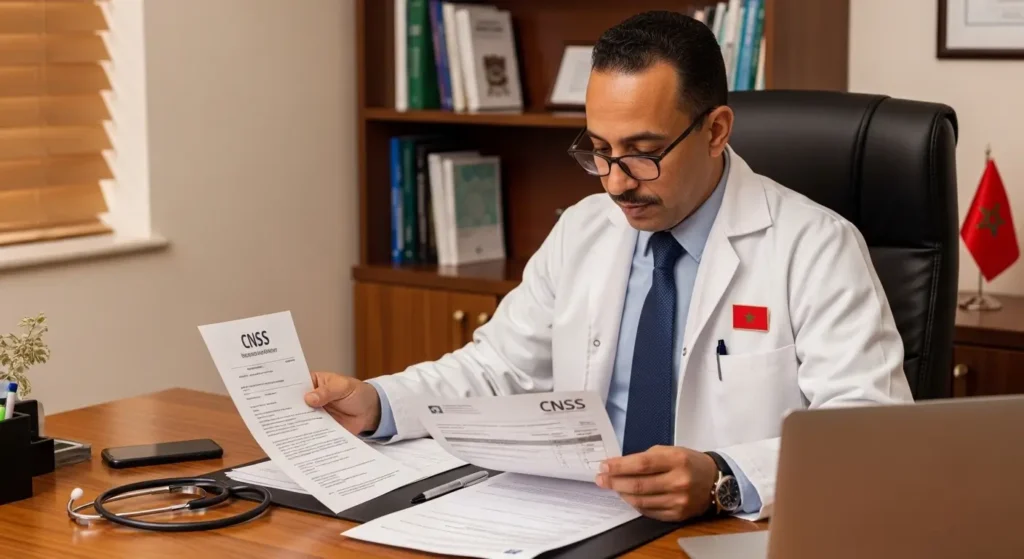
This section is the most valuable part of this guide for most Moroccan patients. Understanding reimbursement is the difference between paying 3,000 DH and paying 400 DH for the same exam.
Understanding the TNR (Tarif National de Référence)
Before diving into percentages, you need to understand one concept: the TNR.
- The TNR is the government’s official reference price for each medical act in Morocco
- Your insurer reimburses a percentage of the TNR — not the actual invoice amount
- For brain MRI, the TNR is approximately 1,500 – 1,800 DH
- Private centers often charge more than the TNR, which means there is always a gap to cover
Worked example:
A private center charges 3,000 DH for your brain MRI. CNSS reimburses 80% of 1,800 DH (TNR) = 1,440 DH You pay the difference: 3,000 – 1,440 = 1,560 DH out-of-pocket If you also have a supplemental mutuelle covering 80% of the remaining gap: you pay roughly 312 DH
This is why having both CNSS and a complementary mutuelle is so powerful.
How Much Does CNSS Reimburse for a Brain MRI?
- Outpatient (most common situation): CNSS reimburses 80% of the TNR
- In a private hospital (hospitalization): reimbursement rises to 90% of the TNR
- In a public hospital: reimbursement is 100% of the TNR
Documents required to get reimbursed by CNSS:
- Original medical prescription (ordonnance)
- Feuille de soin (social security care form)
- Original paid invoice from the radiology center
- Your CNSS affiliation number and card
- Bank account details (RIB) for direct transfer
How Much Does CNOPS Reimburse for a Brain MRI?
- CNOPS covers civil servants and generally offers more generous coverage than CNSS
- Typical reimbursement: 80 – 100% depending on the affiliated mutual (MFP, MGPAP, FAR, etc.)
- Some CNOPS members benefit from near-total coverage when using approved centers
Private Insurance and Supplemental Mutuelle Coverage
- Many Moroccan employees have a complementary mutuelle through their employer
- When combined with CNSS or CNOPS, total coverage often reaches 85 – 95% of the invoice
- Practical step: Call your mutuelle before booking to ask if the exam requires pre-authorization and whether the center you chose is in their network
Step-by-Step: How to Get Reimbursed
- Get your ordonnance from your doctor — it must mention the type of MRI and the clinical indication
- Have the MRI done and pay the full invoice at the center
- Collect all documents: original paid invoice + radiology report + ordonnance + feuille de soin
- Submit the dossier to your CNSS branch, your employer’s HR department, or your mutuelle portal
- Wait for reimbursement: typically 2 to 6 weeks; some mutuelles offer faster digital processing
RAMED and Low-Income Patients
- RAMED beneficiaries are entitled to free or near-free care in public hospitals
- Brain MRI is covered under RAMED at CHU facilities across Morocco
- What you need: your RAMED card + a doctor’s referral to the appropriate hospital department
- Note: availability depends on the hospital’s machine schedule — ask specifically about MRI wait times
Brain MRI With or Without Injection — What You Need to Know
One of the most common questions Moroccan patients ask is whether they can save money by avoiding the gadolinium injection. Here is a clear answer.
What Is Gadolinium Injection?
- Gadolinium is an intravenous contrast agent injected during the MRI
- It makes certain tissues “light up” on the images, revealing abnormalities that would otherwise be invisible
- The injection is given mid-scan, after the first set of images is taken
- It is generally very well-tolerated; serious allergic reactions are rare but possible — always inform the team of any known allergies
When Is Injection Medically Necessary?
Injection is required for:
- Suspected brain tumors (primary or metastatic)
- Active multiple sclerosis plaques
- Brain infections (meningitis, encephalitis, abscess)
- Vascular malformations and certain types of aneurysm
- Post-operative follow-up to check for residual tumor
Injection is generally NOT needed for:
- Routine headache investigation
- Standard epilepsy workup (in most cases)
- White matter disease screening
- Initial dementia assessment
What “at the radiologist’s discretion” means: Some prescriptions give the radiologist the authority to decide during the exam. In practice, this means they scan first without injection — and if the images suggest a lesion that needs contrast to characterize, they proceed with the injection.
Can You Save Money by Skipping the Injection?
| Without Injection | With Injection | Saving | |
|---|---|---|---|
| Private clinic (average) | 1,500 – 2,200 DH | 2,200 – 4,500 DH | 300 – 750 DH |
| Public hospital (average) | 800 – 1,000 DH | 1,000 – 1,500 DH | 200 – 500 DH |
The critical caveat: Never request an exam without injection purely to save money if your doctor or radiologist says injection is needed. A non-diagnostic MRI means you will have to repeat the exam — and pay twice. Follow your prescription.
MRI Injection vs. CT Scan Injection — Not the Same Thing
- Brain MRI uses gadolinium (a magnetic contrast agent)
- Brain CT scan uses iodinated contrast (an X-ray dye)
- They have different risk profiles, different protocols, and cannot be substituted for each other
- If your doctor switches you from MRI to CT scan (or vice versa), the injection protocol changes entirely — always inform both centers of your situation
Why Would a Doctor Prescribe a Brain MRI? Common Reasons Explained
If you have just received a prescription and are wondering what your doctor suspects, this section gives you a clear picture of the most common reasons.
Symptoms That Lead to a Brain MRI Prescription
- Severe or unusual headaches — especially sudden, “worst headache of my life” type (thunderclap headache)
- Persistent vertigo or unexplained loss of balance
- Visual disturbances — double vision, sudden partial vision loss, visual field defects
- Memory problems or rapid cognitive decline
- Unexplained muscle weakness or one-sided paralysis
- Speech difficulties — slurred speech or inability to find words
- Epileptic seizures — first-time or unexplained
Medical Conditions Diagnosed or Monitored with Brain MRI
| Condition | Why MRI Is Used |
|---|---|
| Brain tumor | Detects size, location, and type of tumor |
| Stroke (AVC) | Identifies ischemic or hemorrhagic damage |
| Multiple sclerosis | Shows active and old lesions in the brain and spine |
| Aneurysm | Reveals vascular bulges before they rupture |
| Epilepsy | Locates structural causes of seizures |
| Hydrocephalus | Shows excess fluid accumulation |
| Meningitis / encephalitis | Confirms infection and its extent |
| Alzheimer’s / dementia | Assesses atrophy patterns |
Having a Brain MRI Does Not Mean Something Is Seriously Wrong
This is worth saying clearly: most brain MRI results come back normal.
Doctors prescribe brain MRI as a way to rule out serious conditions — not because they are certain something is wrong. A normal result is a medically valuable result. It confirms your brain is structurally healthy and allows your doctor to explore other causes for your symptoms.
If you are anxious about the exam, that is completely understandable. But know that the majority of patients who go through a brain MRI leave with reassuring news.
Brain MRI vs. Brain CT Scan — Which One Do You Need?
Many Moroccan patients are confused about the difference between a brain MRI and a brain scanner (CT scan). They are two completely different technologies and they are not interchangeable.
How Each Machine Works
| Feature | Brain MRI | Brain CT Scan (Scanner) |
|---|---|---|
| Technology | Magnetic field + radio waves | X-ray beams |
| Radiation | None | Small dose of ionizing radiation |
| Duration | 15 – 45 minutes | 5 – 15 minutes |
| Best for | Soft tissue, brain matter, spinal cord | Trauma, skull fractures, acute bleeding |
| Cost in Morocco (private) | 1,800 – 4,500 DH | 600 – 1,200 DH |
When Each Exam Is Used
| Clinical Situation | Preferred Exam |
|---|---|
| Suspected stroke (acute) | CT scan (faster, available everywhere) |
| Brain tumor workup | MRI (more detailed soft tissue imaging) |
| Head trauma / skull fracture | CT scan |
| Multiple sclerosis | MRI |
| Epilepsy investigation | MRI |
| Meningitis / brain abscess | MRI (with injection) |
| Post-operative follow-up | MRI or both |
| Sudden intense headache (ER) | CT scan first, then MRI if needed |
Can You Ask for a CT Scan Instead of an MRI to Save Money?
No. The type of exam is determined by the clinical question your doctor needs to answer — not by your preference or budget.
Switching from MRI to CT scan to save money can lead to:
- A missed diagnosis (CT cannot see certain brain lesions that MRI detects)
- A repeat exam once the error is discovered — costing you more in the end
- A delay in treatment that has real health consequences
Always follow your prescription. If you have concerns about cost, ask your doctor whether both exams are truly necessary and whether one can be deferred.
How to Prepare for Your Brain MRI in Morocco
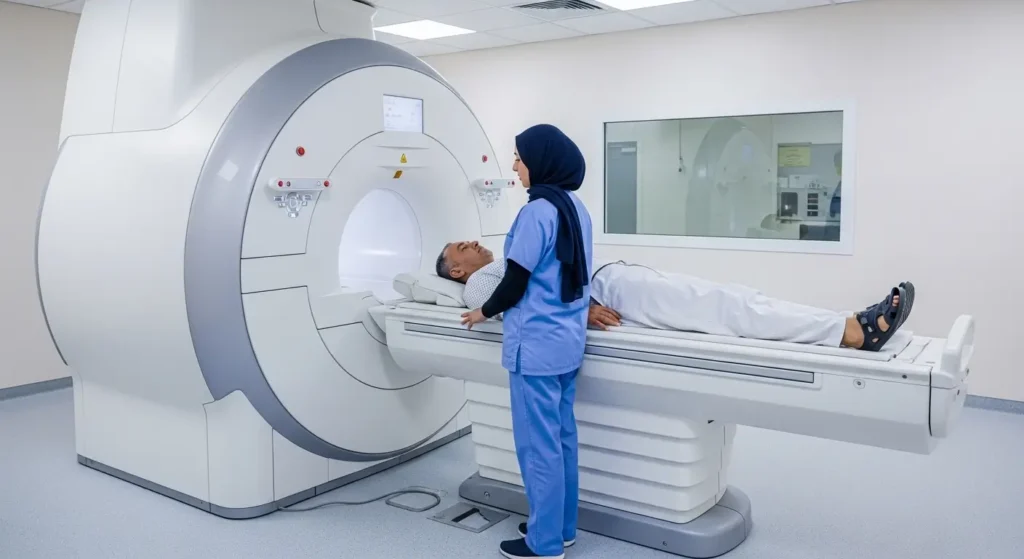
What to Bring to Your Appointment
Make sure you have the following with you on the day of your exam:
- ✅ Original medical prescription (ordonnance) — mandatory
- ✅ National ID card (CIN)
- ✅ CNSS, CNOPS, or insurance card
- ✅ Any previous brain imaging (MRI, CT scan, X-rays) — even if years old
- ✅ Implant card if you have any metallic implant (pacemaker, cochlear implant, joint prosthesis)
- ✅ Insurance pre-authorization form if your mutuelle requires it
Do You Need to Fast Before a Brain MRI?
- Without injection: No fasting required
- With injection: Some centers recommend fasting for 4 hours as a precaution against nausea
- Your regular medication: Continue taking it as normal unless your doctor instructs otherwise
- Avoid heavy meals and alcohol for 2 to 3 hours before the exam as a general precaution
When in doubt, call the radiology center the day before and ask specifically about their fasting protocol.
Who Cannot Have a Brain MRI? Contraindications
Absolute contraindications — MRI is not possible:
- Certain types of cardiac pacemakers (some newer models are MRI-compatible — check with your cardiologist)
- Cochlear implants (some models)
- Ferromagnetic aneurysm clips (older generation)
- Metallic foreign bodies in the eye or orbit
Relative contraindications — inform the radiologist and they will assess:
- Other joint or bone prostheses
- Dental implants and certain orthodontic devices
- Tattoos (some metallic pigments can cause minor irritation)
- First trimester of pregnancy (MRI is generally avoided unless medically necessary)
Always declare every implant or metallic device you have, even if you think it is minor. The radiologist will check its MRI compatibility and make the decision.
What If You Are Claustrophobic?
MRI machines are enclosed tunnels, which can be distressing for patients with claustrophobia. For a brain MRI:
- Only your head enters the machine — your body remains largely outside, which makes it less anxiety-inducing than a full-body abdominal or cardiac MRI
- Options available in Morocco:
- Mild oral sedation (benzodiazepine) prescribed by your doctor beforehand
- Open MRI machines (available in select centers in Casablanca and Rabat)
- Practical step: Tell the booking team you are claustrophobic when you call for your appointment — they can prepare accordingly
How Long Does a Brain MRI Take?
| Phase | Duration |
|---|---|
| Registration and prep | 15 – 20 minutes |
| Scan without injection | 15 – 30 minutes |
| Additional sequences with injection | +10 – 15 minutes |
| Waiting for preliminary check by radiologist | 10 – 15 minutes |
| Total time at the center | 45 – 90 minutes |
| Written radiology report | 24 – 48 hours (private) / 2 – 5 days (public) |
Do You Need a Prescription to Get a Brain MRI in Morocco?
The Direct Answer
Yes. A medical prescription is mandatory to perform a brain MRI in Morocco — in both the public and private sectors.
Without a valid ordonnance:
- Most private centers will refuse to perform the exam
- There is no possibility of reimbursement from CNSS, CNOPS, or any mutuelle
- The exam loses its legal and medical validity for follow-up care
What Must the Prescription Include?
A valid brain MRI prescription must contain all of the following:
- Type of exam: “IRM cérébrale” or “Brain MRI”
- Anatomical region: brain / encéphale
- Clinical indication: the reason for the exam (e.g., “persistent headaches”, “first epileptic seizure”, “suspected AVC”)
- Injection protocol: with injection, without injection, or at the radiologist’s discretion
- Doctor information: full name, specialty, signature, official stamp, and date
Prescription validity: generally 3 to 6 months in Morocco. Do not wait too long before booking your exam.
Which Doctor Can Prescribe a Brain MRI?
Any of the following doctors can legally prescribe a brain MRI in Morocco:
- General practitioner (médecin généraliste)
- Neurologist
- Neurosurgeon
- Ophthalmologist (for visual disturbances)
- ENT specialist (for vertigo)
- Emergency department physician
Some advanced MRI protocols (functional MRI, MR spectroscopy, perfusion imaging) may require a specialist’s prescription rather than a general practitioner’s.
How to Choose the Right Radiology Center for Your Brain MRI
Questions to Ask Before Booking
When you call a radiology center, ask these questions before committing:
- What is the exact price for a brain MRI with/without injection?
- What Tesla machine do you use — 1.5T or 3T?
- Do you accept my insurance (CNSS, CNOPS, or my specific mutuelle)?
- Do you offer tiers payant (direct billing to my insurer)?
- What is the current wait time for an appointment?
- How long before I receive the written report?
Call at least two or three centers. Prices and availability vary more than most patients expect.
Do You Really Need a 3 Tesla Machine?
| Situation | Machine Needed |
|---|---|
| Routine headache / vertigo | 1.5T is sufficient |
| Standard epilepsy workup | 1.5T is sufficient |
| Suspected tumor (initial assessment) | 1.5T is sufficient |
| Epilepsy focus localization (pre-surgery) | 3T recommended |
| Pituitary microadenoma | 3T recommended |
| High-resolution vascular imaging | 3T recommended |
Choosing a 1.5T center when 3T is not required saves you 300 – 700 DH in the private sector. Your radiologist will always recommend upgrading if clinically needed.
Green Flags: Signs of a Trustworthy Radiology Center
- ✅ Gives you a clear price quote over the phone without hesitation
- ✅ Accepts CNSS / CNOPS with tiers payant option
- ✅ Has a board-certified radiologist on-site, not just on call
- ✅ Delivers a written, signed radiology report within 24 – 48 hours
- ✅ Can tell you exactly what Tesla machine they operate
Red Flags: Warning Signs to Avoid
- ❌ Cannot or refuses to give a price before you arrive
- ❌ Cannot tell you the Tesla rating of their machine
- ❌ No full-time radiologist on-site
- ❌ Provides only a verbal result — no written report
- ❌ Pressures you to add exams not specified in your prescription
What Is Tiers Payant — and Why It Matters
Tiers payant is a direct billing arrangement between the radiology center and your insurer.
- Instead of paying the full invoice yourself and waiting weeks for reimbursement, the center bills CNSS or CNOPS directly
- You pay only the remaining portion (the gap between the center’s fee and what insurance covers)
- This is particularly valuable when the upfront cost is 2,000 – 3,000 DH
When calling to book, always ask: “Est-ce que vous faites le tiers payant CNSS / CNOPS?”
Not all centers offer it, but many do — and it can make a significant practical difference in how much cash you need on the day.
Summary: What You Need to Remember
Here is everything from this guide in condensed form.
Brain MRI Cost in Morocco — Key Numbers
| Sector | Price Range | Out-of-Pocket After Insurance |
|---|---|---|
| Public hospital | 800 – 1,200 DH | Near zero (RAMED) / very low (AMO) |
| Private clinic | 1,800 – 4,500 DH | ~300 – 800 DH with CNSS + mutuelle |
Your Action Plan: 5 Steps
- Get your ordonnance — without it, nothing else is possible
- Call 2 – 3 radiology centers and compare prices, machine type, and insurance acceptance
- Confirm your insurance coverage — call CNSS, CNOPS, or your mutuelle before the exam
- Ask about tiers payant — avoid advancing the full amount if possible
- Bring everything on the day — prescription, ID, insurance card, previous imaging, and implant card if relevant
A Final Note
A brain MRI is a routine, safe, and painless exam. Millions of people have it every year. The machine makes noise — but it does not hurt. You will be in and out in under 90 minutes, and most patients receive reassuring results.
If you have been putting off the exam because of the cost, this guide has shown you that with the right insurance path, the out-of-pocket amount is often much more manageable than the headline price suggests. Book the exam. Your health is worth the call.
Frequently Asked Questions — Brain MRI Cost in Morocco
What is the average cost of a brain MRI in Morocco?
The brain MRI cost in Morocco ranges from 800 to 1,200 DH in public hospitals and from 1,800 to 4,500 DH in private clinics, depending on whether contrast injection is required and which city you are in.
Does CNSS reimburse brain MRI exams?
Yes. CNSS reimburses 80% of the TNR (reference tariff of approximately 1,800 DH) for outpatient MRI exams. This rises to 90% for private hospitalization and 100% for public hospitalization.
Can I have a brain MRI without a prescription in Morocco?
No. A medical prescription is mandatory in both the public and private sectors. Without it, the exam cannot legally proceed and no insurance reimbursement is possible.
How long does a brain MRI take?
The scan itself takes 15 to 45 minutes. Plan for a total of 45 to 90 minutes at the center including registration, preparation, and a preliminary radiologist check.
What is the difference between a brain MRI and a brain CT scan in Morocco?
A brain MRI uses magnetic fields and produces highly detailed images of brain tissue with no radiation. A brain CT scan uses X-rays, is faster and cheaper (600 – 1,200 DH), but is less detailed for brain matter. They are not interchangeable — your doctor prescribes the right one based on your clinical situation.
Is a brain MRI dangerous?
No. MRI uses magnetic fields and radio waves — there is no ionizing radiation. It is safe for the vast majority of patients. The main exceptions are people with certain metallic implants or devices.
How long before I receive my radiology report?
In private centers, the written report is typically ready within 24 to 48 hours. In public hospitals, it may take 2 to 5 days.
Can I have a brain MRI if I am claustrophobic?
Yes. For a brain MRI, only your head enters the machine — your body stays largely outside. If you are still anxious, ask your doctor about mild oral sedation beforehand, or ask the center if they have an open MRI machine.
Is a 3 Tesla MRI better than 1.5 Tesla for the brain?
A 3T machine offers higher resolution, but 1.5T is clinically sufficient for most standard brain exams. Your neurologist or radiologist will specifically request 3T only when your condition requires it.
How much does a brain MRI cost in Casablanca?
In Casablanca, the brain MRI cost ranges from 2,000 to 4,000 DH in private centers and approximately 800 to 1,200 DH at CHU Ibn Rochd (public).