If you’re searching for brain MRI prices in Morocco, here’s what you need to know right away: expect to pay between 900 DH and 3,000 DH depending on where you go. Public hospitals charge 900-1,200 DH, while private centers range from 1,500-3,000 DH. The good news? If you have AMO Tadamon coverage, you can get your brain MRI completely free at public hospitals. Insurance like CNSS or CNOPS typically covers 70-100% of the cost.
This guide breaks down everything you need to know about brain MRI pricing across Morocco, from Casablanca to Tangier, including which centers to choose, how to maximize your insurance coverage, and practical tips to reduce your out-of-pocket costs.
Table of Contents
Brain MRI Prices in Morocco: What You’ll Actually Pay
Understanding brain MRI costs in Morocco starts with knowing the difference between public and private facilities. The price gap is significant, and your choice will depend on how urgent your situation is and what insurance coverage you have.
Public Hospital Brain MRI Prices
Public hospitals offer the most affordable option for brain MRI scans in Morocco:
- Standard brain MRI: 900-1,200 DH
- Brain MRI with contrast: 1,200-1,500 DH
- Wait time: 1-4 weeks for appointments
- Cost with AMO Tadamon: 0 DH (completely free)
Major public hospitals in cities like Casablanca (CHU Ibn Rochd), Rabat (CHU Ibn Sina), and Tangier provide the same diagnostic quality as private centers. The main difference is the waiting period and facility comfort level. If your doctor says the MRI isn’t urgent, public hospitals represent excellent value.
Private Center Brain MRI Prices
Private radiology centers charge more but offer faster service:
- Standard brain MRI (1.5 Tesla): 1,500-2,200 DH
- Brain MRI with contrast: 1,800-3,000 DH
- Premium 3 Tesla MRI: 2,500-3,500 DH
- Wait time: 2-7 days for appointments
Private centers like those in Casablanca’s Maarif or Anfa neighborhoods, or Rabat’s Agdal area, typically provide same-week appointments. Many offer online booking, air-conditioned waiting rooms, and faster result delivery (often within 24 hours).
Emergency and Urgent Brain MRI Pricing
When you need results quickly, expect to pay premium rates:
- Urgent appointments (within 3 days): Add 200-300 DH to base price
- Same-day emergency service: Add 400-500 DH to base price
- Weekend or night appointments: Additional 300-600 DH surcharge
Most major private centers in Casablanca, Rabat, and Marrakech can accommodate urgent requests, though availability varies. Always call ahead to confirm same-day or urgent availability.
Brain MRI Price Comparison: Quick Reference Table
| Facility Type | Standard MRI | With Contrast | Wait Time | Best For |
|---|---|---|---|---|
| Public Hospital | 900-1,200 DH | 1,200-1,500 DH | 1-4 weeks | AMO Tadamon holders, non-urgent cases |
| Private Center (1.5T) | 1,500-2,200 DH | 1,800-2,800 DH | 2-7 days | Most patients with insurance |
| Private Center (3T) | 2,500-3,000 DH | 2,800-3,500 DH | 2-7 days | Complex diagnoses requiring detail |
| Emergency Service | 2,000-2,500 DH | 2,500-3,500 DH | Same day | Urgent medical situations |
Your out-of-pocket cost: With CNSS or CNOPS insurance, you typically pay 200-600 DH after reimbursement for a standard private center MRI.
Brain MRI Prices by Major Moroccan Cities
Prices vary significantly depending on where you live in Morocco. Here’s what to expect in each major city.
Casablanca Brain MRI Prices
As Morocco’s economic capital, Casablanca has the highest concentration of radiology centers—and the highest prices:
Public Option:
- CHU Ibn Rochd: 1,000-1,200 DH
- Wait time: 2-4 weeks
- Free with AMO Tadamon
Private Centers (Price Range: 1,800-3,000 DH):
Polyclinique Abderrahman Harouchi (Maarif)
- Equipment: 1.5 Tesla MRI
- Price: 1,900-2,200 DH (with contrast: 2,400 DH)
- Wait time: 3-5 days
- Phone: 0522-25-XX-XX
- Accepts: CNSS, CNOPS, major private insurance
Centre de Radiologie Panorama (Anfa)
- Equipment: 3 Tesla MRI
- Price: 2,500-3,000 DH (with contrast: 3,200 DH)
- Wait time: 2-4 days
- Advanced imaging for complex cases
Clinique Multispecialities Zerktouni
- Equipment: 1.5 Tesla MRI
- Price: 1,800-2,100 DH
- Wait time: 4-7 days
- Good value for standard brain MRI
Centre d’Imagerie Medicale Ain Diab
- Equipment: 1.5 Tesla MRI
- Price: 1,700-2,000 DH
- Wait time: 5-7 days
- Among the more affordable private options
Casablanca represents the higher end of Morocco’s brain MRI pricing, typically 15-20% more expensive than smaller cities.
Rabat Brain MRI Prices
The capital offers competitive pricing with good availability:
Public Option:
- CHU Ibn Sina: 1,000-1,200 DH
- Wait time: 2-3 weeks
- Free with AMO Tadamon
Private Centers (Price Range: 1,600-2,800 DH):
Clinique Al Madina (Agdal)
- Equipment: 1.5 Tesla MRI
- Price: 1,700-2,000 DH
- Wait time: 3-5 days
- Well-regarded radiologists
Centre Radiologique Souissi
- Equipment: 3 Tesla MRI
- Price: 2,400-2,800 DH
- Wait time: 2-4 days
- Premium imaging quality
Polyclinique Les Orangers
- Equipment: 1.5 Tesla MRI
- Price: 1,600-1,900 DH
- Wait time: 4-6 days
- Good insurance acceptance
Rabat prices are generally 10-15% lower than Casablanca while maintaining similar quality standards.
Tangier Brain MRI Prices
Northern Morocco’s major city offers reasonable pricing:
Public Option:
- CHU Mohammed VI: 900-1,100 DH
- Wait time: 2-4 weeks
- Free with AMO Tadamon
Private Centers (Price Range: 1,400-2,500 DH):
Clinique du Détroit
- Equipment: 1.5 Tesla MRI
- Price: 1,500-1,800 DH
- Wait time: 3-6 days
- Accepts most insurance
Centre de Radiologie Tanger Ville
- Equipment: 1.5 Tesla MRI
- Price: 1,400-1,700 DH
- Wait time: 4-7 days
- Competitive pricing
Polyclinique Al Mandari
- Equipment: 1.5 Tesla MRI
- Price: 1,600-2,000 DH
- Wait time: 3-5 days
Tangier offers some of the best value in Morocco for private brain MRI services, with prices 20-25% lower than Casablanca.
Marrakech Brain MRI Prices
The tourist city has premium pricing but good availability:
Private Centers (Price Range: 1,600-3,000 DH):
- Polyclinique du Sud: 1,800-2,200 DH
- Clinique Al Majd: 1,600-2,000 DH
- Centre Radiologique Gueliz: 2,000-2,500 DH
- Wait times: 3-7 days typically
Marrakech pricing reflects its status as a tourist destination, with some centers catering to international patients at higher rates.
Other Major Cities Brain MRI Prices
Agadir: 1,500-2,600 DH (private centers)
- CHU Hassan II: 1,000 DH (public option)
- 3-5 private radiology centers available
Fes: 1,400-2,400 DH (private centers)
- CHU Hassan II: 900-1,100 DH (public option)
- Competitive pricing, longer wait times
Oujda: 1,300-2,200 DH (private centers)
- Among the most affordable cities for private MRI
- Limited 3 Tesla availability
General pattern: Smaller cities offer 15-30% lower prices than Casablanca, but may have fewer advanced imaging options (3 Tesla machines) and longer wait times.
Insurance Coverage for Brain MRI in Morocco
Understanding your insurance coverage can dramatically reduce your out-of-pocket costs for a brain MRI. Here’s how each major insurance type works.
AMO Tadamon Coverage (Public Insurance)
AMO Tadamon provides the best coverage for brain MRI scans:
Coverage details:
- 100% free at public hospitals
- Covers over 12 million Moroccans
- No out-of-pocket cost for the MRI exam
- Includes contrast material if medically necessary
How to use AMO Tadamon:
- Get prescription from your doctor
- Book appointment at public hospital (CHU)
- Bring your AMO card and ID
- Pay nothing—exam is fully covered
- Accept 2-4 week wait time
Eligibility verification:
- Check your AMO Tadamon card for active status
- Confirm coverage by calling 0800 00 4040
- Bring valid prescription (required even with insurance)
This is the most economical option if you’re not in a medical emergency and can wait several weeks for your appointment.
CNSS Coverage (Private Sector Employees)
CNSS covers 70-80% of the TNR (Tarification Nationale de Référence) for brain MRI:
How CNSS reimbursement works:
The TNR for brain MRI is approximately 1,200 DH. CNSS reimburses 70-80% of this amount, regardless of what you actually paid.
Example calculation:
- You pay private center: 2,000 DH
- TNR reference: 1,200 DH
- CNSS reimburses 70%: 840 DH
- Your final cost: 1,160 DH
Documents needed for reimbursement:
- Original detailed invoice (facture)
- Medical prescription from doctor
- Fiche de soins signed and stamped by center
- Copy of your CNSS card
- RIB (bank details) for direct deposit
Reimbursement timeline: Submit within 2 weeks of exam, expect payment in 3-4 weeks.
CNOPS Coverage (Public Sector Employees)
CNOPS offers better reimbursement rates than CNSS:
Coverage rate: 80-90% of TNR
Example calculation:
- You pay private center: 2,000 DH
- TNR reference: 1,200 DH
- CNOPS reimburses 90%: 1,080 DH
- Your final cost: 920 DH
Additional benefits:
- Higher reimbursement percentage
- Faster processing (2-3 weeks typically)
- Some centers offer direct billing (tiers payant)
Documents required:
- Same as CNSS (prescription, facture, fiche de soins)
- CNOPS card copy
- Bank details for reimbursement
With CNOPS coverage, your out-of-pocket cost for a private brain MRI typically ranges from 400-800 DH depending on the facility price.
Private Insurance (Mutuelles)
Private insurance coverage varies widely by policy:
Coverage rates: 70-100% of actual price (not just TNR)
Major insurers in Morocco:
- Saham Assurance
- Wafa Assurance
- Atlanta Assurance
- AXA Assurance
- RMA Watanya
What to verify before your MRI:
- Does your policy cover brain MRI? (most do)
- What percentage is reimbursed?
- Is 3 Tesla MRI covered at the same rate?
- Does the center offer direct billing (tiers payant)?
- Any annual limit on imaging exams?
Direct billing (tiers payant): Some private insurers have agreements with specific radiology centers where you pay only your portion upfront (typically 10-30%). The center bills your insurance directly for the rest. This is the most convenient option—ask your insurance company for their network of radiology centers.
How to Verify Coverage Before Booking
Never assume your insurance covers brain MRI. Always verify:
- Call your insurance company with the specific exam code
- Ask these questions:
- “What percentage do you cover for brain MRI?”
- “Is there a difference between 1.5T and 3T coverage?”
- “What’s the TNR reference you use?”
- “Do you have direct billing agreements with centers in [your city]?”
- Get written confirmation if the amount is significant
- Verify the center accepts your insurance before booking
Taking 10 minutes to verify coverage can save you hundreds of dirhams in unexpected costs.
What Affects Brain MRI Prices in Morocco?
Understanding why prices vary helps you make informed decisions about where to get your brain MRI.
MRI Machine Quality: 1.5 Tesla vs 3 Tesla
The type of MRI machine significantly impacts both price and image quality:
1.5 Tesla MRI (Standard):
- Price: 1,500-2,000 DH
- Image quality: Excellent for most diagnoses
- Scan time: 25-35 minutes
- Availability: Widely available across Morocco
- Best for: Routine brain scans, tumor detection, stroke evaluation
3 Tesla MRI (Premium):
- Price: 2,200-3,500 DH
- Image quality: Superior resolution and detail
- Scan time: 20-30 minutes (faster)
- Availability: Limited to major cities
- Best for: Small lesions, detailed vascular imaging, MS monitoring
Do you need 3 Tesla? For 90% of brain MRI cases, a 1.5 Tesla machine provides perfectly adequate diagnostic images. Your neurologist or radiologist will specify if you genuinely need the higher resolution of 3 Tesla imaging. Don’t pay extra for 3T unless medically necessary.
Contrast Material Impact on Price
Gadolinium-based contrast agents add 300-600 DH to your brain MRI cost:
When contrast is needed:
- Suspected brain tumors
- Multiple sclerosis evaluation
- Post-surgical monitoring
- Vascular malformations
- Infection or inflammation assessment
When contrast isn’t needed:
- Routine headache evaluation
- Most stroke assessments
- Trauma follow-up
- Dementia screening
Your doctor decides whether contrast is necessary based on your symptoms and what they’re looking for. Never skip contrast if your prescription specifies it—the additional diagnostic information is worth the extra cost.
Important safety note: Before contrast injection, you’ll need recent kidney function blood test (creatinine). Most radiology centers require this test to be done within the past 3 months.
Geographic Location Within Morocco
Where you live significantly impacts brain MRI pricing:
Price tiers by location:
- Tier 1 (Highest): Casablanca, Rabat – Base price 1,800-3,000 DH
- Tier 2 (Moderate): Marrakech, Agadir, Tangier – Base price 1,500-2,500 DH
- Tier 3 (Lower): Fes, Oujda, Meknes – Base price 1,300-2,200 DH
- Tier 4 (Lowest): Smaller cities – Base price 1,200-2,000 DH
Within-city variation: Even in the same city, neighborhood matters. Premium areas like Casablanca’s Anfa or Rabat’s Souissi charge 20-30% more than centers in residential neighborhoods.
If you live between two cities (for example, between Rabat and Casablanca), consider checking prices in both locations. The savings might be worth a short drive.
Facility Type and Reputation
Brand recognition and facility prestige affect pricing:
Premium centers (2,200-3,500 DH):
- International accreditation
- Latest equipment (3 Tesla)
- Specialized radiologists
- Luxury waiting areas
- Same-day results
Mid-range centers (1,600-2,200 DH):
- Modern equipment (1.5 Tesla)
- Qualified radiologists
- Standard service
- 24-48 hour results
Budget-friendly centers (1,400-1,800 DH):
- Older but functional equipment
- Basic service
- Longer result delivery
Expert perspective: A well-maintained 1.5 Tesla machine in a budget center often produces the same diagnostic quality as a premium center’s equipment. The radiologist’s expertise in reading the images matters more than the facility’s marble floors.
Urgency Level and Appointment Timing
When you need your MRI affects what you pay:
Standard appointment (2-7 day wait):
- Base price
- Most economical
- Requires advance planning
Urgent appointment (within 3 days):
- Base price + 200-300 DH
- Limited availability
- Must call to arrange
Emergency/same-day:
- Base price + 400-500 DH
- Very limited availability
- Usually reserved for serious medical situations
Weekend/night surcharges:
- Saturday: +200-300 DH
- Sunday/holidays: +400-500 DH
- After hours (8pm-8am): +300-600 DH
Money-saving tip: If your doctor says the MRI isn’t urgent, booking during regular weekday hours saves significant money.
Why Your Doctor Might Order a Brain MRI
Understanding what brain MRI detects helps you appreciate why the exam is worth the investment.
Common Conditions Brain MRI Diagnoses
Brain MRI is the gold standard for detecting soft tissue abnormalities in the brain:
Stroke and transient ischemic attack (TIA):
- Detects areas of brain damage from lack of blood flow
- Shows bleeding in brain tissue
- Identifies blocked or narrowed blood vessels
- Critical for treatment planning in first 24-48 hours
Brain tumors:
- Identifies location, size, and type of growth
- Distinguishes benign from malignant tumors
- Monitors tumor growth over time
- Guides surgical planning
Severe and persistent migraines:
- Rules out serious underlying causes
- Detects structural abnormalities
- Identifies blood vessel problems
- Provides peace of mind when results are normal
Epilepsy and seizure disorders:
- Finds structural brain abnormalities causing seizures
- Detects scarring or lesions
- Helps determine if surgery is an option
- Guides medication decisions
Multiple sclerosis (MS):
- Shows characteristic lesions in brain white matter
- Monitors disease progression
- Evaluates treatment effectiveness
- Essential for MS diagnosis and management
Head trauma and injuries:
- Assesses damage after accidents
- Detects bleeding or swelling
- Monitors recovery progress
- Identifies long-term complications
Brain infections:
- Detects abscesses or collections of pus
- Identifies meningitis complications
- Shows inflammation patterns
- Guides antibiotic treatment
Memory problems and dementia:
- Shows brain shrinkage patterns
- Detects vascular changes
- Rules out treatable causes
- Aids early Alzheimer’s diagnosis
When Doctors Typically Order Brain MRI
Your doctor will likely order a brain MRI if you experience:
- Severe headaches that are new, different, or worsening
- Vision or hearing loss that’s unexplained or sudden
- Weakness or numbness on one side of your body
- Coordination problems or difficulty walking
- Seizures or fainting episodes
- Memory loss or confusion that’s progressing
- Head trauma with ongoing symptoms
- Persistent dizziness or balance problems
Not every headache needs an MRI, but your doctor evaluates your specific symptoms, medical history, and exam findings to determine if brain imaging is appropriate.
Brain MRI vs CT Scan: Which One Do You Need?
Both brain MRI and CT scans create images of your brain, but they’re used in different situations:
Brain MRI advantages:
- Superior soft tissue detail
- Better for brain structure evaluation
- No radiation exposure
- Sees early strokes better
- Best for: tumors, MS, detailed diagnosis
Brain CT advantages:
- Much faster (5 minutes vs 30 minutes)
- Better for bone injuries
- Shows acute bleeding better
- More widely available
- Less expensive (600-1,200 DH vs 1,500-3,000 DH)
- Best for: emergency trauma, skull fractures, acute bleeding
Your doctor chooses based on:
- What they suspect is wrong
- How urgent the situation is
- Your ability to lie still for 30 minutes
- Whether you have metal implants (can’t do MRI)
- Cost considerations
In emergency rooms, CT is usually done first because it’s faster. If more detail is needed, MRI follows later.
What to Expect During Your Brain MRI
Knowing what happens during a brain MRI reduces anxiety and helps you prepare properly.
Before Your Brain MRI Appointment
You absolutely must have:
- Medical prescription (ordonnance) from a doctor—this is mandatory by Moroccan law
- Valid ID card or passport
- Insurance card (if using insurance)
- Previous brain scans (if you’ve had any)
What to tell the center when booking:
- Any metal implants (pacemaker, cochlear implants, aneurysm clips)
- If you’re pregnant or might be pregnant
- If you have kidney problems (important for contrast)
- If you have severe claustrophobia
- Your weight (some MRI machines have weight limits)
What to remove before the scan:
- All jewelry (earrings, necklaces, rings, piercings)
- Watches
- Hairpins, clips, or bobby pins
- Belts with metal buckles
- Bras with underwire
- Dentures (sometimes)
- Hearing aids
- Coins, keys, wallet, phone
Leave at home or in your car:
- Credit/debit cards (MRI magnet will erase them)
- Phone (can be damaged)
- Anything valuable you don’t want lost
No Preparation Required for Brain MRI
Unlike some medical tests, brain MRI is simple to prepare for:
✅ Eat normally – No fasting required ✅ Drink normally – Stay hydrated ✅ Take your medications – Unless doctor says otherwise ✅ Wear comfortable clothes – You may not need to change ❌ No special diet needed
Exception: If you’re having contrast injection AND you have kidney problems, your doctor may give you specific instructions about hydration.
During the Brain MRI Procedure (20-45 minutes)
Here’s exactly what happens step by step:
1. Check-in and paperwork (10 minutes):
- Complete forms
- Verify prescription
- Confirm insurance
- Metal screening questionnaire
- Change into gown if needed
2. Preparation (5 minutes):
- Remove all metal objects
- Secure belongings in locker
- Technician explains procedure
- If contrast needed: IV line placed in arm
3. In the MRI room (20-40 minutes):
- Lie on padded table on your back
- Head positioned in special cradle
- Foam pads placed around your head to keep it still
- Panic button placed in your hand
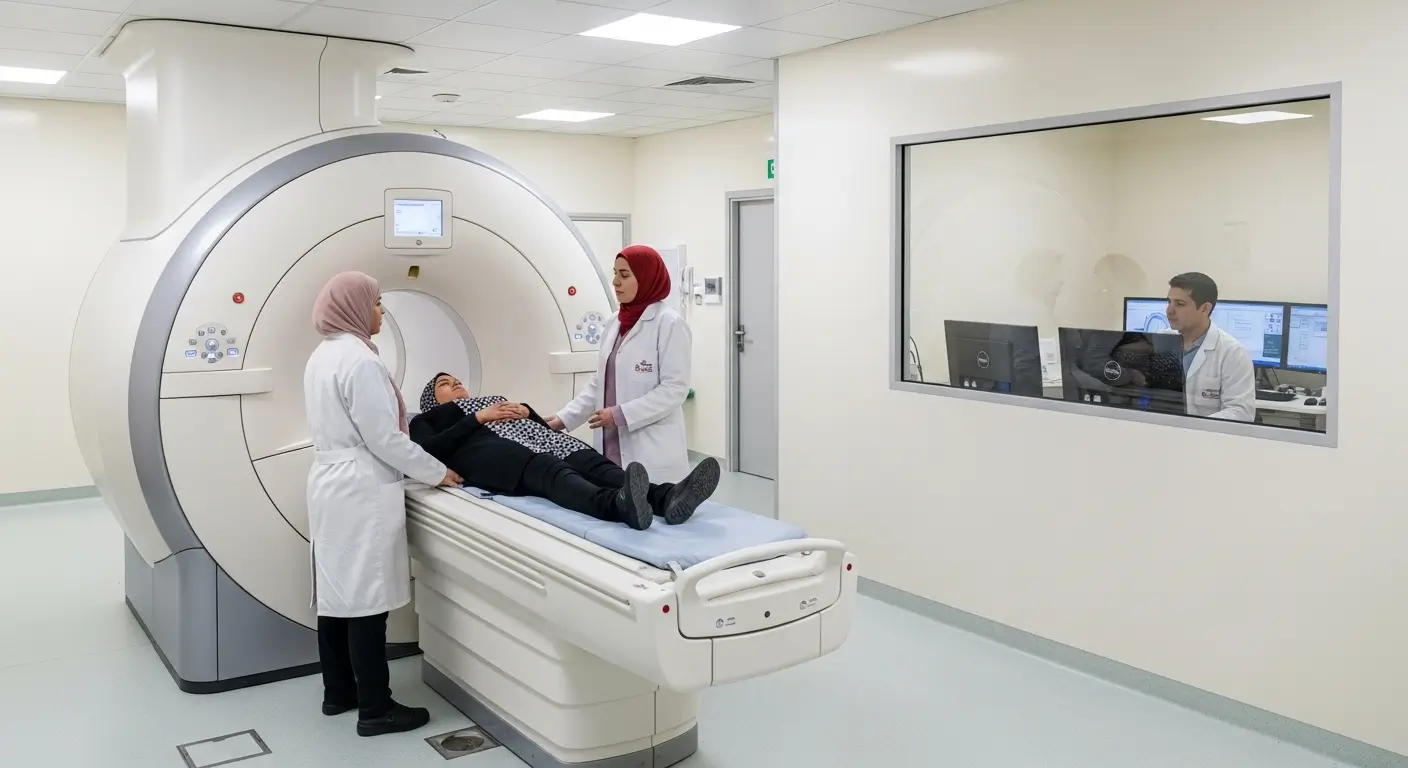
- Table slides into circular magnet tunnel
- Only your head goes deep inside – your body remains mostly outside
4. The scanning process:
- It’s LOUD – loud knocking, buzzing, banging sounds
- You’ll wear earplugs or headphones (some centers play music)
- Must stay completely still – any movement blurs images
- Each sequence lasts 2-5 minutes
- Total: 4-8 different sequences
- Technician watches you on camera entire time
- Can talk to technician through intercom
5. If contrast is needed:
- Midway through, table slides out
- Contrast injected through IV (30 seconds)
- Feels cool going into your arm
- Table slides back in for more images
- Additional 10-15 minutes of scanning
6. Completion:
- Table slides out
- Remove headphones/earplugs
- If IV was placed, it’s removed
- Get dressed and collect belongings
If You Have Claustrophobia
Many people worry about feeling trapped in the MRI machine. Here’s how to cope:
Tell the staff beforehand:
- They can help you manage anxiety
- Some positions are less claustrophobic
- Knowing what to expect reduces fear
Coping strategies:
- Keep your eyes closed throughout the entire scan
- Practice deep breathing – slow inhales and exhales
- Don’t look up when in the machine – look at your body instead
- Visualize a calm place – beach, garden, peaceful memory
- Remember: You can stop at any time by pressing the panic button
Medical options if needed:
- Mild sedative – ask your doctor to prescribe before appointment
- Open MRI machines – available at some centers (ask when booking)
- Shorter protocols – some situations allow faster scans
Reality check: The MRI tunnel is much shorter than people imagine. For brain MRI, only your head and upper shoulders go deep inside. Your body from the chest down remains outside the machine. Most people who worry about claustrophobia end up tolerating the exam just fine.
Brain MRI Doesn’t Hurt
Let’s address common fears:
Is it painful? No. The MRI machine doesn’t touch you. You lie still on a padded table. No needles, no poking (unless you need contrast injection, which is just a normal IV stick).
The loudest part: The knocking and banging sounds startle people, but earplugs and headphones protect your hearing. Think of it like being near construction work – loud but not harmful.
Contrast injection: If needed, feels like any IV injection – brief pinch when needle goes in, cool sensation when dye flows into your vein. Some people taste metal briefly. No pain.
Staying still: This is the hardest part for most people. Your head is cushioned and gently secured so you don’t accidentally move. It’s slightly uncomfortable but not painful.
After Your Brain MRI
Immediate post-MRI:
- Resume all normal activities immediately
- Drive home (unless you took sedative)
- No recovery time needed
- Go back to work if needed
If you had contrast:
- Drink extra water for 24 hours (helps flush it out)
- Rare side effects: headache, nausea (usually mild)
- Serious allergic reactions are extremely rare
Getting your results:
- Standard timing: 24-48 hours
- Urgent cases: Same day possible (but costs more)
- How delivered: CD with images + written radiologist report
- Who reads it: Your referring doctor explains results to you
What you receive:
- CD-ROM with hundreds of brain images
- Written report (3-5 pages) describing findings
- Measurements if tumors or abnormalities found
- Comparison to previous scans if available
Next steps:
- Schedule follow-up with your doctor
- Bring CD and report to appointment
- Doctor explains what findings mean for you
- Treatment plan discussed if abnormalities found
Most people feel fine immediately after brain MRI and can return to their regular schedule.
How to Get Brain MRI for Less Money in Morocco
The cost of brain MRI can strain your budget, but these strategies help you minimize out-of-pocket expenses.
Strategy #1: Use AMO Tadamon for Free Brain MRI
If you have AMO Tadamon coverage, this is your best option:
Cost: 0 DH at public hospitals
How to access:
- Get prescription from your family doctor
- Call public hospital radiology department
- Book appointment (accept 2-4 week wait)
- Bring AMO card, ID, and prescription
- Complete exam at no cost
Which hospitals:
- Casablanca: CHU Ibn Rochd
- Rabat: CHU Ibn Sina
- Tangier: CHU Mohammed VI
- Marrakech: CHU Mohammed VI
- Fes: CHU Hassan II
Trade-off: You wait longer (2-4 weeks vs 2-7 days private), but you pay nothing. If your condition isn’t urgent, this saves 1,500-3,000 DH.
Who qualifies: Over 12 million Moroccans have AMO Tadamon. Check your coverage at 0800 00 4040.
Strategy #2: Compare Prices at Multiple Centers
Brain MRI prices for the same exam can vary by 500-1,000 DH between centers in the same city.
Action steps:
- Call 3-4 centers in your area
- Ask specific questions:
- “What’s your price for brain MRI without contrast?”
- “How much extra for contrast if needed?”
- “Do you accept [my insurance]?”
- “What’s your current wait time?”
- Compare total costs including insurance coverage
- Check reviews if available online
Example comparison (Casablanca):
- Center A: 2,200 DH (Anfa location, premium facility)
- Center B: 1,800 DH (Maarif location, modern equipment)
- Center C: 1,600 DH (residential area, basic service)
All three use 1.5 Tesla machines. All produce diagnostic-quality images. You could save 600 DH by choosing Center C over Center A.
Strategy #3: Choose Standard 1.5 Tesla MRI (Not 3T)
Unless your doctor specifically requires 3 Tesla imaging, choose standard MRI:
Savings: 500-1,000 DH
1.5 Tesla is sufficient for:
- Routine headache evaluation
- Stroke detection
- Most tumor diagnoses
- MS initial diagnosis
- Post-trauma assessment
- Dementia screening
3 Tesla is necessary for:
- Very small tumor detection
- Detailed vascular imaging
- MS monitoring (follow-up scans)
- Pre-surgical planning for complex cases
Ask your doctor: “Do I need 3 Tesla imaging, or is 1.5 Tesla adequate for my diagnosis?” Most doctors will tell you honestly if you can save money with standard imaging.
Strategy #4: Avoid Urgent Appointment Fees
Planning ahead saves money:
Savings: 300-500 DH
How:
- Don’t wait until symptoms are severe to see doctor
- Get prescription and book MRI early
- Accept standard wait times (not urgent slots)
- Avoid weekend/evening appointments
Exception: If you’re having stroke symptoms, severe head trauma, or sudden neurological changes, urgency is medically necessary—don’t delay to save money.
Strategy #5: Maximize Insurance Reimbursement
Get every dirham back that you’re entitled to:
Submit reimbursement immediately:
- Don’t wait weeks to file
- Include all required documents
- Follow up if payment is delayed beyond 4 weeks
Required documents checklist:
- ✅ Original detailed invoice (facture détaillée)
- ✅ Medical prescription (ordonnance)
- ✅ Fiche de soins (signed and stamped)
- ✅ Copy of insurance card
- ✅ RIB (bank details)
- ✅ Copy of ID card
Missing even one document delays reimbursement by weeks.
Ask about direct billing (tiers payant):
- Some insurers have agreements with specific centers
- You pay only your portion (10-30%)
- Center bills insurance directly
- Saves you from paying full amount upfront
Call your insurance before booking: “Do you have tiers payant agreements with any radiology centers in [your city]?”
Strategy #6: Consider Smaller Cities if You Live Between Them
Geographic price differences can be significant:
Example scenario: You live in Berrechid, between Casablanca and Settat.
- Casablanca center: 2,000 DH
- Settat center: 1,500 DH
- Savings: 500 DH (worth the 20-minute drive)
Other examples:
- Live near Kenitra? Check both Kenitra and Rabat prices
- Between Marrakech and Agadir? Compare both cities
- Near Oujda? Smaller town centers often charge 20-30% less
Important: Verify the smaller city center has qualified radiologists and modern equipment. Savings aren’t worth poor diagnostic quality.
Strategy #7: Ask About Payment Plans
Some centers offer installment payments for expensive scans:
When to ask:
- 3 Tesla MRI costs (2,500-3,500 DH)
- When you need the exam but can’t pay full amount upfront
- If insurance reimbursement takes weeks
Typical arrangements:
- 50% at appointment, 50% within 30 days
- 3 monthly installments
- Small administrative fee may apply
Not all centers offer this—ask at registration: “Do you have payment plans available?”
What NOT to Do to Save Money
Some “cost-saving” ideas are dangerous or illegal:
❌ Don’t skip the MRI if your doctor ordered it Your doctor prescribed it for a medical reason. Delaying diagnosis of serious conditions (stroke, tumor, MS) can lead to worse outcomes and higher treatment costs later.
❌ Don’t go without a prescription It’s illegal in Morocco to perform MRI without medical prescription. Centers that break this rule may cut other corners too.
❌ Don’t use fraudulent insurance Presenting fake insurance cards is a crime. You’ll be caught, prosecuted, and still have to pay.
❌ Don’t choose a center solely on price A 1,200 DH MRI on a broken-down machine with inexperienced radiologist is worse than a 2,000 DH exam with quality equipment and expert interpretation. Balance cost and quality.
Frequently Asked Questions About Brain MRI in Morocco
Do I need a prescription for brain MRI in Morocco?
Yes, absolutely required. Moroccan law mandates that all medical imaging, including brain MRI, must be ordered by a licensed physician. No radiology center will perform MRI without an ordonnance (prescription).
If you think you need a brain MRI but don’t have a prescription, start by seeing a general practitioner (consultation costs 150-300 DH). Explain your symptoms. If the doctor agrees MRI is needed, they’ll write the prescription. Alternatively, neurologists and other specialists can prescribe brain MRI.
Attempting to get MRI without prescription wastes your time—every center will turn you away.
How long does a brain MRI take?
The actual MRI scanning takes 20-30 minutes for brain without contrast, or 30-45 minutes with contrast injection.
Your total appointment time including check-in, paperwork, preparation, and getting dressed afterward is typically 45-60 minutes.
Time breakdown:
- Check-in and paperwork: 5-10 minutes
- Changing and preparation: 5 minutes
- Positioning in MRI machine: 5 minutes
- Actual scanning: 20-45 minutes
- Getting dressed and checkout: 5-10 minutes
If you’re on a tight schedule, tell the center when booking so they can accommodate you.
When will I get my brain MRI results?
Standard delivery: 24-48 hours at most private centers.
Same-day results: Available at some centers for urgent cases, but this typically costs an additional 300-500 DH.
What you receive:
- CD-ROM with digital images (hundreds of slices of your brain)
- Written radiologist report (3-5 pages describing findings)
- Sometimes a preliminary phone call if serious abnormalities found
How results are delivered:
- Pick up in person at the center
- Some centers email digital report
- Mailed to your home (rare)
Next step: Take the CD and report to your referring doctor, who will explain what the findings mean and discuss any needed treatment.
Public hospitals may take 3-5 days for results due to higher patient volumes.
Is brain MRI painful or scary?
Not painful at all. Brain MRI is completely painless. The machine doesn’t touch you—you simply lie on a padded table. No cutting, no poking, no procedures.
The only needle you might experience is if contrast is needed (IV injection in your arm), which feels like any normal blood draw.
What surprises people:
The noise: Brain MRI is LOUD—loud knocking, banging, buzzing sounds. The machine’s magnetic coils make these noises when taking images. You’ll wear earplugs or headphones for protection. It’s startling but not harmful.
The enclosed space: Your head goes into a tunnel, which bothers people with claustrophobia. However, the tunnel is shorter than most people imagine, and only your head goes deep inside. Your body from the chest down remains outside the machine.
Staying still: The hardest part is lying perfectly still for 20-45 minutes. Your head is cushioned and gently secured to prevent accidental movement. It’s mildly uncomfortable but not painful.
Most patients’ reaction afterward: “That wasn’t nearly as bad as I expected.”
Can I eat before brain MRI?
Yes, eat normally. For brain MRI, there’s no fasting requirement. You can eat and drink as you normally would before your appointment.
Also okay:
- Drink water, coffee, tea
- Take your regular medications
- Eat breakfast, lunch, or dinner before the exam
Exception: If you’re extremely anxious and your doctor prescribed a sedative to take before the MRI, they may give you specific instructions about eating.
For other types of MRI (abdominal, pelvic), fasting may be required—but not for brain imaging.
Is MRI safe? Does it have radiation?
Very safe. Brain MRI uses magnetic fields and radio waves to create images—no radiation whatsoever. Unlike X-rays or CT scans, MRI doesn’t expose you to ionizing radiation.
Safety highlights:
- Can be repeated as often as medically necessary
- Safe for children (though they may need sedation to stay still)
- No long-term health effects
- Non-invasive (nothing enters your body except contrast if needed)
Main risks:
- Metal objects being pulled into the strong magnet (this is why you remove all metal)
- Pacemakers, cochlear implants, some aneurysm clips cannot go near MRI—these are absolute contraindications
- Contrast allergic reactions are extremely rare (less than 1%)
MRI is considered one of the safest medical imaging techniques available.
What can’t I bring into the MRI room?
The MRI machine has an extremely powerful magnet (30,000-60,000 times stronger than Earth’s magnetic field) that attracts metal objects with dangerous force.
Absolutely remove all:
- Jewelry: earrings, necklaces, rings, bracelets, piercings
- Watches
- Hairpins, clips, bobby pins, barrettes
- Belts with metal buckles
- Bras with underwire
- Coins, keys, wallet
- Phones, tablets, electronics
- Hearing aids (remove just before scan)
- Dentures with metal components
- Glasses (usually okay to keep until positioned)
Leave outside or in your car:
- Credit/debit cards (magnet will erase them permanently)
- Keys with electronic fobs (will be damaged)
- Watches (expensive ones will be ruined)
- Anything you value that you don’t want to lose
The center provides:
- Secure locker for belongings
- Gown if your clothes have metal components
If you forget and bring metal near the MRI: Objects can fly across the room and injure people. This is serious—always disclose all metal items to technicians.
Can I get brain MRI while pregnant?
Generally considered safe, especially after the first trimester (12 weeks). MRI has no radiation, which makes it safer than CT scans during pregnancy.
Important considerations:
First trimester (weeks 1-12):
- Most doctors prefer to avoid MRI unless absolutely necessary
- Critical period of fetal development
- Only done if benefits clearly outweigh any theoretical risks
Second and third trimesters:
- MRI is considered safe when medically indicated
- Used to evaluate fetal abnormalities, maternal brain conditions
- No evidence of harm to developing baby
Contrast during pregnancy:
- Should be avoided if possible
- Gadolinium-based contrast crosses placenta
- Only used in rare situations where benefits clearly exceed risks
What to do:
- Tell your doctor you’re pregnant (or might be pregnant)
- Tell MRI technicians before the scan
- Wear protective lead apron over abdomen
- Your doctor will determine if MRI is truly necessary
If you discover you’re pregnant after having brain MRI, don’t panic—the exam itself poses minimal to no risk. Consult your obstetrician for reassurance.
What if I have metal implants in my body?
Metal implants are a critical safety concern for MRI. You must disclose all implanted devices to your doctor and the MRI center before booking.
Absolute contraindications (CANNOT have MRI):
- Cardiac pacemakers (most older models)
- Implantable cardioverter defibrillators (ICDs)
- Cochlear implants (most types)
- Some older aneurysm clips in the brain
- Metal fragments in eyes
- Some medication pumps
Usually safe after documentation:
- Hip or knee replacements (after healing period)
- Surgical screws, plates, rods (orthopedic hardware)
- Dental fillings and crowns
- Intrauterine devices (IUDs)
- Coronary stents (after 6-8 weeks)
- Most modern surgical clips
What you need to do:
- Make a complete list of all devices/implants in your body
- Bring documentation: surgery reports, device cards
- Know the manufacturer and model of implants if possible
- Tell both your doctor and MRI center before appointment
The MRI center will:
- Review your implant documentation
- Verify safety with manufacturer database
- Decide if exam can proceed
- May require additional safety precautions
Never hide implants or devices from MRI staff. The strong magnet can move metal objects inside your body, causing serious injury or death. When in doubt, the center will err on the side of safety and not perform the exam.
How do I get insurance reimbursement for my brain MRI?
Getting reimbursed efficiently requires the right documents and following proper procedures.
Step-by-step reimbursement process:
1. Pay the center and collect documents: When you complete your MRI, ensure you receive:
- Facture détaillée (detailed itemized invoice) – original copy
- Fiche de soins – signed and stamped by the radiology center
- Copy of prescription (keep the original for your records)
2. Make copies of personal documents:
- Your insurance card (CNSS, CNOPS, or private insurance)
- National ID card
- RIB (Relevé d’Identité Bancaire) – bank details for direct deposit
3. Submit to your insurance:
For CNSS:
- Submit at nearest CNSS office
- Or mail to: [CNSS address for medical reimbursements]
- Or online portal if available
For CNOPS:
- Submit at CNOPS regional office
- Or online through CNOPS portal
- Direct deposit to your bank account
For private insurance:
- Check your policy for submission address
- Many insurers offer email submission now
- Some have mobile apps for document upload
4. Follow up:
- CNSS: Expect 3-4 weeks for reimbursement
- CNOPS: Typically 2-3 weeks
- Private insurance: Varies (1-4 weeks)
- If delayed beyond normal timeline, call to inquire
Common mistakes that delay reimbursement:
- Missing stamps on fiche de soins
- Submitting photocopy instead of original invoice
- Incomplete prescription information
- Wrong bank account details
- Missing one required document
Tiers payant (direct billing): If your insurance has an agreement with the radiology center:
- You pay only your portion (10-30%)
- Center bills insurance directly for the rest
- No reimbursement process needed
- Ask about this option when booking
Public hospital vs private center—which should I choose?
The choice depends on your insurance, urgency, and budget.
Choose public hospital if:
✅ You have AMO Tadamon coverage (it’s FREE) ✅ Your condition is not urgent ✅ You can wait 2-4 weeks for appointment ✅ You want to minimize out-of-pocket costs ✅ Cost is your primary concern
Public hospital advantages:
- 0-1,200 DH cost
- Same diagnostic quality as private
- FREE with AMO Tadamon
- Experienced radiologists
Public hospital disadvantages:
- Long wait times (2-4 weeks typical)
- Basic facilities
- May be crowded
- Results may take 3-5 days
Choose private center if:
✅ You need the exam within a week ✅ You have CNSS, CNOPS, or private insurance ✅ You can afford 400-1,000 DH out-of-pocket ✅ You value comfort and convenience ✅ Your condition needs prompt diagnosis
Private center advantages:
- Fast appointments (2-7 days)
- Comfortable facilities
- Results in 24-48 hours
- Better customer service
- More appointment time options
Private center disadvantages:
- Higher cost (1,500-3,000 DH)
- Out-of-pocket even with insurance
- Quality varies between centers
Expert recommendation: For non-urgent conditions with AMO Tadamon, public hospitals are excellent value. For semi-urgent situations with other insurance, mid-priced private centers offer the best balance of cost and service.
What’s the difference between 1.5 Tesla and 3 Tesla MRI?
Tesla (T) measures the strength of the MRI machine’s magnetic field. Higher Tesla = stronger magnet = more detailed images.
1.5 Tesla MRI (Standard):
- Magnetic strength: 1.5 Tesla
- Image quality: Excellent for routine diagnostics
- Scan time: 25-35 minutes for brain
- Cost: 1,500-2,000 DH
- Availability: Widely available across Morocco
- Noise level: Moderate
- Adequate for: 90% of brain MRI indications
3 Tesla MRI (Premium):
- Magnetic strength: 3 Tesla (twice as strong)
- Image quality: Superior resolution and detail
- Scan time: 20-30 minutes (faster)
- Cost: 2,500-3,500 DH
- Availability: Limited to major cities and premium centers
- Noise level: Louder
- Best for: Complex cases needing extreme detail
When you need 3 Tesla:
- Very small tumor detection (less than 5mm)
- Detailed vascular imaging (brain blood vessels)
- MS lesion monitoring (tracking multiple sclerosis)
- Pre-surgical planning for complex brain surgery
- When 1.5T results are inconclusive
When 1.5 Tesla is sufficient:
- Routine headache evaluation
- Stroke detection
- Most brain tumor diagnoses
- Epilepsy evaluation
- Trauma assessment
- Infection detection
- Initial MS diagnosis
Bottom line: For most patients, 1.5 Tesla MRI provides perfectly adequate diagnostic images. Don’t pay extra for 3 Tesla unless your neurologist or radiologist specifically recommends it. The radiologist’s expertise in interpreting images matters more than the machine’s Tesla strength.
Can someone come with me into the MRI room?
Usually no for safety reasons. The MRI’s powerful magnet makes the scanning room a controlled environment.
Why companions typically stay outside:
- Magnetic field is dangerous with any metal objects
- Risk of injury from flying metal
- Limited space in MRI room
- Companion’s metal objects (belt, jewelry, bra) pose hazards
- Noise exposure for companion
Companion waits in:
- Comfortable waiting room
- Can see you through window in some facilities
- Staff keeps them updated on progress
Exceptions (rare circumstances):
- Young children – parent may be allowed in after thorough metal screening
- Severe anxiety/claustrophobia – trusted person may help calm you
- Disability requiring assistance – caregiver may be necessary
If allowed, companion must:
- Remove ALL metal objects
- Complete metal screening questionnaire
- Wear protective ear equipment
- Stay in designated safe zone
- Follow all technician instructions
Alternative comfort measures:
- Hold panic button during scan
- Listen to music through headphones
- Communicate with technician via intercom
- Know companion is nearby waiting
Most people tolerate brain MRI just fine without someone in the room. The technician monitors you constantly and can stop the exam immediately if you need help.
Final Tips for Getting Brain MRI in Morocco
Before you book your brain MRI appointment, keep these practical tips in mind to ensure a smooth experience and manage your costs effectively.
Before Booking Your Appointment
✅ Get prescription from your doctor – mandatory for all MRI exams ✅ Call 2-3 centers to compare prices – prices vary 500-1,000 DH between facilities ✅ Verify your insurance coverage – know exactly what you’ll pay out-of-pocket ✅ Ask about wait times – balance urgency with cost ✅ Confirm what documents to bring – avoid appointment delays
Essential Questions to Ask When Calling Centers
Get all the information upfront to avoid surprises:
About pricing:
- “What’s the exact total price for brain MRI without contrast?”
- “How much extra if contrast is needed?”
- “Are there any additional fees I should know about?”
About insurance:
- “Do you accept [my specific insurance]?”
- “Do you offer tiers payant (direct billing) with my insurance?”
- “What documents do I need for insurance reimbursement?”
About the facility:
- “Is it a 1.5 Tesla or 3 Tesla MRI machine?”
- “What’s your current wait time for appointments?”
- “How long until I receive results?”
- “What do I need to bring to my appointment?”
Smart Money Decisions
If not urgent and you have AMO Tadamon: → Public hospital = 0 DH cost (accept the 2-4 week wait)
If semi-urgent with CNSS/CNOPS insurance: → Mid-priced private center with 1.5T MRI = 400-800 DH out-of-pocket after reimbursement
If very urgent: → Pay for fast private appointment = full private cost but faster diagnosis and treatment
Never compromise: → Don’t skip the exam to save money if your doctor ordered it—early diagnosis can save your life and reduce long-term treatment costs.
Red Flags: Centers to Avoid
Be cautious if a radiology center:
❌ Won’t give price quote over phone – transparency matters ❌ Pressures you to book immediately – legitimate centers don’t rush you ❌ Doesn’t ask for prescription – it’s legally required ❌ Has very old equipment – ask when their MRI was last updated ❌ Offers suspiciously low prices – if it seems too good to be true, verify quality ❌ No radiologist on-site – delays results and raises quality concerns ❌ Poor online reviews – check Google reviews if available
What Makes a Quality Brain MRI Center
Look for these positive signs:
✅ Modern equipment (MRI machine less than 10 years old) ✅ Board-certified radiologists specializing in neuroimaging ✅ Clean, professional facility ✅ Clear pricing information provided upfront ✅ Staff answers questions patiently ✅ Accepts major insurance types ✅ Results delivered within promised timeframe ✅ Good reputation in medical community
Day of Your Appointment Checklist
Bring with you:
- ✅ Medical prescription (ordonnance)
- ✅ National ID card or passport
- ✅ Insurance card
- ✅ Previous brain scans if you have any (for comparison)
- ✅ List of current medications
- ✅ Recent kidney function test results (if contrast may be needed)
Wear:
- ✅ Comfortable clothing without metal
- ✅ Sports bra or tank top (no underwire)
- ✅ Pants without metal zipper/buttons or swap for center’s gown
Leave at home:
- ❌ Credit/debit cards (magnet will erase them)
- ❌ Expensive jewelry
- ❌ Unnecessary valuables
Conclusion: Making the Right Brain MRI Decision for Your Health and Budget
Brain MRI in Morocco costs between 900 DH and 3,000 DH depending on whether you choose public hospitals or private centers. With the right insurance coverage and smart planning, you can significantly reduce your out-of-pocket expenses:
- AMO Tadamon holders: Get brain MRI completely free at public hospitals
- CNSS/CNOPS coverage: Pay only 200-800 DH after reimbursement at private centers
- No insurance: Public hospitals offer the most affordable option at 900-1,200 DH
The most important decision is not to delay getting the MRI if your doctor ordered it. Whether you’re experiencing severe headaches, neurological symptoms, or need follow-up imaging for a known condition, brain MRI provides critical diagnostic information that guides your treatment and can detect serious conditions early when they’re most treatable.
Use this guide to:
- Compare prices across different cities and centers
- Understand your insurance coverage and maximize reimbursement
- Choose between public and private facilities based on urgency and budget
- Prepare properly for your appointment
- Know what to expect during the procedure
Take action now: Call 2-3 radiology centers in your area to compare prices, verify your insurance coverage, and book your appointment. Your health is worth the investment, and with the money-saving strategies in this guide, you can get the quality brain imaging you need at a price that fits your budget.
If you have additional questions about brain MRI pricing or need help finding a center in your city, consult with your doctor or contact the radiology centers directly. Most centers have helpful staff who can guide you through the process, explain costs, and verify insurance coverage before you book.