
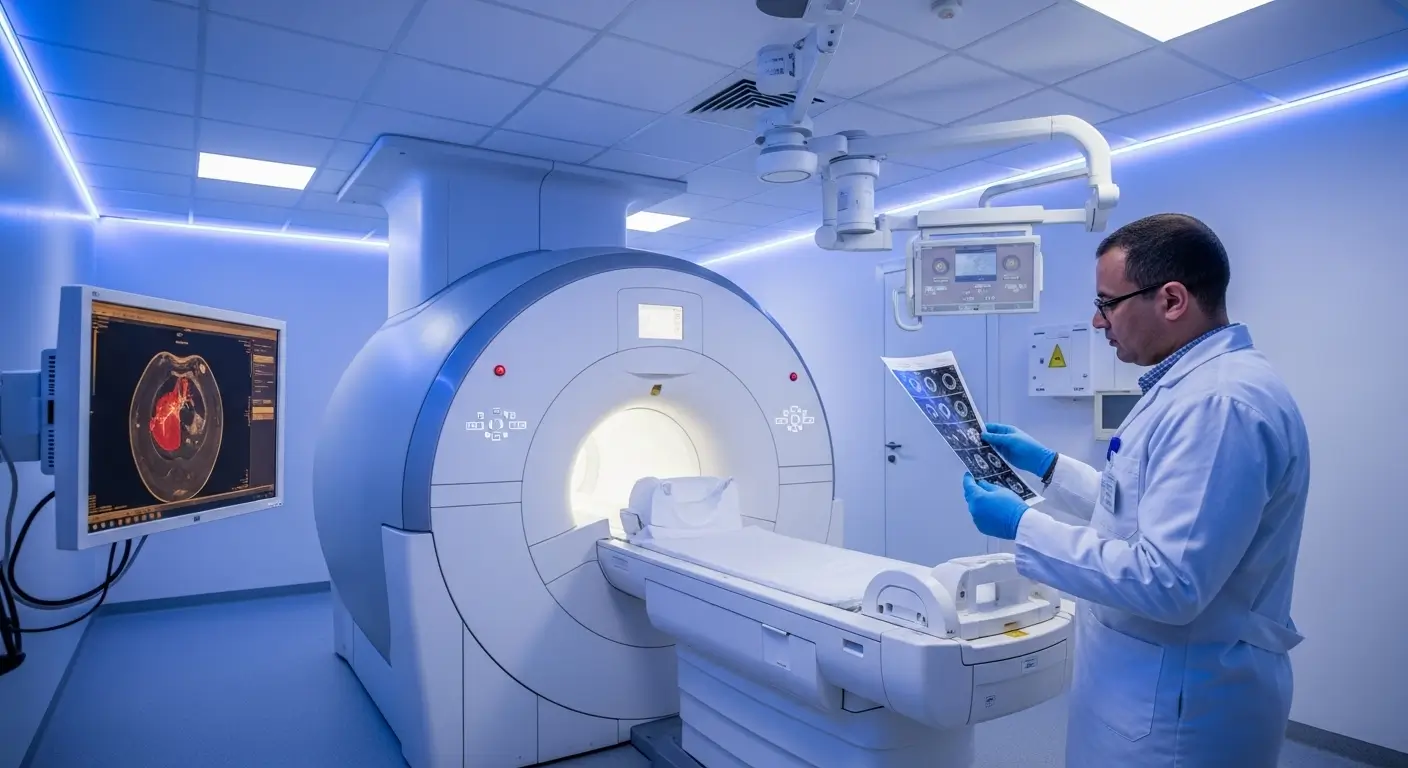
A cardiac MRI in Morocco costs between 2,000 and 4,500 MAD at private imaging centers. Public hospitals offer the same exam for 800 to 1,500 MAD — but with longer waiting times. If you hold CNSS or CNOPS insurance, you can recover a significant portion of that cost through reimbursement.
Table of Contents
How Much Does a Cardiac MRI Cost in Morocco?
The Price Range — Answered Directly
The cardiac MRI cost in Morocco depends on three main factors: whether you go to a public hospital or a private clinic, which city you are in, and whether your exam requires a contrast injection.
Here is what you can expect to pay:
| Facility Type | Price Range (MAD) | Waiting Time |
|---|---|---|
| Public hospital (CHU) | 800 – 1,500 MAD | 1 to 4 weeks |
| Private imaging clinic | 2,000 – 4,500 MAD | 2 to 7 days |
Extra costs to factor in:
- Gadolinium contrast injection: adds 200 to 400 MAD on top of the base price (not always required — your cardiologist’s prescription will specify)
- Radiologist’s written report (compte-rendu): some centers include this in the price; others bill it separately — always ask upfront
- 3 Tesla machine vs. 1.5 Tesla machine: centers equipped with a 3T scanner typically charge 200 to 300 MAD more than centers using a standard 1.5T machine
Cardiac MRI Cost by City in Morocco
Prices vary across cities. Casablanca and Rabat tend to be slightly more expensive than secondary cities due to higher operating costs.
| City | Public Hospital Price | Private Clinic Price | Notes |
|---|---|---|---|
| Casablanca | 1,000 – 1,500 MAD | 2,500 – 4,500 MAD | Widest choice of private centers |
| Rabat | 800 – 1,300 MAD | 2,200 – 4,000 MAD | Centre National de Cardiologie is the reference |
| Marrakech | 900 – 1,300 MAD | 2,000 – 3,500 MAD | Several private clinics now equipped |
| Fès | 800 – 1,200 MAD | 1,900 – 3,200 MAD | CHU Hassan II is the main public option |
| Agadir | 900 – 1,400 MAD | 2,000 – 3,000 MAD | Fewer centers; book in advance |
| Tanger | 900 – 1,300 MAD | 2,000 – 3,400 MAD | Growing private sector |
| Meknès | Not widely available | 2,000 – 3,000 MAD | Patients sometimes travel to Fès or Rabat |
Note for patients in smaller cities: Cardiac MRI is specialized equipment. If your city does not have an equipped center, the nearest option is usually a major university hospital (CHU) in Fès, Rabat, or Casablanca. Factor in travel cost when comparing public vs. private pricing.
What Makes the Cardiac MRI Cost Go Up or Down?
Understanding these variables helps you ask the right questions when calling a center to get a quote:
- Machine type — 1.5T (standard) vs. 3T (premium, sharper images for complex cases)
- Imaging protocol — A basic structural exam costs less than a full protocol that includes myocardial perfusion imaging and late gadolinium enhancement (LGE) sequences
- Contrast agent — Gadolinium injection is not required for every cardiac MRI; check your prescription
- Sector — Public hospitals are 50–70% cheaper, but require patience with scheduling
- City — Casablanca and Rabat command a premium over secondary cities
- Stress MRI add-on — If a pharmacological stress test is added to your protocol, expect an additional charge of 500 to 800 MAD
- Report turnaround — Centers that deliver a same-day compte-rendu from a specialized cardiac radiologist may charge slightly more
Insurance Reimbursement — What Will You Actually Pay Out of Pocket?
This is the question most Moroccan patients have but struggle to find a clear answer to. Here is a plain-language breakdown by insurance type.
How the Reimbursement System Works
The key concept: Insurance companies do not reimburse based on what the clinic charges you. They reimburse based on the Tarif National de Référence (TNR) — a standard rate set by ANAM (Agence Nationale de l’Assurance Maladie). Private clinics often charge more than the TNR. The gap between what they charge and what insurance covers is called the dépassement d’honoraires — and it comes out of your pocket.
Example:
- Private clinic charges: 3,000 MAD
- TNR (official reference rate): 1,400 MAD
- CNSS reimburses 70% of TNR: 980 MAD
- Your actual out-of-pocket cost: 3,000 – 980 = 2,020 MAD
This is why the cardiac MRI cost in Morocco feels expensive even for insured patients — reimbursement is calculated on the TNR, not on the real invoice.
CNSS Policyholders
| Situation | Reimbursement Rate |
|---|---|
| Outpatient exam at a private clinic | 70–80% of TNR |
| Exam during private hospitalization | 90% of TNR |
| Exam at a public hospital (CHU) | 100% of TNR |

Does cardiac MRI require prior approval (entente préalable)? Yes — for cardiac MRI, CNSS typically requires prior authorization. Your cardiologist submits the request before you schedule the exam. Without this approval, your reimbursement claim may be rejected.
Documents needed to file a CNSS reimbursement claim:
- ✅ Original cardiologist’s prescription (ordonnance)
- ✅ Itemized invoice from the imaging center (with the ACT code)
- ✅ Feuille de soins (patient care form), stamped by the center
- ✅ Your CNSS insurance card (or affiliation number)
- ✅ Bank account details (RIB) for transfer
Submit these at your nearest CNSS branch or through the online CNSS portal if your employer has activated the digital service.
CNOPS Policyholders (Civil Servants)
CNOPS generally offers slightly more favorable reimbursement conditions for radiology exams than CNSS.
- Reimbursement rate: typically 80–90% of TNR for outpatient imaging
- Contrast agent (gadolinium): check with your CNOPS mutuelle — some cover the contrast separately, others include it in the global act rate
- Tiers payant (direct billing): Some CNOPS-affiliated private centers allow direct billing, meaning you only pay the dépassement upfront and the center claims the rest directly from CNOPS — ask when booking
AMO Tadamon (Previously Uninsured Patients)
If you are covered under AMO Tadamon (the expanded universal coverage scheme for previously uninsured Moroccans):
- Cardiac MRI is covered under AMO Tadamon
- It must be performed at an accredited public facility (CHU or Centre National de Cardiologie)
- Practical reality: public hospital waiting times are the main bottleneck — plan for 2 to 4 weeks from prescription to exam date
- Private clinics are generally not covered under AMO Tadamon
No Insurance: Paying Out of Pocket
If you have no insurance coverage:
- The full private clinic cardiac MRI cost in Morocco (2,000–4,500 MAD) falls entirely on you
- Negotiation is acceptable — especially for cash payments, some private centers offer a 10–15% reduction
- CHU public hospitals remain your most affordable option: 800–1,500 MAD with no insurance required, just a valid prescription and national ID
- Some private centers offer installment payment plans (paiement en plusieurs fois) — inquire at the front desk before booking
Where to Get a Cardiac MRI in Morocco
How to Choose the Right Center
Not all imaging centers that offer MRI are equipped or specialized for cardiac MRI. Here is what to verify before booking:
- Machine minimum: 1.5 Tesla is the accepted standard for cardiac imaging. For complex cases (cardiomyopathy, post-infarct viability), a 3T machine delivers superior image quality
- Specialized radiologist: Confirm that the center has a cardiologist-radiologist (or a radiologist trained specifically in cardiac MRI) — general radiologists may not be qualified to interpret cardiac sequences
- ECG synchronization equipment: This is mandatory for cardiac MRI and should be standard — but worth confirming for smaller centers
- Insurance acceptance: Ask whether they accept your insurance as tiers payant or if you must pay upfront and claim later
- Report turnaround: If your cardiologist needs the compte-rendu quickly (for surgery planning or urgent decision-making), confirm the delivery timeline
Public Hospitals with Cardiac MRI Equipment
| Hospital | City | Key Notes |
|---|---|---|
| Centre National de Cardiologie | Rabat | Reference center for cardiac imaging in Morocco; specialized team; longest wait times |
| CHU Ibn Sina | Rabat | University hospital; accepts CNSS, CNOPS, AMO Tadamon |
| CHU Ibn Rochd | Casablanca | Largest CHU in Morocco; cardiac radiology department |
| CHU Hassan II | Fès | Serves northern and central Morocco |
| CHU Mohammed VI | Marrakech | Serves southern Morocco |
How to book at a public hospital:
- Obtain your cardiologist’s prescription
- Present at the radiology scheduling desk in person (most CHUs do not take phone bookings for MRI)
- Request the first available slot — and ask to be placed on the cancellation list for a faster appointment
- Bring your insurance card and national ID
Selecting a Private Center
When comparing private centers for cardiac MRI cost in Morocco, use this checklist:
- [ ] Do they have a cardiac-specialized radiologist on staff?
- [ ] What is the machine Tesla rating (1.5T or 3T)?
- [ ] Is gadolinium contrast included in the quoted price?
- [ ] Is the compte-rendu included in the price?
- [ ] Do they accept your insurance (tiers payant) or require upfront payment?
- [ ] What is the waiting time for an appointment?
- [ ] What is the turnaround time for the written report?
Before Your Appointment — What to Bring and Do
Required Documents
Bring all of these on the day of your cardiac MRI:
- Cardiologist’s or physician’s prescription — mandatory without exception; the center will not perform the exam without it
- National ID card (CIN)
- Insurance card (CNSS, CNOPS, or other)
- Creatinine blood test results — required if contrast injection is planned; results must typically be less than 3 months old (tests kidney function to ensure gadolinium is safe)
- Implant card — if you have a pacemaker, defibrillator, cochlear implant, or any metallic surgical device
- Previous cardiac imaging reports — ECG, echocardiography, or prior MRI results, if available; they help the radiologist tailor the protocol
Pre-Exam Instructions
Follow these steps before your cardiac MRI appointment:
48 hours before:
- If a stress MRI (pharmacological) has been prescribed, ask your cardiologist which medications to pause — some vasodilators must be stopped 48 hours before
Morning of the exam:
- Fast for at least 4 to 6 hours — no food, no juice, no milk. Water is allowed and encouraged
- Avoid caffeine, tobacco, and energy drinks for at least 4 hours before the exam — these raise heart rate and reduce image quality
- Continue your regular cardiac medications unless your cardiologist has specifically told you otherwise
- Wear comfortable clothing with no metallic elements — underwire bras, belts, and jeans with metal rivets will need to be removed
At the center:
- Arrive 15 minutes early to complete the safety questionnaire and administrative paperwork
- You will change into a hospital gown before entering the MRI room
What to Tell the Radiologist Before Starting
Always inform the staff of the following:
- Allergies — especially any prior reaction to iodine contrast agents or gadolinium
- Kidney disease — reduced kidney function changes how safely gadolinium can be used
- All metallic implants — pacemaker, joint prosthesis, cochlear implant, vascular clips, surgical staples, metallic fragments from past accidents
- Pregnancy or possible pregnancy — gadolinium is generally avoided during pregnancy; the exam itself may still be possible without contrast
- Claustrophobia — tell the team before you enter; mild sedation can be arranged in advance at most centers
- Recent surgeries — especially any cardiac or vascular procedure involving clips or stents
What Happens During the Exam — Step by Step
Knowing what to expect makes the cardiac MRI experience much less stressful. Here is exactly what happens from arrival to leaving the center.
Step 1 — Arrival and Preparation (15–20 minutes)
- Check in at reception; your prescription and documents are verified
- You sign an informed consent form
- A nurse reviews your safety questionnaire for metallic implants and allergies
- You change into a hospital gown and remove all jewelry, watches, and hair clips
- If contrast is planned, a nurse places an intravenous (IV) line in your arm
- ECG electrodes (small sticky patches) are placed on your chest — these synchronize image acquisition with your heartbeat
- A blood pressure cuff is placed on one arm in some protocols
Step 2 — Inside the MRI Machine (30–60 minutes)
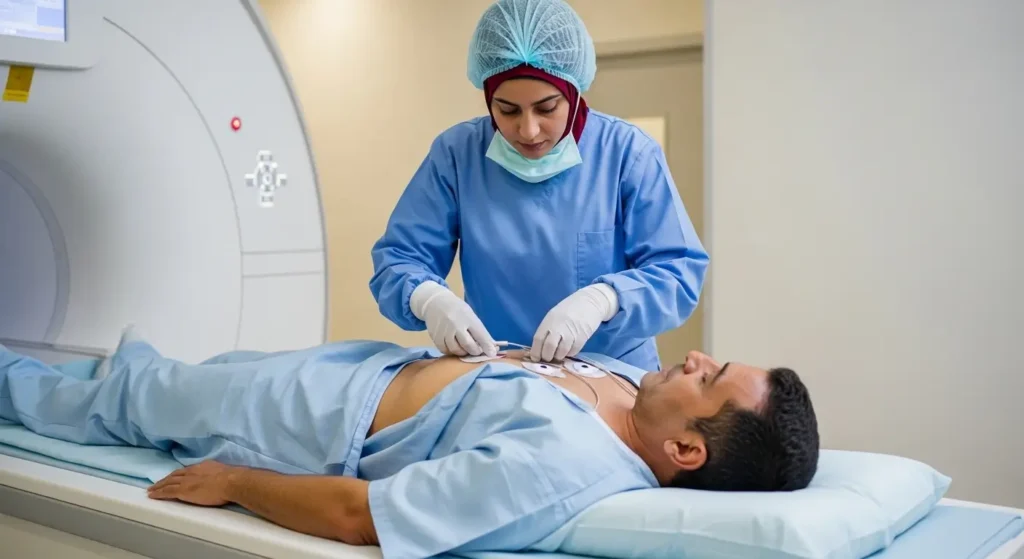
- You lie flat on your back on a sliding table
- A surface coil (a flat antenna device) is placed over your chest — this receives the MRI signal from your heart
- The table slides into the MRI bore (the cylindrical opening of the machine)
- The machine is loud — rhythmic banging and clicking sounds are normal. Earplugs or headphones with music are provided
- The radiographer speaks to you through an intercom and is visible through a window — you are never alone
- Breath-holding instructions: you will be asked to hold your breath for short periods of 10 to 15 seconds during image acquisition. This is repeated multiple times and is the trickiest part for most patients — it becomes easier after the first few rounds
- Do not move between breath-holds; even small movements blur the images and may require sequences to be repeated
Step 3 — Contrast Injection (If Required)
- Gadolinium contrast agent is injected through the IV line partway through the exam
- Normal sensations: a brief wave of warmth, a mild metallic taste in the mouth — both pass within 30 seconds
- After injection, the radiographer waits 10 to 15 minutes before acquiring late gadolinium enhancement (LGE) images — these reveal any scarring, fibrosis, or inflammation in the heart muscle with high precision
Step 4 — Stress Cardiac MRI (If Prescribed)
If your cardiologist has prescribed a pharmacological stress MRI:
- A vasodilator drug (adenosine or regadenoson) is injected to dilate the coronary arteries and simulate the effect of physical exercise — without you needing to move
- Temporary sensations: flushing, a feeling of mild chest pressure or shortness of breath, mild headache — all of these are brief and fully reversible within 1 to 2 minutes
- A dedicated nurse monitors your blood pressure, ECG, and oxygen level throughout this phase
- Confirm when booking that the center offers stress cardiac MRI — not all private centers have the protocol or the monitoring equipment
Step 5 — After the Exam
- The IV line is removed; you can eat, drink, and resume normal activities immediately
- Drink plenty of water for the next several hours to help your kidneys flush the gadolinium
- The radiologist analyzes all images and writes the compte-rendu (the detailed written report for your cardiologist)
- Report turnaround varies by center:
- Same-day at some private centers
- 24 to 72 hours at most centers
- Up to 5 to 7 days at busy public hospitals
- Always confirm the turnaround time before leaving — and ask whether you collect the report in person or receive it digitally
Who Cannot Have a Cardiac MRI — Contraindications
The MRI machine uses a powerful magnetic field. This means certain metallic or electronic devices are incompatible — and some cannot enter the MRI room at all.
Absolute Contraindications (Exam Cannot Be Performed)
The following make cardiac MRI impossible under standard conditions:
| Contraindication | Reason |
|---|---|
| Older pacemakers (pre-2010) | The magnetic field can disrupt or damage the device |
| Older implantable defibrillators (ICDs) | Same risk as pacemakers |
| Cochlear (inner ear) implants (most models) | Metallic and electronic components are MRI-unsafe |
| Certain brain aneurysm clips | Magnetic force can displace the clip — serious risk |
| Metallic fragments in the eye or near the brain | Movement risk under magnetic field |
Always bring your implant identification card. It specifies the exact model, manufacturer, and MRI compatibility status of your device.
Relative Contraindications (Exam May Be Possible With Precautions)
| Situation | What Can Be Done |
|---|---|
| MRI-conditional pacemaker (post-2010 models) | Exam is possible under strict conditions with the cardiology team present at the center |
| Severe claustrophobia | Mild sedation can be arranged in advance; inform the center when booking |
| Severe chronic kidney failure (GFR < 30 mL/min) | Gadolinium injection is avoided; exam without contrast may still be feasible |
| Pregnancy (first trimester) | Generally avoided; second and third trimesters are allowed without contrast if clinically urgent |
| Some joint prostheses and surgical staples | Most modern orthopedic implants are MRI-safe; bring documentation |
What to Do If You Have a Contraindication
If cardiac MRI is not possible for you, discuss these alternatives with your cardiologist:
- Cardiac CT scanner (scanner cardiaque): Fast (5–15 minutes), less affected by pacemakers, excellent for coronary artery anatomy — but uses X-ray radiation and iodinated contrast. Cardiac CT cost in Morocco is generally lower than MRI (1,200–2,500 MAD)
- Echocardiography (echo cardiaque): No contraindications, widely available, lower cost — evaluates cardiac function but cannot assess heart muscle tissue characteristics
- Nuclear cardiology (scintigraphie myocardique): Functional perfusion imaging useful for ischemia detection when MRI is not possible — available at major CHU hospitals
Is Cardiac MRI Worth the Cost? — Comparison With Other Tests
Facing a cardiac MRI cost of 2,000 to 4,500 MAD in Morocco, most patients reasonably ask: “Do I really need this? Is there a cheaper exam that does the same thing?”
Here is an honest comparison.
Cardiac MRI vs. Echocardiography
| Feature | Cardiac MRI | Echocardiography |
|---|---|---|
| What it evaluates | Heart muscle tissue, scarring, fibrosis, inflammation | Cardiac function, valve motion, cavity dimensions |
| Cost in Morocco | 2,000 – 4,500 MAD | 250 – 600 MAD |
| Availability | Major cities only | Available nationwide, even in small clinics |
| Contraindications | Yes (metallic implants) | None |
| Radiation | None | None |
| Best for | Cardiomyopathy diagnosis, myocarditis, post-infarct viability | Routine follow-up, valve disease, left ventricular function |
Bottom line: Echocardiography and cardiac MRI are complementary — not interchangeable. If your cardiologist has prescribed cardiac MRI, it is because echocardiography cannot answer the specific clinical question. Do not substitute one for the other without medical guidance.
Cardiac MRI vs. Cardiac CT Scanner
| Feature | Cardiac MRI | Cardiac CT Scanner |
|---|---|---|
| Exam duration | 30 – 60 minutes | 5 – 15 minutes |
| Radiation | None | Yes (low dose) |
| Best for | Myocardial tissue, volumes, ejection fraction | Coronary anatomy, calcification scoring |
| Cost in Morocco | 2,000 – 4,500 MAD | 1,200 – 2,500 MAD |
| Affected by irregular heart rate | Yes — arrhythmia complicates image acquisition | Less so |
| Pacemaker compatibility | Limited | Generally compatible |
Bottom line: Cardiac CT is better for evaluating coronary arteries. Cardiac MRI is better for evaluating the heart muscle itself. Your cardiologist chooses based on what question needs to be answered.
When Cardiac MRI Is the Only Correct Answer
Your cardiologist prescribes cardiac MRI — not a cheaper alternative — in these specific clinical situations:
- Dilated cardiomyopathy: Determining whether the cause is ischemic (coronary blockage) or non-ischemic (genetic, inflammatory)
- Hypertrophic cardiomyopathy: Quantifying fibrosis and stratifying sudden cardiac death risk
- Myocarditis: The gadolinium enhancement pattern is diagnostic in a way no other exam can replicate
- Post-infarction viability assessment: Deciding whether opening a blocked artery will actually benefit the patient’s heart muscle — a decision worth thousands of dirhams in interventional procedures
- Arrhythmogenic right ventricular cardiomyopathy (ARVC): Structural assessment of the right ventricle
- Cardiac tumors or masses: Tissue characterization to distinguish benign from malignant
- Congenital heart disease in adults: Precise anatomical mapping before surgical or catheter-based repair
In all of these situations, the cardiac MRI cost in Morocco is not avoidable — it is the medically correct and most cost-efficient path to an accurate diagnosis.
Frequently Asked Questions
How much does a cardiac MRI cost in Morocco?
The cardiac MRI cost in Morocco ranges from 2,000 to 4,500 MAD at private imaging centers and from 800 to 1,500 MAD at public hospitals (CHU). The price varies based on city, machine quality (1.5T vs. 3T), whether contrast injection is required, and whether the radiologist’s report is included.
Is cardiac MRI reimbursed by CNSS in Morocco?
Yes. CNSS reimburses cardiac MRI at 70–80% of the official Tarif National de Référence (TNR) for outpatient exams. Prior authorization (entente préalable) from your cardiologist is typically required. Note that the reimbursement is calculated on the TNR — not on the actual private clinic price — so your out-of-pocket cost may still be significant.
Do I need a prescription to get a cardiac MRI in Morocco?
Yes — a prescription from a cardiologist or treating physician is mandatory. No imaging center in Morocco will perform the exam without one. The prescription is also required for insurance reimbursement.
How long does a cardiac MRI take?
The exam itself takes between 30 and 60 minutes inside the machine. With preparation, changing, and IV placement, plan for a total appointment time of 1.5 to 2 hours at the center.
Can I eat before a cardiac MRI?
No. You must fast for at least 4 to 6 hours before the exam — no food, no juice, no milk. Water is allowed and encouraged. Avoid caffeine and tobacco for at least 4 hours before.
Can someone with a pacemaker get a cardiac MRI?
It depends on the pacemaker model. Older devices (generally pre-2010) are incompatible with MRI. Newer “MRI-conditional” pacemakers allow the exam under strict conditions with cardiology monitoring. Always bring your implant card so the center can verify compatibility before the appointment.
What is the difference between cardiac MRI and echocardiography?
Echocardiography evaluates how the heart functions — contraction strength, valve movement, cavity size. Cardiac MRI evaluates the heart muscle tissue itself — detecting scarring, inflammation, fibrosis, and infiltration. They answer different clinical questions and are complementary, not interchangeable.
How long before I receive my cardiac MRI results?
It varies by center. Some private clinics deliver the compte-rendu (written radiologist report) the same day. Most centers deliver it within 24 to 72 hours. Public hospitals may take 5 to 7 days. Always confirm the turnaround time before booking.
Is cardiac MRI painful or dangerous?
No. The exam is non-invasive and painless. There is no radiation. The contrast injection (gadolinium) may cause a brief sensation of warmth, which passes within seconds. The main discomfort is the noise of the machine and the need to hold your breath repeatedly. The exam is considered very safe for the vast majority of patients.
Where can I get a cardiac MRI in Casablanca, Rabat, or Marrakech?
All three cities have multiple public and private options. In Rabat, the Centre National de Cardiologie is the reference public center. In Casablanca, CHU Ibn Rochd is the main public option, with numerous private imaging clinics available. In Marrakech, CHU Mohammed VI and several private centers are equipped. Contact the imaging department directly for current availability and pricing.
Conclusion
The cardiac MRI cost in Morocco ranges from 800 MAD at a public hospital to 4,500 MAD at a premium private clinic — with insurance reimbursement covering a meaningful portion for CNSS and CNOPS policyholders.
Here is what to do next:
- Confirm your prescription includes all required details (exam type, with or without contrast)
- Check your insurance eligibility and request prior authorization if required by CNSS
- Get a blood test for creatinine if contrast injection is planned
- Book your center — verify they have a cardiac-specialized radiologist and ask about the compte-rendu turnaround
- Bring all documents on the day: prescription, CIN, insurance card, creatinine results, implant card if applicable
The exam itself is safe, non-irradiating, and well-tolerated. The cardiac MRI cost in Morocco, while significant, reflects a gold-standard diagnostic tool that often saves patients from more expensive and invasive procedures down the line.