
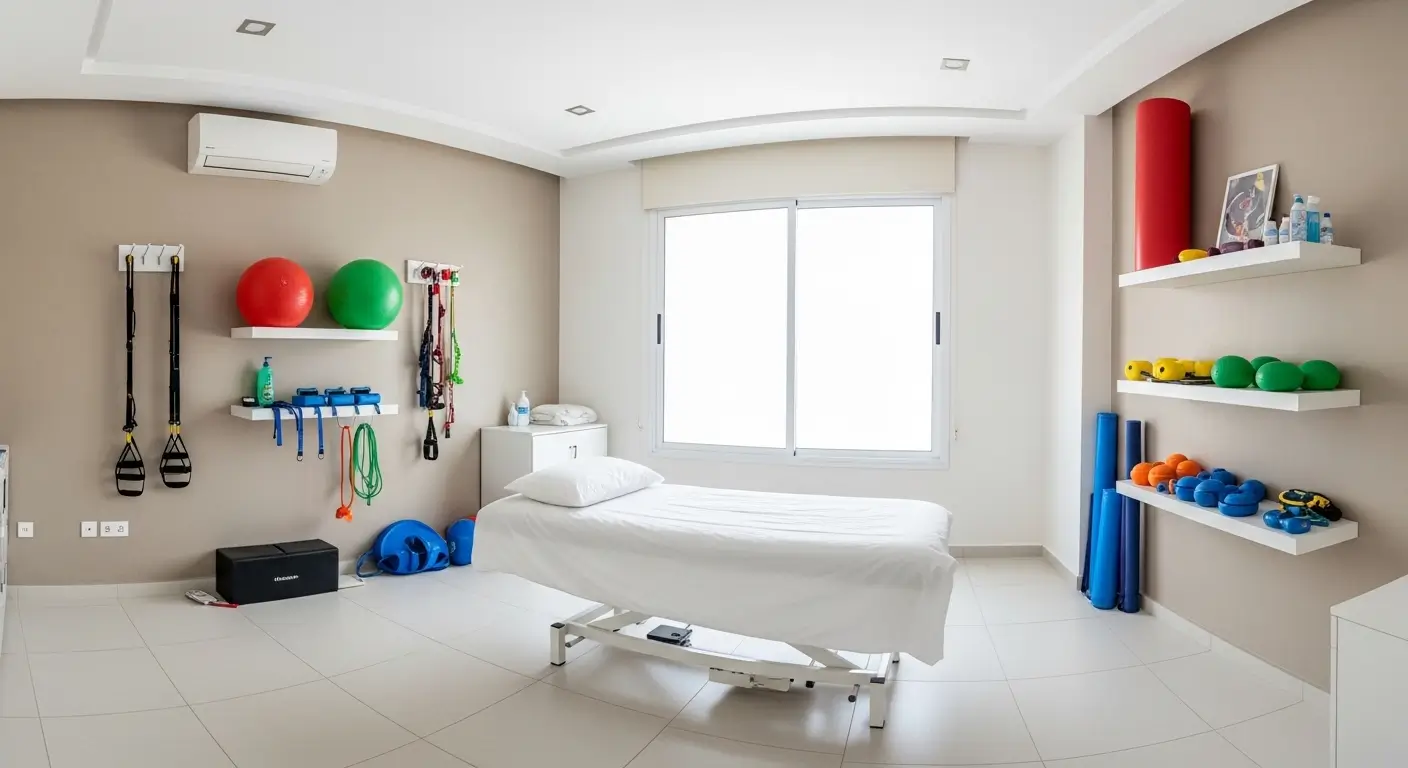
Need physiotherapy in Morocco but confused about pricing? When you call different clinics, you might hear quotes ranging from 150 DH to 400 DH per session, leaving you wondering what’s actually fair. Understanding physiotherapy prices helps you budget properly and avoid overpaying for treatment you need.
This complete guide breaks down what you’ll actually pay for physiotherapy across Morocco. You’ll learn the real costs in your city, how to maximize insurance coverage, and whether home visits are worth the extra expense. Whether you’re dealing with back pain, recovering from surgery, or managing a chronic condition, you’ll know exactly what to expect before booking your first appointment.
By the end of this article, you’ll understand session costs in major Moroccan cities, how much your insurance will cover, the total investment for your complete treatment, and practical ways to get quality care without overspending.
Table of Contents
How Much Does a Physiotherapy Session Cost in Morocco?

The average physiotherapy session in Morocco costs between 150 DH and 400 DH, depending on several factors including your location, the type of treatment, and the physiotherapist’s experience.
Standard Session Prices Across Morocco
Here’s what you can expect to pay for different types of physiotherapy services:
| Service Type | Price Range |
|---|---|
| Basic rehabilitation session | 150-250 DH |
| Specialized treatment session | 250-400 DH |
| Home visit session | 300-500 DH |
| Initial assessment/consultation | 200-350 DH |
| Chronic condition management | 150-300 DH |
| Sports physiotherapy | 250-400 DH |
These prices represent what most Moroccans pay across the country. Your actual cost might fall outside this range depending on specific circumstances.
What Affects Your Session Price?
Several factors determine how much you’ll pay for physiotherapy treatment.
Physiotherapist Qualifications
More experienced physiotherapists typically charge higher rates:
- Years of experience: Practitioners with 10+ years often charge 50-100 DH more per session
- Specialized certifications: Additional training in sports therapy, pediatrics, or neurology justifies premium pricing
- International training: Physiotherapists trained abroad may charge at the higher end of the range
Clinic Location and Facilities
Where you receive treatment significantly impacts the price:
- Major cities vs. smaller towns: Casablanca and Rabat charge 30-50% more than smaller cities
- Modern equipment: Clinics with advanced electrotherapy or laser equipment charge premium rates
- Clinic reputation: Well-established centers with strong reputations can command higher prices
Session Duration
Treatment length directly affects cost:
- 30-minute sessions: 150-200 DH (basic treatments)
- 45-minute sessions: 200-300 DH (most common duration)
- 60-minute sessions: 300-400 DH (complex cases or intensive therapy)
Most physiotherapists in Morocco offer 45-minute sessions as the standard treatment window.
Physiotherapy Costs by Treatment Type
Different conditions require different treatment approaches, which affects pricing. Understanding these variations helps you budget accurately for your specific needs.
General Rehabilitation Pricing
General rehabilitation covers common issues like:
- Lower back pain
- Neck pain and stiffness
- Joint pain
- Muscle strains
- Poor posture correction
Average cost: 200-300 DH per session
Most patients need 6-10 sessions for general rehabilitation, spreading treatment over 3-5 weeks. Total investment typically ranges from 1,200 to 3,000 DH before insurance reimbursement.
Sports Physiotherapy Costs
Sports physiotherapy treats athletic injuries and helps prevent future problems:
- Sprains and strains
- Tendonitis
- Ligament injuries
- Running-related injuries
- Performance optimization
Average cost: 250-400 DH per session
Sports physiotherapy costs more because it requires:
- Specialized knowledge of athletic movements
- Advanced manual therapy techniques
- Sport-specific rehabilitation protocols
- Performance testing equipment
Athletes typically need 8-12 sessions depending on injury severity.
Post-Surgery Physiotherapy Prices
Recovering from surgery requires structured physiotherapy:
- Knee replacement rehabilitation
- Hip surgery recovery
- Shoulder surgery rehabilitation
- Spinal surgery recovery
- Fracture healing support
Average cost: 250-350 DH per session
Post-surgical patients usually need 10-15 sessions over 6-8 weeks. Your surgeon will provide specific recommendations based on your procedure. Most insurance plans cover post-operative physiotherapy with proper documentation.
Chronic Condition Management
Long-term conditions require ongoing physiotherapy support:
- Stroke rehabilitation: Regaining movement and function after stroke
- Parkinson’s disease treatment: Maintaining mobility and reducing symptoms
- Arthritis management: Reducing pain and improving joint function
- Multiple sclerosis: Managing symptoms and maintaining independence
Average cost: 150-300 DH per session
Chronic condition management often requires 12-20+ sessions, with some patients continuing treatment indefinitely. The lower price point reflects the long-term commitment and higher session frequency.
Pediatric Physiotherapy
Children with developmental or injury-related conditions need specialized care:
- Developmental delays
- Cerebral palsy
- Sports injuries
- Postural problems
- Torticollis
Average cost: 250-350 DH per session
Pediatric physiotherapy requires specialized training, child-friendly facilities, and often longer sessions to account for shorter attention spans and parent education time.
Manual Therapy vs. Electrotherapy Pricing
Understanding these two approaches helps explain price differences:
Manual Therapy (hands-on techniques):
- Joint mobilization
- Soft tissue massage
- Stretching
- Manipulation
- Typically costs 200-300 DH
Electrotherapy (equipment-based treatment):
- Ultrasound therapy
- Electrical stimulation
- Laser therapy
- Heat/cold therapy
- Typically costs 150-250 DH
Most treatment sessions combine both approaches. Pure manual therapy often costs more because it requires the physiotherapist’s full attention throughout the session, while electrotherapy allows them to treat multiple patients simultaneously.
Physiotherapy Prices by Moroccan City
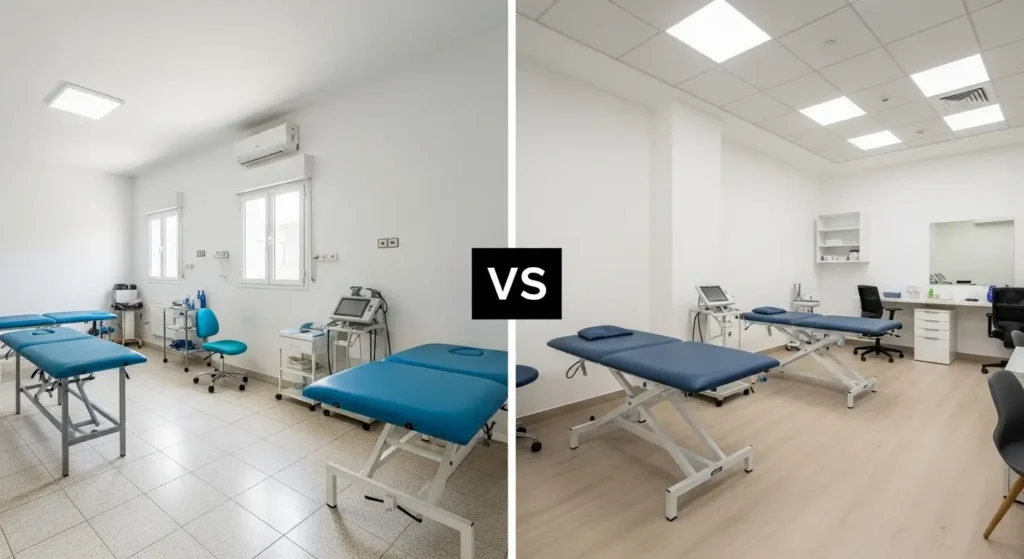
Where you live in Morocco significantly affects what you’ll pay for physiotherapy. Major cities charge premium rates while smaller towns offer more affordable options.
Casablanca Physiotherapy Costs
Average session: 250-350 DH
Casablanca has Morocco’s highest physiotherapy prices due to:
- Higher operating costs (rent, utilities, staff)
- Greater concentration of specialized practitioners
- Higher income levels supporting premium pricing
- More advanced equipment and facilities
Finding affordable options in Casablanca:
- Look for clinics in Hay Mohammadi or Sidi Moumen (20-30% lower than Maarif or Anfa)
- University hospital physiotherapy departments offer reduced rates
- Group practice clinics spread costs across multiple providers
- Browse verified physiotherapy centers in Casablanca to compare prices and services
Rabat Physiotherapy Pricing
Average session: 200-300 DH
Morocco’s capital offers slightly lower prices than Casablanca while maintaining high quality standards. The concentration of government employees with good insurance coverage keeps prices competitive.
Best value neighborhoods:
- Agdal: Mid-range pricing with quality care
- Hassan: Affordable options near the medina
- Hay Riad: Modern clinics with competitive rates
- Find qualified physiotherapists in Rabat across all neighborhoods with detailed pricing information.
Tangier Physiotherapy Rates
Average session: 200-300 DH
Tangier’s physiotherapy market balances between serving local residents and expatriates. Prices remain reasonable compared to Casablanca.
Home visit services are widely available across Tangier, typically adding 100-150 DH to standard clinic rates. The city’s compact size makes home visits more affordable than in larger cities. Explore physiotherapy centers in Tangier to find providers offering both clinic and home services.
Marrakech Treatment Costs
Average session: 180-280 DH
Marrakech has two distinct physiotherapy markets:
Tourist-focused clinics (Hivernage, Gueliz):
- 250-350 DH per session
- Multi-language services
- Often cater to hotel guests
Local-focused clinics (Massira, Daoudiate):
- 180-250 DH per session
- Arabic/French speaking
- Better value for residents
Choose based on your needs and budget, but don’t assume tourist area clinics provide better care.
Fes and Meknes Pricing
Average session: 150-250 DH
These historic cities offer Morocco’s most affordable physiotherapy rates without sacrificing quality. Lower operating costs translate directly to patient savings.
The physiotherapy community in Fes and Meknes is tight-knit, with many practitioners trained at the same institutions. Quality remains consistent across different price points.
Agadir and Coastal Cities
Average session: 200-300 DH
Agadir’s physiotherapy prices reflect its tourism economy. Seasonal variations occur:
- Peak season (November-March): Prices may increase 10-15% due to demand
- Off-season (June-September): Better negotiating power for packages
Other coastal cities like El Jadida and Essaouira follow similar patterns with slightly lower base rates.
City-by-City Price Comparison
| City | Average Session Cost | Home Visit Cost | Market Characteristics |
|---|---|---|---|
| Casablanca | 250-350 DH | 350-500 DH | Highest prices, most options |
| Rabat | 200-300 DH | 300-450 DH | Good balance of price/quality |
| Tangier | 200-300 DH | 300-450 DH | Growing market, competitive |
| Marrakech | 180-280 DH | 280-400 DH | Two-tier market system |
| Fes | 150-250 DH | 250-350 DH | Most affordable major city |
| Meknes | 150-250 DH | 250-350 DH | Consistent with Fes pricing |
| Agadir | 200-300 DH | 300-450 DH | Seasonal price variations |
Insurance Coverage: How Much Will You Actually Pay?
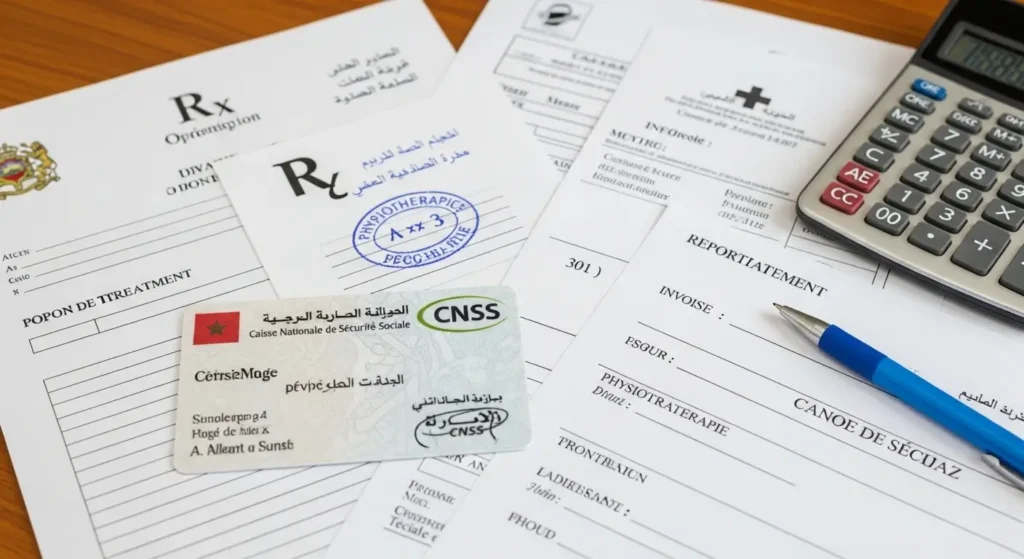
Understanding your insurance coverage is crucial for budgeting physiotherapy treatment. Most Moroccans won’t pay the full session price thanks to various coverage options.
CNSS (National Social Security Fund) Coverage
The CNSS covers physiotherapy for private sector employees and their dependents.
Coverage details:
- Reimburses 70% of approved rates for physiotherapy sessions
- Requires a valid medical prescription from a doctor
- Claims must be submitted within 6 months of treatment
- Processing time: typically 2-4 weeks
Required documentation:
- Medical prescription clearly indicating physiotherapy need
- Detailed invoice from the physiotherapist (facture)
- Treatment report outlining sessions completed
- CNSS membership card (attestation d’affiliation)
- Completed reimbursement form (feuille de soins)
Example calculation:
- Session cost: 250 DH
- CNSS coverage (70%): 175 DH
- Your cost: 75 DH per session
Mutual Insurance (Mutuelle) Reimbursement
Mutuelle insurance supplements CNSS coverage or provides primary coverage for members.
Typical coverage rates: 50-80% depending on your plan tier
Better mutuelle plans offer:
- Higher reimbursement percentages (up to 100% for some plans)
- Faster processing times
- Direct billing with partner clinics
- Coverage for home visits
Pre-approval requirements:
Some mutuelle companies require pre-authorization for physiotherapy treatment exceeding 10 sessions. Contact your insurance provider before starting long-term treatment to avoid coverage issues.
Reimbursement limits:
Most mutuelle plans cap annual physiotherapy coverage at:
- Basic plans: 2,000-3,000 DH per year
- Premium plans: 5,000-10,000 DH per year
- Family plans: Combined limits for all family members
CNOPS Coverage for Public Sector Employees
Public sector workers and their families benefit from CNOPS coverage.
Coverage percentage: Typically 80-90% of physiotherapy costs
Authorized providers: CNOPS maintains a network of approved physiotherapy centers. Verify that your chosen clinic accepts CNOPS before starting treatment to ensure coverage.
Claim process:
- Obtain medical prescription from approved doctor
- Receive treatment at CNOPS-approved facility
- Submit claim with required documentation
- Receive reimbursement within 3-4 weeks
CNOPS generally offers better coverage rates than CNSS, reflecting the public sector employment benefit package.
AMO/RAMED Coverage for Physiotherapy
AMO (basic health insurance) and RAMED (medical assistance for the economically disadvantaged) provide limited physiotherapy coverage.
What’s covered:
- Essential rehabilitation after surgery or injury
- Treatment for acute conditions
- Limited number of sessions per year (typically 10-15)
What’s not covered:
- Chronic condition management beyond basic care
- Sports physiotherapy
- Wellness or preventive treatments
- Home visit services
Out-of-pocket costs: Even with coverage, patients typically pay 30-50% of session costs. For a 200 DH session, expect to pay 60-100 DH yourself.
What You Need for Insurance Reimbursement
Gather these documents before your first physiotherapy session:
Essential documentation checklist:
✓ Medical prescription from your doctor specifying:
- Diagnosis
- Recommended treatment
- Number of sessions
- Treatment frequency
✓ Invoice/receipt from physiotherapist including:
- Session date and duration
- Treatment provided
- Cost breakdown
- Physiotherapist’s stamp and signature
✓ Treatment report documenting:
- Progress notes
- Techniques used
- Patient response to treatment
✓ Insurance membership card with:
- Current coverage status
- Member identification number
- Beneficiary information
✓ Claim form properly completed with:
- Patient information
- Provider details
- Treatment dates and costs
Missing any of these documents will delay or prevent reimbursement. Keep copies of everything you submit.
Direct Billing vs. Reimbursement
Understanding these two payment methods helps you manage cash flow during treatment.
Direct billing:
- Clinic bills insurance company directly
- You pay only your portion at each visit
- No waiting for reimbursement
- Requires insurance pre-approval
- Only available at partnered facilities
Advantages:
- Better cash flow management
- No upfront payment of full amount
- Simpler administrative process
Reimbursement:
- You pay full amount upfront
- Submit claims to insurance
- Receive payment 2-6 weeks later
- Works with any physiotherapy provider
Advantages:
- Freedom to choose any practitioner
- No need for insurance pre-approval
- Works with all insurance types
Most large physiotherapy centers in Casablanca and Rabat offer direct billing with major insurance providers. Smaller clinics typically use the reimbursement model.
Clinic Sessions vs. Home Physiotherapy: Which Costs Less?
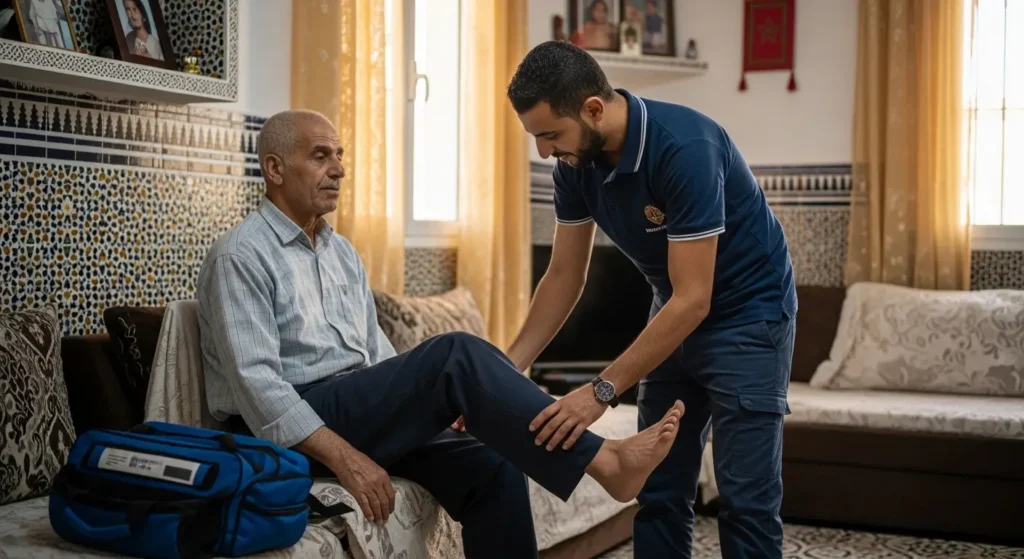
Choosing between clinic visits and home physiotherapy affects both your budget and treatment convenience. Understanding the cost difference helps you make the right decision.
In-Clinic Physiotherapy Costs
Average price: 150-350 DH per session
What’s included:
- 30-60 minute treatment session
- Access to clinic equipment (exercise machines, electrotherapy devices)
- Professional treatment environment
- Potentially multiple therapists for complex cases
- Exercise instruction using clinic facilities
When to choose clinic treatment:
Choose in-clinic sessions when:
- You can travel comfortably to the clinic
- You need specialized equipment not available at home
- You benefit from the clinical environment’s structure
- You want lower per-session costs
- Your insurance covers clinic visits better than home visits
Home Physiotherapy Service Prices
Average price: 300-500 DH per session
The higher cost reflects:
- Travel time to your location
- Fuel and transportation costs
- Limited number of patients per day
- Bringing portable equipment
- Scheduling flexibility (including evenings/weekends)
What’s included:
- Treatment in your home environment
- Portable equipment brought by therapist
- Personalized one-on-one attention
- Family education in your space
- Treatment schedule adapted to your routine
Service areas: Home physiotherapy is widely available in:
- Casablanca (all districts)
- Rabat-Salé-Témara
- Tangier
- Marrakech
- Agadir
- Other major cities
24/7 availability: Some home physiotherapy services offer evening, weekend, and emergency appointments at premium rates (typically 400-600 DH per session).
When Home Visits Are Worth the Extra Cost
Despite the higher price, home physiotherapy makes financial and practical sense in these situations:
1. Post-surgery patients:
- Transportation to clinic is painful or risky
- Reduced infection risk by staying home
- Faster recovery in comfortable environment
- Worth the 150-200 DH extra per session
2. Elderly patients with mobility issues:
- Eliminates taxi costs (round trip: 40-100 DH)
- Reduces fall risk during travel
- No energy wasted on transportation
- Family can observe and learn techniques
3. Busy professionals:
- Saves 1-2 hours of travel and waiting time
- Allows treatment during work breaks
- Flexible scheduling around meetings
- Time savings justify additional cost
4. Severe pain conditions:
- Sitting in cars or waiting rooms increases pain
- Immediate access to comfortable positions at home
- Less stress and anxiety
- Better treatment outcomes
How to Save on Home Physiotherapy
Get home treatment without breaking the budget:
Negotiate package deals:
- Book 10 sessions upfront: typically 10-15% discount
- Monthly unlimited plans for chronic conditions: 2,000-3,000 DH
- Family member discounts: 20% off when treating multiple people
Share travel costs:
- Coordinate with neighbors needing physiotherapy
- Same-building treatments on the same day
- Split travel fees among multiple patients
- Reduces per-person cost by 30-50%
Off-peak hour discounts:
- Mid-morning slots (10 AM-12 PM): 50-100 DH less
- Early afternoon (2 PM-4 PM): standard rates
- Evening/weekend: premium pricing
Choose closer providers:
- Therapists within 5 km charge less for travel
- Saves 50-100 DH per session
- More flexible scheduling
Cost Comparison: Clinic vs. Home Treatment
| Factor | Clinic Visit | Home Visit | Difference |
|---|---|---|---|
| Session cost | 200 DH | 350 DH | +150 DH |
| Transportation | 40 DH (round trip) | 0 DH | -40 DH |
| Time investment | 2-3 hours | 1 hour | -1-2 hours |
| Waiting time | 15-30 minutes | None | None |
| Equipment access | Full clinic equipment | Portable only | Clinic advantage |
| Privacy | Shared space | Complete privacy | Home advantage |
| Net cost | 240 DH | 350 DH | +110 DH |
The real cost difference is often smaller than it appears when you factor in transportation and time value.
How Many Sessions Will You Need? (Total Cost Calculator)
Understanding treatment duration helps you budget properly for physiotherapy. Session requirements vary significantly based on your condition.
Typical Treatment Duration by Condition
Acute Injuries
Common conditions:
- Ankle sprains
- Muscle strains
- Simple back pain
- Whiplash
- Tennis elbow
Sessions needed: 6-8 sessions
Frequency: 2-3 times per week
Timeline: 3-4 weeks
Total cost estimate:
- Standard rate (250 DH): 1,500-2,000 DH
- After insurance (30% cost): 450-600 DH out of pocket
Most acute injuries respond well to focused short-term treatment. Following home exercise programs between sessions speeds recovery.
Chronic Conditions
Common conditions:
- Chronic lower back pain
- Osteoarthritis
- Fibromyalgia
- Chronic neck pain
- Long-term joint problems
Sessions needed: 12-20+ sessions
Frequency: 2 times per week initially, then 1 time per week for maintenance
Timeline: 6-10 weeks for initial improvement, ongoing for management
Total cost estimate:
- Standard rate (200 DH): 2,400-4,000 DH
- After insurance (30% cost): 720-1,200 DH out of pocket
Chronic conditions require longer treatment periods and often benefit from maintenance sessions every 2-4 weeks after initial improvement.
Post-Surgery Recovery
Common procedures:
- Knee replacement
- Hip replacement
- Rotator cuff repair
- ACL reconstruction
- Spinal surgery
Sessions needed: 10-15 sessions
Frequency: 3 times per week initially, reducing to 2 times per week
Timeline: 4-6 weeks intensive therapy
Total cost estimate:
- Standard rate (300 DH): 3,000-4,500 DH
- After insurance (20% cost): 600-900 DH out of pocket
Post-surgical insurance coverage is typically better than other conditions. Your surgeon’s prescription strengthens insurance claims.
Real Cost Examples
Understanding actual patient costs helps you budget realistically.
Example 1: Lower Back Pain Treatment
Patient profile: 35-year-old office worker, CNSS coverage
- Condition: Acute lower back pain
- Sessions needed: 8 sessions over 4 weeks
- Session cost: 250 DH
- Total cost: 2,000 DH
- Insurance coverage (70%): 1,400 DH reimbursed
- Out-of-pocket cost: 600 DH
Additional costs:
- Doctor consultation for prescription: 200 DH
- Total investment: 800 DH
Example 2: Sports Injury Rehabilitation
Patient profile: 28-year-old athlete, Mutuelle coverage
- Condition: Ankle sprain from football
- Sessions needed: 10 sessions over 5 weeks
- Session cost: 300 DH (sports physiotherapy)
- Total cost: 3,000 DH
- Insurance coverage (70%): 2,100 DH reimbursed
- Out-of-pocket cost: 900 DH
Additional costs:
- Sports medicine doctor: 300 DH
- Ankle support brace: 150 DH
- Total investment: 1,350 DH
Example 3: Stroke Rehabilitation
Patient profile: 67-year-old retiree, CNOPS coverage
- Condition: Post-stroke right-side weakness
- Sessions needed: 20 sessions over 10 weeks
- Session cost: 200 DH
- Total cost: 4,000 DH
- Insurance coverage (80%): 3,200 DH reimbursed
- Out-of-pocket cost: 800 DH
Additional costs:
- Neurologist consultation: 400 DH
- Home exercise equipment: 300 DH
- Total investment: 1,500 DH
Example 4: Pediatric Developmental Therapy
Patient profile: 5-year-old child, parents’ Mutuelle coverage
- Condition: Developmental coordination disorder
- Sessions needed: 15 sessions over 8 weeks
- Session cost: 300 DH
- Total cost: 4,500 DH
- Insurance coverage (60%): 2,700 DH reimbursed
- Out-of-pocket cost: 1,800 DH
Additional costs:
- Pediatric specialist: 350 DH
- Developmental tools for home: 200 DH
- Total investment: 2,350 DH
These examples show that insurance significantly reduces your financial burden, but you should still budget 600-2,000 DH for most treatment programs.
What’s Included in Your Physiotherapy Session Price?
Knowing what you’re paying for helps you evaluate whether you’re getting good value. Standard physiotherapy sessions include several components.
Standard Session Components
Initial assessment (first visit):
- Detailed medical history review
- Physical examination and movement testing
- Pain and function evaluation
- Treatment goal setting
- Customized treatment plan development
First sessions typically last 45-60 minutes and may cost 50-100 DH more than regular sessions.
Hands-on treatment time:
- Manual therapy techniques
- Joint mobilization
- Soft tissue massage
- Stretching and manipulation
- Postural correction
This is the core of your physiotherapy session, typically 20-30 minutes of direct hands-on work.
Exercise instruction:
- Therapeutic exercises demonstrated
- Proper form correction
- Progression guidance
- Safety precautions explained
Home exercise program:
- Written or illustrated exercise sheets
- Video demonstrations (some clinics)
- Daily routine recommendations
- Progression schedule
Progress evaluation:
- Regular reassessment of your condition
- Treatment plan adjustments
- Goal achievement tracking
- Communication with referring doctor
What Usually Costs Extra
Understanding additional charges prevents surprise bills:
Initial consultation fee (if separate):
- Some clinics charge 200-350 DH for first assessment
- Others include it in the first treatment session
- Always ask upfront
Specialized equipment rental:
- TENS unit for home use: 50-100 DH per week
- Compression therapy devices: 100-200 DH per week
- Traction devices: 150-250 DH per week
Take-home tools:
- Resistance bands: 50-150 DH
- Exercise balls: 100-200 DH
- Foam rollers: 150-300 DH
- Hot/cold packs: 50-100 DH
Extended session time:
- Standard 45-minute sessions: base price
- 60-minute sessions: +50-100 DH
- 90-minute intensive sessions: +100-200 DH
Weekend or evening appointments:
- Saturday morning: standard rate or +50 DH
- Saturday afternoon/Sunday: +50-100 DH
- After 6 PM weekdays: +50-100 DH
- Emergency same-day appointments: +100-200 DH
Questions to Ask Before Your First Session
Protect yourself from unexpected costs by asking these questions:
About pricing:
- “What is your per-session cost, and what does it include?”
- “Is the initial consultation charged separately?”
- “Do you offer package discounts for multiple sessions?”
- “What are your payment options (cash, card, installments)?”
About insurance: 5. “Do you accept my insurance (CNSS/CNOPS/Mutuelle)?” 6. “Do you offer direct billing or reimbursement only?” 7. “What documentation will you provide for my insurance claim?”
About treatment: 8. “How many sessions do you estimate I’ll need?” 9. “How long is each session?” 10. “What happens if I need to cancel or reschedule?”
About additional costs: 11. “Are there any additional fees I should know about?” 12. “Do you charge extra for weekend appointments?” 13. “Will I need to purchase any equipment?”
Asking these questions upfront prevents misunderstandings and helps you budget accurately.
How to Find Affordable Physiotherapy in Morocco
Quality physiotherapy doesn’t have to drain your budget. Smart strategies help you access professional care at reasonable prices.
Look for Package Deals
Most physiotherapy clinics offer discounts when you commit to multiple sessions:
10-session packages:
- Typical discount: 10-15%
- Standard cost: 2,500 DH (10 × 250 DH)
- Package price: 2,125-2,250 DH
- Savings: 250-375 DH
Monthly unlimited plans:
- Best for chronic conditions requiring 8+ sessions monthly
- Fixed monthly fee: 2,000-3,000 DH
- Savings increase with more sessions
- Typical offering in major cities
Family member discounts:
- Second family member: 10-20% off
- Multiple children: 15-25% off total
- Great for families with multiple needs
Payment terms:
- Most packages paid upfront
- Some clinics offer split payment (50% now, 50% at session 5)
- Unused sessions typically valid 3-6 months
Use Your Insurance Wisely
Maximize your insurance benefits with these strategies:
Choose providers with direct billing:
- No upfront payment of full costs
- Better cash flow management
- Automatic claim submission
- Available at most large clinics
Verify coverage before starting:
- Call your insurance company
- Confirm approved treatment types
- Check annual limits
- Get pre-authorization if required
Submit claims promptly:
- File within required timeframe (usually 6 months)
- Complete all paperwork accurately
- Follow up if processing takes longer than stated
- Keep copies of everything
Maximize annual benefits:
- If you have 3,000 DH annual limit, use it strategically
- Complete treatment in one calendar year if possible
- Plan timing around benefit renewal dates
Consider Training Clinics
Physiotherapy school clinics offer exceptional value:
Benefits:
- Supervised student practitioners
- Faculty oversight ensures quality
- Significantly lower costs: 50-100 DH per session
- Same evidence-based treatments
- Longer appointment times (students take more time)
Considerations:
- Longer waiting lists (1-3 weeks typical)
- Students learning clinical skills
- Appointments take longer overall
- Limited evening/weekend availability
Where to find training clinics:
- University hospitals in major cities
- Physiotherapy schools in Casablanca, Rabat, Fes
- Teaching hospitals with rehabilitation departments
Perfect for non-urgent conditions where you can wait for appointments and have schedule flexibility.
Negotiate Payment Plans
Don’t let upfront costs prevent needed treatment:
Most clinics offer:
- Installment options for long-term treatment
- Split payments over treatment duration
- Interest-free payment plans
- Especially common for post-surgery rehabilitation
How to negotiate:
- Explain your situation honestly
- Propose a realistic payment schedule
- Ask about their standard payment plan options
- Get the agreement in writing
Example payment plan:
- Total treatment cost: 3,000 DH (12 sessions)
- Down payment: 1,000 DH
- Four monthly payments: 500 DH each
- No interest charges
Many physiotherapists would rather work with you on payments than lose you as a patient.
Compare Prices (Without Sacrificing Quality)
Smart comparison shopping saves money without compromising care:
How to compare effectively:
- Call 3-5 clinics in your area
- Ask about their rates
- Request information about therapist qualifications
- Inquire about equipment and techniques used
- Ask about qualifications and experience
- Years in practice
- Specialized training
- Success with your specific condition
- Patient testimonials
- Check online reviews
- Google reviews
- Facebook recommendations
- Healthcare forums
- Ask friends and family
- Don’t choose based on price alone
- Cheapest isn’t always best value
- Most expensive doesn’t guarantee better results
- Focus on experience with your condition
- Consider location and convenience
Red flags:
- Prices significantly below market rate (below 100 DH in major cities)
- Pushy sales tactics or pressure to buy packages
- No clear pricing information provided upfront
- Unwillingness to discuss qualifications
- No proper documentation or receipts
Good value indicators:
- Transparent pricing
- Willing to answer all questions
- Clear treatment plans with estimated duration
- Proper credentials displayed
- Clean, professional facility
- Good communication and explanations
Common Mistakes When Choosing Physiotherapy (That Cost You More)
Avoiding these errors saves money and improves treatment outcomes.
Mistake #1: Skipping the Initial Assessment
Some patients try to save money by skipping the comprehensive first appointment and jumping straight to treatment.
Why this costs more:
- Treating the wrong problem wastes sessions
- Missed underlying causes lead to recurring issues
- No baseline measurements make progress hard to track
- May need to restart treatment from scratch
The fix: Invest in proper initial assessment (200-350 DH). It saves money by ensuring correct diagnosis and treatment plan from day one.
Mistake #2: Not Verifying Insurance Coverage First
Starting treatment without confirming insurance coverage leads to unpleasant financial surprises.
Common problems:
- Clinic not in your insurance network
- Treatment type not covered by your plan
- Missing required pre-authorization
- Annual limit already exceeded
The fix: Call your insurance company before your first appointment. Ask specifically:
- Is this clinic/therapist covered?
- Is my condition covered?
- Do I need pre-authorization?
- What’s my coverage percentage?
- How much of my annual limit remains?
Five minutes on the phone saves hundreds or thousands of dirhams.
Mistake #3: Choosing the Cheapest Option Without Research
The lowest price sometimes means:
- Inexperienced practitioners
- Outdated techniques
- Poor equipment
- Rushed sessions with inadequate attention
Real cost:
- 15 sessions at 120 DH with poor results: 1,800 DH wasted
- 8 sessions at 250 DH with full recovery: 2,000 DH well spent
The fix: Evaluate quality factors alongside price:
- Therapist qualifications and experience
- Treatment approach and techniques
- Clinic facilities and equipment
- Patient reviews and outcomes
- Professional communication
Better to pay moderate prices and recover quickly than chase bargains and stay injured longer.
Mistake #4: Not Asking About Package Discounts
Many patients pay per session without realizing package discounts exist.
What you lose:
- 10 sessions at 250 DH: 2,500 DH
- 10-session package at 225 DH: 2,250 DH
- Lost savings: 250 DH
The fix: Always ask about package options at your first visit, especially if you know you’ll need multiple sessions. Most clinics offer discounts but don’t advertise them prominently.
Mistake #5: Starting Treatment Without a Medical Prescription
Some patients start physiotherapy without seeing a doctor first.
Why this is expensive:
- No insurance reimbursement without prescription
- May be treating the wrong condition
- Could waste money on unnecessary treatment
- Might delay needed medical intervention
Example cost difference:
- 8 sessions without prescription: 2,000 DH (full cost)
- 8 sessions with prescription: 600 DH (after 70% insurance coverage)
- Lost reimbursement: 1,400 DH
The fix: See your doctor first. The consultation costs 150-300 DH but unlocks insurance coverage worth much more.
Mistake #6: Not Following the Treatment Plan
Missing appointments or skipping home exercises extends treatment time.
How this wastes money:
- Skipping 3 sessions due to “feeling better” then needing 6 more sessions later
- Not doing home exercises doubles recovery time
- Inconsistent attendance prevents progress
The fix:
- Schedule all appointments in advance
- Treat appointments as non-negotiable
- Do prescribed home exercises daily
- Communicate with your therapist if something isn’t working
Completing treatment properly the first time costs less than stopping and restarting.
Physiotherapy Price Myths in Morocco (What’s Actually True?)
Separating fact from fiction helps you make better decisions about physiotherapy care.
Myth #1: “More Expensive = Better Results”
The myth: The most expensive physiotherapist will give you the best treatment and fastest recovery.
The reality: Price reflects multiple factors beyond treatment quality:
- Location and overhead costs
- Years of experience (not always directly linked to outcomes)
- Clinic amenities and comfort
- Brand reputation
- Marketing and positioning
What actually matters for results:
- Therapist’s experience with your specific condition
- Evidence-based treatment approaches
- Quality of patient-therapist communication
- Your commitment to the treatment plan
- Accurate diagnosis
A 200 DH session with a therapist experienced in your condition often produces better results than a 400 DH session with a general practitioner, even if they’re more expensive.
The truth: Mid-range pricing (200-300 DH in major cities) typically offers the best value. Extremely high or low prices should prompt questions, but price alone doesn’t determine outcomes.
Myth #2: “Insurance Covers Everything”
The myth: If you have CNSS or Mutuelle, physiotherapy won’t cost you anything.
The reality: Insurance reduces but doesn’t eliminate costs:
- CNSS covers 70% (you pay 30%)
- Mutuelle covers 50-80% depending on plan
- CNOPS offers the best coverage at 80-90%
- AMO/RAMED covers only 50-70%
Out-of-pocket costs remain:
- 250 DH session with 70% coverage = 75 DH you pay
- 10 sessions = 750 DH total out of pocket
- Plus doctor consultation, any equipment, etc.
Annual limits apply: Most insurance plans cap physiotherapy coverage at 2,000-5,000 DH yearly. Chronic conditions requiring extensive treatment may exceed limits.
The truth: Budget for paying 20-50% of physiotherapy costs yourself, even with good insurance.
Myth #3: “Home Visits Are Always Too Expensive”
The myth: Home physiotherapy is a luxury only wealthy people can afford.
The reality: When you calculate total costs, home visits are often more affordable:
Clinic visit total cost:
- Session: 200 DH
- Taxi round trip: 40-60 DH
- Time lost: 2-3 hours
- Parking (if driving): 10-20 DH
- Total: 250-280 DH
Home visit cost: 350 DH
Real difference: 70-100 DH per session
For elderly, post-surgical, or severely injured patients:
- No caregiver taxi fare needed
- No fall risk during transport
- No pain from travel
- Better treatment outcomes
The truth: Home visits cost 100-150 DH more per session but save time, reduce stress, and may speed recovery. For many patients, they’re worth every dirham.
Myth #4: “You Need 20+ Sessions for Any Problem”
The myth: All physiotherapy requires months of treatment and dozens of sessions.
The reality: Session requirements vary dramatically by condition:
- Acute injuries: 6-8 sessions
- Simple back pain: 6-10 sessions
- Post-surgery: 10-15 sessions
- Chronic conditions: 12-20+ sessions
Warning sign: A therapist who immediately recommends 20-30 sessions without proper assessment may be overselling.
What ethical therapists do:
- Start with conservative estimate
- Reassess every 4-6 sessions
- Adjust plan based on progress
- Discharge when goals achieved
- Teach self-management strategies
The truth: Most common conditions resolve in 6-12 sessions with proper treatment and patient compliance. Be skeptical of therapists who push for excessive sessions upfront.
Myth #5: “All Physiotherapists Charge the Same”
The myth: Physiotherapy pricing is standardized across Morocco, so there’s no point shopping around.
The reality: Prices vary significantly:
Within the same city (Casablanca example):
- Hay Mohammadi clinic: 150 DH
- Maarif clinic: 250 DH
- Anfa clinic: 350 DH
Same neighborhood, different providers:
- Experienced therapist: 300 DH
- Recent graduate: 180 DH
- Hospital outpatient: 120 DH
Factors creating price differences:
- Therapist experience and credentials
- Clinic operating costs and location
- Equipment and facilities
- Target patient demographic
- Insurance network participation
The truth: Calling 3-5 providers can reveal 100-200 DH price differences for similar quality care. Always compare before committing.
Additional Costs to Budget For
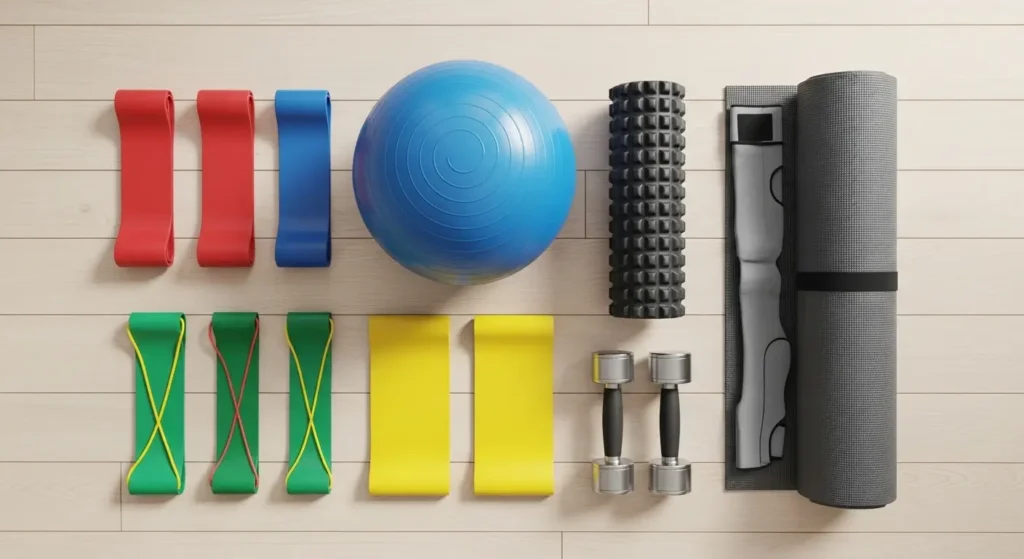
Physiotherapy session fees represent your main expense, but other costs add up. Plan for these additional expenses:
Initial Medical Consultation
You need a doctor’s prescription before starting physiotherapy.
Doctor consultation costs:
- General practitioner: 150-250 DH
- Specialist (orthopedist, neurologist, sports medicine): 300-500 DH
- Hospital outpatient visit: 100-200 DH
What you get:
- Physical examination
- Diagnosis
- Prescription for physiotherapy
- Number of sessions recommended
- Any medication if needed
This one-time cost unlocks insurance coverage for all subsequent physiotherapy sessions.
Diagnostic Tests (If Needed)
Your doctor may order imaging or tests before prescribing physiotherapy:
Common diagnostic costs:
- X-rays: 150-400 DH
- MRI scan: 1,500-3,000 DH
- CT scan: 800-1,500 DH
- Ultrasound: 300-600 DH
- EMG/nerve studies: 800-1,200 DH
Insurance coverage: Most insurance plans cover 70-80% of diagnostic tests when medically necessary. Keep all receipts for reimbursement.
Not always required: Many conditions (simple back pain, sprains, strains) don’t need imaging. If your doctor orders expensive tests, ask if they’re truly necessary or could be done later if treatment doesn’t help.
Recommended Equipment
Your physiotherapist may recommend tools for home exercise:
Common equipment costs:
- Resistance bands set: 50-150 DH
- Exercise/therapy ball: 100-200 DH
- Foam roller: 150-300 DH
- Yoga mat: 100-250 DH
- Hand weights (pair): 150-400 DH
- Ankle/wrist weights: 100-200 DH
Support devices:
- Knee brace: 200-800 DH
- Ankle support: 150-400 DH
- Back support belt: 200-500 DH
- Wrist splint: 100-300 DH
- Compression sleeves: 150-350 DH
Where to buy:
- Medical supply stores (best quality, higher prices)
- Sports equipment stores (good balance)
- Online marketplaces (lowest prices, verify quality)
- Some clinics sell equipment (convenient but often more expensive)
Money-saving tip: Ask your physiotherapist which equipment is truly essential versus “nice to have.” Start with basics and add more only if needed.
Medications (If Prescribed)
Your doctor may prescribe medications alongside physiotherapy:
Common medication costs:
- Pain relievers (NSAIDs): 30-100 DH per month
- Muscle relaxants: 50-150 DH per month
- Anti-inflammatory gels/creams: 40-120 DH
- Hot/cold packs (reusable): 50-100 DH
Insurance coverage: Most plans cover 70-80% of prescription medication costs.
Total additional cost estimate:
For a typical physiotherapy treatment program:
- Doctor consultation: 200 DH
- Diagnostic tests (if needed): 0-2,000 DH
- Basic equipment: 200-400 DH
- Medications (2 months): 100-300 DH
- Total additional expenses: 500-2,900 DH
Budget an extra 500-1,000 DH beyond physiotherapy session costs for most treatment programs.
Frequently Asked Questions About Physiotherapy Prices in Morocco
How much does physiotherapy cost per session in Morocco?
Physiotherapy sessions in Morocco typically cost between 150 DH and 400 DH depending on your location, treatment type, and the physiotherapist’s experience. Casablanca has the highest rates (250-350 DH), while smaller cities like Fes and Meknes charge less (150-250 DH). Specialized treatments like sports physiotherapy cost more than general rehabilitation.
Does CNSS cover physiotherapy costs?
Yes, CNSS covers 70% of approved physiotherapy session costs. You need a valid medical prescription from a doctor, and you must submit proper documentation including invoices, treatment reports, and your CNSS membership card. Claims must be filed within 6 months of treatment, and processing typically takes 2-4 weeks.
Is home physiotherapy more expensive than clinic visits?
Yes, home physiotherapy typically costs 300-500 DH per session compared to 150-350 DH for clinic visits. The higher price covers the physiotherapist’s travel time, transportation costs, and scheduling flexibility. However, when you factor in your taxi costs (40-60 DH round trip) and time savings, the actual difference is often only 100-150 DH per session.
How many physiotherapy sessions will I need?
Most conditions require 6-12 sessions over 6-8 weeks. Acute injuries like sprains typically need 6-8 sessions, while chronic conditions may require 12-20+ sessions. Post-surgical rehabilitation usually needs 10-15 sessions. Your physiotherapist will provide a more specific estimate after the initial assessment based on your condition and progress.
Can I negotiate physiotherapy prices in Morocco?
While individual session prices are usually fixed, many clinics offer package discounts when you book multiple sessions upfront. Typical discounts range from 10-15% for 10-session packages. You can also negotiate payment plans for expensive treatment programs, with many clinics offering interest-free installments spread over your treatment duration.
Do I need a prescription for insurance to cover physiotherapy?
Yes, all insurance providers in Morocco (CNSS, CNOPS, Mutuelle, AMO) require a medical prescription from a licensed doctor for physiotherapy reimbursement. The prescription must specify your diagnosis, recommended treatment type, number of sessions, and frequency. Without this prescription, you’ll pay full costs with no insurance coverage.
What’s the difference between 150 DH and 400 DH physiotherapy sessions?
Price differences reflect therapist experience, treatment complexity, session duration, location, and clinic facilities. A 150 DH session might be 30 minutes of basic treatment in a smaller city, while 400 DH could buy 60 minutes with a highly specialized therapist in Casablanca using advanced equipment. Mid-range pricing (200-300 DH) usually offers the best value for most patients.
Are there free or low-cost physiotherapy options in Morocco?
Yes, public hospital physiotherapy departments and physiotherapy school training clinics offer significantly reduced rates (50-100 DH per session). University teaching hospitals provide supervised student treatments with faculty oversight. These options have longer waiting lists (1-3 weeks typical) but deliver quality evidence-based care at a fraction of private clinic costs.
How much does sports physiotherapy cost in Morocco?
Sports physiotherapy typically costs 250-400 DH per session, which is higher than general rehabilitation (200-300 DH). The premium pricing reflects specialized knowledge of athletic injuries, advanced manual therapy techniques, sport-specific rehabilitation protocols, and performance testing equipment. Athletes usually need 8-12 sessions depending on injury severity.
Do physiotherapy prices increase during Ramadan or summer?
Physiotherapy prices generally remain stable throughout the year in most cities. However, some clinics may have reduced hours during Ramadan, potentially affecting appointment availability. Tourist-oriented clinics in cities like Marrakech and Agadir may charge 10-15% more during peak season (November-March) due to higher demand, but local-focused clinics maintain consistent pricing.
What payment methods do physiotherapy clinics accept?
Most physiotherapy clinics accept cash payment, which remains the most common method. Larger clinics in major cities accept credit and debit cards, though some charge a small processing fee (2-3%). Some established clinics offer payment plans for long-term treatment, allowing you to split costs over multiple months with interest-free installments for qualified patients.
Is the first physiotherapy session more expensive?
Yes, initial assessment appointments typically cost 200-350 DH, which is often 50-100 DH more than regular treatment sessions. The first visit lasts 45-60 minutes and includes comprehensive medical history review, physical examination, movement testing, goal setting, and treatment plan development. Some clinics include the assessment in the first treatment session at no extra charge.
Can I use my Mutuelle for physiotherapy?
Yes, Mutuelle insurance covers physiotherapy with reimbursement rates typically ranging from 50-80% depending on your specific plan tier. Better plans may offer up to 100% coverage for certain conditions. Most Mutuelle plans have annual limits of 2,000-10,000 DH for physiotherapy services. Some plans require pre-authorization for treatment exceeding 10 sessions.
How much does pediatric physiotherapy cost?
Pediatric physiotherapy costs 250-350 DH per session on average, reflecting the specialized training required to treat children. Sessions often run longer to accommodate shorter attention spans and parent education time. Common conditions treated include developmental delays, cerebral palsy, sports injuries, and postural problems. Insurance coverage for children typically matches adult coverage rates.
Do I pay less if I buy a package of sessions?
Yes, most clinics offer 10-15% discounts when you purchase packages of 10 or more sessions upfront. For example, if individual sessions cost 250 DH, a 10-session package might cost 2,250 DH (225 DH per session) instead of 2,500 DH, saving you 250 DH. Monthly unlimited plans for chronic conditions typically cost 2,000-3,000 DH and offer even better value for frequent treatment.
Final Tips: Getting the Best Value for Your Physiotherapy Treatment
Finding quality physiotherapy at fair prices requires research and smart decision-making. Here’s how to maximize value while getting the care you need.
Understand the average costs: Expect to pay 150-400 DH per session depending on your city and treatment type. This knowledge prevents you from overpaying or choosing suspiciously cheap options that may deliver poor results.
Verify your insurance coverage first: Call your insurance company before starting treatment. Confirm coverage percentages, annual limits, required documentation, and whether your chosen clinic participates in direct billing. This single phone call can save you 70-80% of treatment costs.
Take advantage of package deals: If you know you’ll need multiple sessions (which most conditions require), ask about package discounts. Saving 10-15% on 10 sessions adds up to significant savings while committing you to completing your treatment program.
Don’t sacrifice quality for low prices: The cheapest option often costs more in the long run if it doesn’t solve your problem. Focus on finding experienced therapists who specialize in your condition rather than just hunting for the lowest price.
Start treatment early: Addressing injuries and pain promptly prevents small problems from becoming chronic conditions requiring extensive treatment. Eight sessions for acute back pain costs far less than 20+ sessions for chronic pain that developed from delayed treatment.
Follow your treatment plan: Skipping sessions, missing home exercises, or stopping treatment when you “feel better” wastes money and time. Complete your full treatment program to avoid recurring problems that require starting over.
Ask questions upfront: Clarify all costs, insurance coverage, session frequency, and treatment duration before committing. Understanding the total investment and payment options prevents surprise bills and financial stress.