
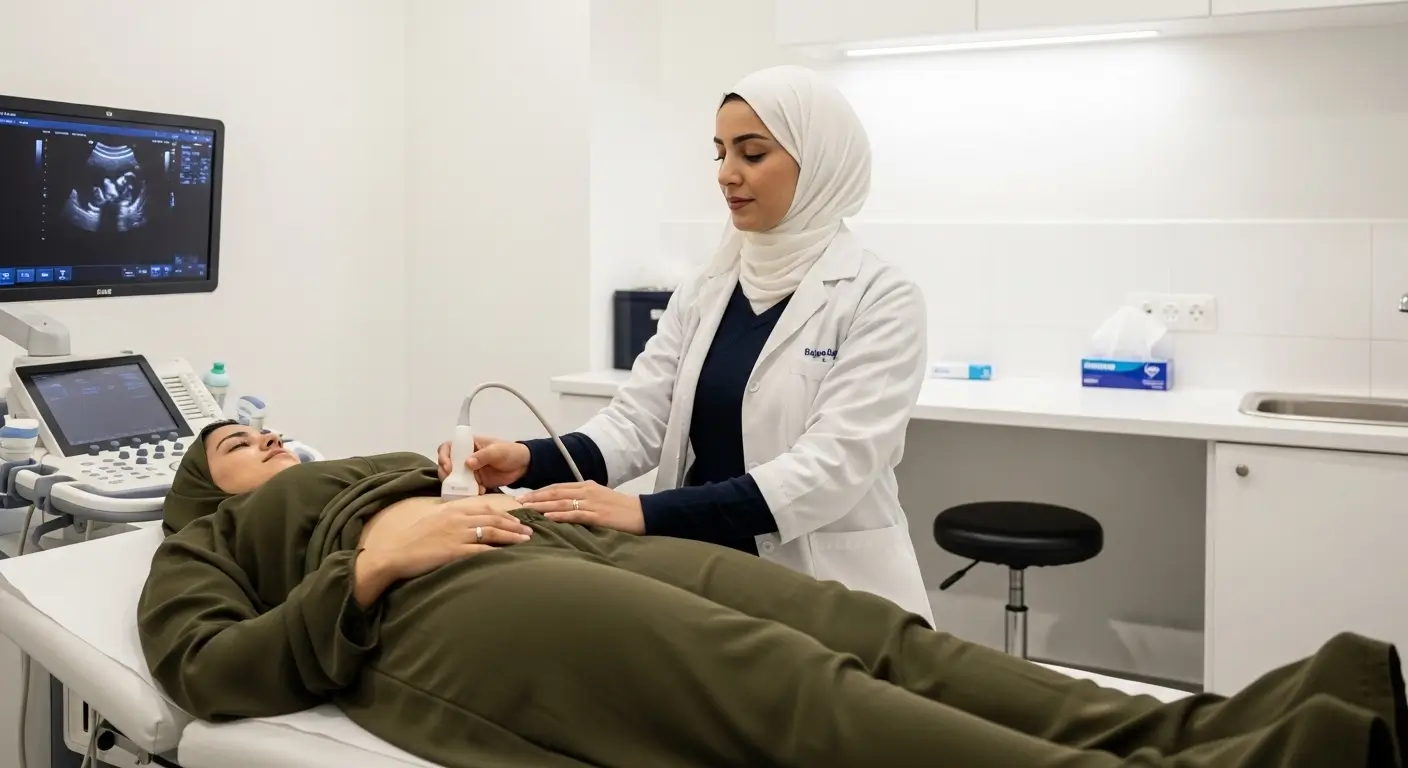
If your doctor just gave you a prescription for an ultrasound (échographie) and you’re wondering how much it will cost, you’re in the right place.
The honest answer: sonography price in Morocco depends on three things — the type of exam, whether you go public or private, and your insurance coverage. This guide breaks all of it down in plain language, with real numbers.
Table of Contents
1. Sonography Price Table by Exam Type
Ultrasound prices in Morocco vary depending on the body area being examined, the imaging technique used (2D, 3D, 4D, or Doppler), and the type of facility. The table below gives you a realistic price range for both public and private sectors, along with the approximate TNR reference rate used by insurers.
Important: Private centers are legally allowed to charge above the TNR rate. Always ask for a written quote (devis) before booking.
Sonography Price by Type — Morocco
| Exam Type | Public Sector (DH) | Private Sector (DH) | Approx. TNR (DH) |
|---|---|---|---|
| Abdominal ultrasound | 150 – 250 | 350 – 600 | ~250 |
| Pelvic / gynecological | 150 – 300 | 300 – 500 | ~230 |
| Obstetric — 1st trimester | 200 – 350 | 350 – 600 | ~280 |
| Morphological — 2nd trimester | 250 – 400 | 450 – 700 | ~350 |
| Growth scan — 3rd trimester | 200 – 350 | 350 – 550 | ~280 |
| 3D / 4D ultrasound | Not available | 800 – 1,500 | Not covered |
| Cardiac (echocardiography) | 300 – 500 | 600 – 1,200 | ~400 |
| Doppler vascular | 300 – 500 | 500 – 900 | ~380 |
| Thyroid / neck | 150 – 250 | 300 – 500 | ~220 |
| Musculoskeletal / tendon | 150 – 250 | 300 – 600 | ~220 |
Key takeaways from this table:
- Public sector sonography is 50–70% cheaper than private for the same exam
- The morphological scan is consistently the most expensive pregnancy ultrasound
- 3D/4D ultrasounds are only available in private centers and are typically not reimbursed by CNSS or CNOPS
- The TNR rate is always lower than private sector prices — this gap affects your reimbursement
2. CNSS & CNOPS Reimbursement — What You Actually Pay

This is the section most Moroccans skip and then regret later. Understanding how reimbursement works will save you money.
What Is the TNR?
The TNR (Tarification Nationale de Référence) is the official reference price set by ANAM (Agence Nationale de l’Assurance Maladie). It is:
- ✅ The basis on which all insurance reimbursements are calculated
- ❌ NOT the price charged by private radiology centers
- ❌ NOT a price cap — private centers can legally charge more
Private centers frequently charge 30% to 100% above the TNR. That gap — called the dépassement d’honoraires — is entirely your responsibility. Your insurer does not cover it.
CNSS Reimbursement Rates
| Situation | Reimbursement Rate |
|---|---|
| Outpatient (secteur libéral) | 70% of TNR |
| Private hospitalization | 90% of TNR |
| Public hospital | 100% of TNR |
| 3 mandatory pregnancy scans | 100% covered |
CNOPS Reimbursement Rates
| Situation | Reimbursement Rate |
|---|---|
| Outpatient (secteur libéral) | 80% of TNR |
| Public hospital | 100% of TNR |
CNOPS is slightly more favorable than CNSS for outpatient sonography.
Worked Example — What You Actually Pay
Here is a real-world calculation for a private pelvic ultrasound:
| Amount | |
|---|---|
| Private center charges | 600 DH |
| TNR reference rate | 230 DH |
| CNSS reimburses (70% of TNR) | 161 DH |
| You pay out of pocket | 439 DH |
If that same exam is done in a public hospital, the CNSS covers 100% of the TNR and the base price is already 150–250 DH — your actual cost is near zero.
The lesson: the more a private center charges above the TNR, the more you pay. Always ask: “Pratiquez-vous les tarifs TNR?”
RAMED Cardholders
If you hold a RAMED card (Régime d’Assistance Médicale):
- Ultrasounds in public hospitals are free or nearly free
- RAMED does not cover private radiology centers
- You will need a referral from a public health center in most cases
3. Public vs. Private — Which Should You Choose?
There is no single right answer. The best choice depends on your situation. Here is an honest comparison:
Side-by-Side Comparison
| Factor | Public Sector | Private Sector |
|---|---|---|
| Sonography price | 150 – 600 DH | 300 – 1,500 DH |
| Insurance reimbursement | 100% of TNR | 70–80% of TNR |
| Wait time | 1–4 weeks | 2–7 days |
| 3D / 4D imaging | ❌ Not available | ✅ Available |
| Same-day appointment | Rare | Common |
| Equipment quality | Good to excellent (major CHUs) | Varies by center |
| Comfort & amenities | Basic | Generally better |
| Report turnaround | 24–72 hours | Same day to 24 hours |
Which Option Fits Your Situation?
Choose public if:
- You are insured (CNSS or CNOPS) and want maximum reimbursement
- You are a RAMED cardholder
- You are not in a rush
- You are doing a standard pregnancy follow-up scan
Choose private if:
- You need an appointment within the week
- You want a 3D or 4D ultrasound
- You have complementary insurance that covers dépassements
- You prefer flexible scheduling and shorter waiting rooms
4. How to Get Reimbursed — Step-by-Step
Done your sonography? Here is exactly how to claim your reimbursement.
Documents You Need
Gather all of these before going to submit:
- Original prescription (ordonnance) — signed and stamped by your doctor, including their CIN number and seal
- Completed feuille de soins — medical expense form, signed by the doctor and the radiology center
- Original paid invoice from the radiology center — copies are NOT accepted
- Your insurance card — carte d’immatriculation CNSS or CNOPS
- RIB (bank account details) — if you want reimbursement by bank transfer
Common mistake: Submitting a photocopy of the invoice. The original is mandatory.
Submission Deadlines
| Insurer | Submission Deadline |
|---|---|
| CNSS | Within 2 months of the exam date |
| CNOPS | Within 6 months of the exam date |
| Insurer processing time | Maximum 60 days (per law 55-19) |
Do not wait. If you miss the CNSS deadline by even one day, your claim will be rejected.
Where to Submit
- In person at your nearest CNSS or CNOPS branch
- Online via the CNSS self-service portal at damancom.ma (for eligible subscribers)
- Via your employer — some companies handle submissions through HR or a mutuelle
Why Claims Get Rejected — Avoid These Errors
- ❌ Prescription is illegible or missing the doctor’s stamp
- ❌ Invoice is a copy, not the original
- ❌ Submitted past the deadline
- ❌ Exam type is not covered (e.g. cosmetic or non-medically prescribed 3D scan)
- ❌ Feuille de soins is incomplete or unsigned
5. How to Find a Conventionné Center
This is the most practical tip in this entire guide: always choose a CNSS or CNOPS conventionné center when possible.
What Does “Conventionné” Mean?
A conventionné center has signed a formal agreement with CNSS or CNOPS to practice at or near the TNR reference rate. This means:
- The gap between what they charge and the TNR is minimal
- Your out-of-pocket cost is significantly lower
- The reimbursement process is usually faster and smoother
Not all private radiology centers are conventionné. Confirm before booking.
How to Find a Conventionné Center
- CNSS online directory — visit cnss.ma and use the healthcare provider search tool
- Call your CNSS or CNOPS branch — ask for a list of conventionné radiology centers in your city
- Ask your prescribing doctor — most doctors know which local centers practice at TNR rates
- Call the center directly and ask: “Êtes-vous conventionné CNSS/CNOPS?”
City-Level Notes
| City | What to Know |
|---|---|
| Casablanca | Highest density of private centers; most competitive pricing; several conventionné options |
| Rabat | Strong public sector (CHU Ibn Sina); many conventionné private alternatives |
| Marrakech | Growing private sector; fewer conventionné options — confirm before booking |
| Fès / Meknès | Public CHUs are well-equipped; limited conventionné private centers |
| Agadir | Smaller market; always verify conventionné status by phone |
6. How to Prepare for Your Ultrasound
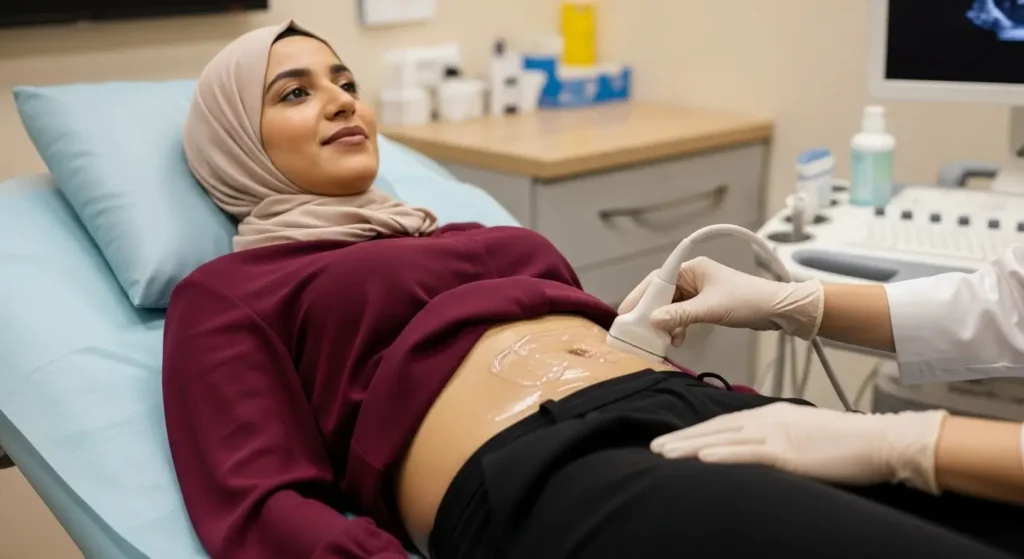
Preparing correctly ensures a clear image and avoids a wasted appointment. Instructions differ by exam type.
Abdominal Ultrasound
- Fast for 6–8 hours before the exam — water only
- Avoid dairy products and gas-producing foods (legumes, carbonated drinks) the day before
- Wear loose, easy-to-lift clothing
Pelvic / Bladder Ultrasound
- Full bladder required: drink 1 liter of water 1 hour before the appointment and do not urinate
- The standard approach is abdominal (external probe with gel)
- Transvaginal approach is sometimes used when abdominal resolution is poor — you must give consent
- If you prefer the abdominal approach only, inform the center when booking
Obstetric / Pregnancy Ultrasound
| Trimester | Preparation |
|---|---|
| 1st trimester | Full bladder recommended |
| 2nd trimester | No special preparation usually needed |
| 3rd trimester | No special preparation; come rested |
- Bring your previous scan reports and carnet de grossesse (maternity record)
- Wear two-piece clothing for easy abdominal access
Other Exam Types
| Exam | Preparation |
|---|---|
| Thyroid / neck | No preparation; wear an open-collar top |
| Cardiac echocardiography | Rest 10 min before; avoid caffeine 3 hours prior |
| Doppler vascular (legs) | Avoid tight clothing or compression garments on the day |
| Musculoskeletal | No specific preparation; expose the affected area easily |
What to Bring to Every Appointment
- ✅ Original prescription (ordonnance) — required without exception at most centers
- ✅ National ID card (CIN)
- ✅ Insurance card (CNSS / CNOPS)
- ✅ Previous imaging reports (if you have them)
- ✅ Comfortable, accessible clothing
No prescription = no exam at most Moroccan radiology centers. Even self-paying patients are asked for an ordonnance. Confirm when booking.
7. Frequently Asked Questions
Cost & Insurance Questions
Is the 3D/4D ultrasound reimbursed by CNSS?
Not automatically. Standard 3D/4D scans done for personal preference (keepsake imaging) are typically not covered. However, if the 3D scan is medically prescribed for a clinical reason (e.g. fetal anomaly evaluation), some mutuelle plans may partially reimburse it. Check with your insurer before the appointment.
I have no insurance — where can I get a cheap sonography in Morocco?
Your best option is the radiology department at your nearest public hospital (CHU, CHR, or CHIS). With a referral from a public health center, the cost is minimal or free. Bring your CIN and, if applicable, your RAMED card.
Can I negotiate the sonography price at a private center?
Yes, particularly if you are having multiple exams in the same session. Some centers offer a package rate. It is always worth asking politely — the worst answer is no.
Does sonography price vary between cities in Morocco?
Yes. Casablanca and Rabat private centers tend to charge the most. Smaller cities like Oujda, Beni Mellal, or Safi often have lower private-sector rates. Public sector pricing is largely standardized nationwide.
Cultural & Personal Questions
Can a single (unmarried) woman have a pelvic ultrasound in Morocco?
Yes. The standard pelvic ultrasound uses the abdominal (external) approach — a probe is pressed gently on your lower abdomen with gel. There is no internal examination involved in the standard procedure.
Will a transvaginal probe be used on a virgin patient?
No. A professional radiologist will only perform the abdominal approach if a patient is a virgin or if a transvaginal exam is declined. You have the right to decline and request the abdominal method only.
Can the exam be done during menstruation?
Yes, for most ultrasound types. Abdominal, obstetric, thyroid, and Doppler exams can be performed without issue. For certain gynecological Doppler assessments, the center may prefer to reschedule — confirm by phone when booking.
Can I request a female radiologist or technician?
Yes. This is your right as a patient. Make the request clearly when calling to book your appointment. Most private centers and public hospitals can accommodate this with sufficient notice.
Will I receive my results on the same day?
Usually yes for standard exams. The radiologist typically produces a written report on the same day. Complex or detailed morphological scans may take 24–48 hours. Ask the center at the time of booking.
Process & Logistics Questions
Can I book a sonography without a prescription in Morocco? Some private centers accept walk-in patients without an ordonnance, especially for pregnancy scans. However, your insurance will not reimburse the exam without a valid prescription. If reimbursement matters to you, get the prescription first.
How long does a sonography take?
- Standard abdominal or pelvic: 15–25 minutes
- Obstetric (standard): 20–30 minutes
- Morphological scan (2nd trimester): 45–60 minutes
- Cardiac echo or Doppler: 30–45 minutes
Will the ultrasound be painful? No. Sonography is a painless, non-invasive procedure. A water-based gel is applied to your skin and a smooth probe is pressed lightly against the surface. There is no radiation involved — it uses sound waves only.
Is ultrasound safe during pregnancy? Yes. Obstetric ultrasound has a decades-long safety record. It uses sound waves, not X-rays or radiation, and is widely recommended for monitoring fetal development. The World Health Organization recommends at least one ultrasound during pregnancy.
Summary — Key Points to Remember
Here is everything you need in one place:
| Topic | Key Point |
|---|---|
| Sonography price range | 150–600 DH public / 300–1,500 DH private |
| Best value option | Public hospital with CNSS/CNOPS = near-zero cost |
| CNSS reimbursement | 70% of TNR (outpatient) |
| CNOPS reimbursement | 80% of TNR (outpatient) |
| Top money-saving tip | Choose a conventionné center practicing at TNR rates |
| Prescription required | Yes — in almost all cases |
| Reimbursement deadline | 2 months (CNSS) / 6 months (CNOPS) |
| Documents needed | Ordonnance + invoice (original) + feuille de soins + insurance card |