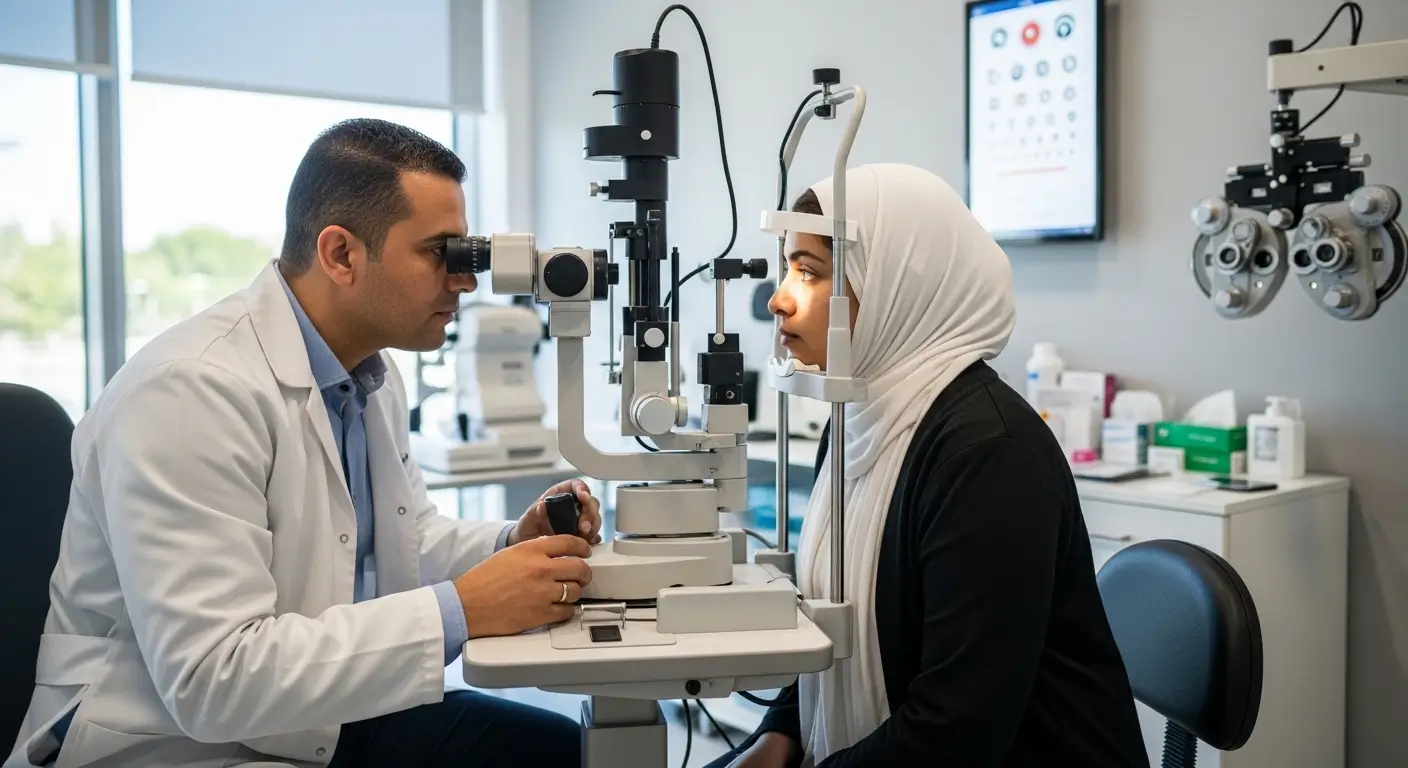
Finding affordable eye care in Morocco shouldn’t feel like guessing in the dark. Whether you’re experiencing blurred vision, need a routine checkup, or considering laser surgery, one question keeps coming up: how much will an ophthalmologist actually cost?
Eye health is essential, but many Moroccans delay visiting an ophthalmologist because they’re worried about expensive consultation fees, hidden costs, or surprise bills. The good news? Understanding ophthalmologist prices in Morocco is simpler than you think, and there are options for every budget—from public hospitals to private clinics.
This guide breaks down exactly what you’ll pay for eye care across Morocco, covers insurance options, reveals hidden costs to watch for, and shows you how to find quality ophthalmologists without overpaying. Let’s get straight to what matters.
Table of Contents
How Much Does an Ophthalmologist Consultation Cost in Morocco?

The first question on everyone’s mind: what’s the actual price tag for seeing an eye specialist? The answer depends on where you go and which city you’re in.
Average Consultation Prices by City
Major Cities (Casablanca, Rabat, Marrakech)
In Morocco’s largest urban centers, ophthalmologist consultation fees typically range from 250 to 500 MAD. Here’s what influences the price:
- Clinic reputation and location – Specialists in upscale neighborhoods like Maarif in Casablanca or Agdal in Rabat charge premium rates
- Doctor’s qualifications – Ophthalmologists with international training or subspecialties (retina specialists, pediatric ophthalmologists) command higher fees
- Facility quality – Modern clinics with advanced diagnostic equipment cost more than basic consultation rooms
Secondary Cities (Tangier, Fes, Agadir, Meknes)
Expect to pay between 200 and 400 MAD in these cities. The prices are slightly lower due to:
- Lower overhead costs
- Less competitive market
- Mix of general and specialized ophthalmologists
Smaller Cities and Rural Areas
In places like Oujda, Kenitra, Tetouan, and Nador, consultation fees drop to 150-300 MAD. However, you’ll face challenges:
- Fewer specialists available
- Longer wait times for appointments
- Limited access to advanced diagnostic tools
- May need to travel to larger cities for complex procedures
Pro tip: If you live in a smaller city and need specialized care (like retinal surgery), factor in transportation costs when comparing local versus big-city options. Sometimes the extra 100-150 MAD for a consultation in Casablanca includes better equipment that prevents a second trip.
What’s Included in a Basic Consultation?
Before you book, understand what your consultation fee covers:
Typically included:
- Initial patient interview and medical history review
- Visual acuity testing (reading the eye chart)
- Basic eye examination with ophthalmoscope
- Preliminary diagnosis
- Prescription for corrective lenses if needed
- Brief treatment recommendations
Usually costs extra:
- Specialized diagnostic tests (OCT scans, visual field tests)
- Contact lens fitting
- Detailed retinal imaging
- Surgical consultations
- Emergency procedures
Always ask upfront: “What does the consultation fee include?” This simple question prevents surprise charges.
First Visit vs. Follow-Up Appointments
Here’s a money-saving insight many Moroccans miss:
- Initial consultation: Full price (200-500 MAD depending on location)
- Follow-up visits: Often 30-50% less, typically 100-250 MAD
- Package deals: Some clinics offer pre-surgery consultation bundles
If you’re managing a chronic condition like glaucoma or diabetic retinopathy, ask about discounted follow-up rates or annual monitoring packages. Over time, these savings add up significantly.
Ophthalmologist Prices for Common Procedures in Morocco
Beyond basic consultations, here’s what you’ll actually pay for the most common eye care services Moroccans need.
Routine Eye Exams and Screenings
| Exam Type | Price Range | When You Need It |
|---|---|---|
| Comprehensive eye exam | 200-400 MAD | Annual checkup, vision changes |
| Children’s eye exam | 180-350 MAD | Ages 3-6, school entry, reading difficulties |
| Diabetic eye screening | 250-450 MAD | Every 6-12 months for diabetics |
| Glaucoma screening | 300-500 MAD | Age 40+, family history |
| Dry eye evaluation | 200-400 MAD | Persistent irritation, computer work |
Reality check: If you have diabetes, budgeting 500-900 MAD annually for eye screenings is essential. Early detection prevents thousands in treatment costs later.
Vision Correction Procedures
Eyeglass Prescription
- Usually included in your consultation fee
- The prescription document is free
- Actual glasses purchased separately (150-1,500 MAD depending on frames and lens type)
Contact Lens Fitting
- Additional 150-300 MAD beyond basic consultation
- Includes trial lenses and fitting instruction
- Follow-up fitting adjustments typically free
LASIK Surgery (per eye)
- Price range: 8,000-15,000 MAD
- Factors affecting cost:
- Surgeon’s experience
- Technology used (blade-free vs. traditional)
- Clinic location
- Post-operative care package
- Not covered by most insurance plans
PRK Surgery (per eye)
- Price range: 7,000-12,000 MAD
- Slightly cheaper than LASIK
- Longer recovery time
- Better for thin corneas
Important: Many clinics offer both eyes together at a discounted package rate (15,000-25,000 MAD total). Always ask about package pricing.
Cataract Surgery Costs
Cataract surgery is one of the most common procedures Moroccans need as they age.
Standard Cataract Surgery:
- Private clinics: 8,000-15,000 MAD per eye
- Public hospitals: 2,000-5,000 MAD per eye
- Includes basic intraocular lens (IOL)
- Day surgery with local anesthesia
Premium Lens Options:
- 15,000-25,000 MAD per eye
- Advanced IOLs that correct astigmatism or presbyopia
- Reduces need for glasses after surgery
- Insurance rarely covers the premium upgrade
What’s typically covered:
- CNSS and CNOPS usually cover 70-90% of standard cataract surgery
- You’ll pay 1,000-5,000 MAD out of pocket at private clinics
- Public hospitals are heavily subsidized if you qualify
Treatment Procedures
Glaucoma Treatment:
- Medication (eye drops): 150-600 MAD monthly
- Laser trabeculoplasty: 2,000-5,000 MAD per eye
- Surgical intervention: 8,000-15,000 MAD
Retinal Laser Treatment:
- Diabetic retinopathy laser: 3,000-8,000 MAD
- Retinal tear repair: 4,000-10,000 MAD
- Multiple sessions may be needed
Dry Eye Treatment:
- Punctal plugs: 500-1,500 MAD
- Intense pulsed light (IPL): 1,000-3,000 MAD per session
- Prescription medications: 200-800 MAD
Eye Infection Treatment:
- Simple conjunctivitis: 150-300 MAD (consultation + drops)
- Corneal ulcer: 400-1,200 MAD (includes antibiotics)
- Severe infections requiring hospitalization: 3,000+ MAD
Diagnostic Testing Costs
Modern ophthalmology relies on specialized equipment. Here’s what these tests cost outside of a basic consultation:
- OCT scan (Optical Coherence Tomography): 300-600 MAD
- Essential for: Macular degeneration, glaucoma monitoring, diabetic retinopathy
- Visual field test: 200-400 MAD
- Essential for: Glaucoma diagnosis and monitoring
- Corneal topography: 250-500 MAD
- Essential for: LASIK pre-screening, keratoconus diagnosis
- Fundus photography: 200-450 MAD
- Essential for: Documenting retinal conditions, diabetic screening
Money-saving insight: If your ophthalmologist orders multiple tests, ask which ones are absolutely necessary for your specific condition. Some tests are “nice to have” while others are critical.
Public vs Private Ophthalmology: Price Comparison
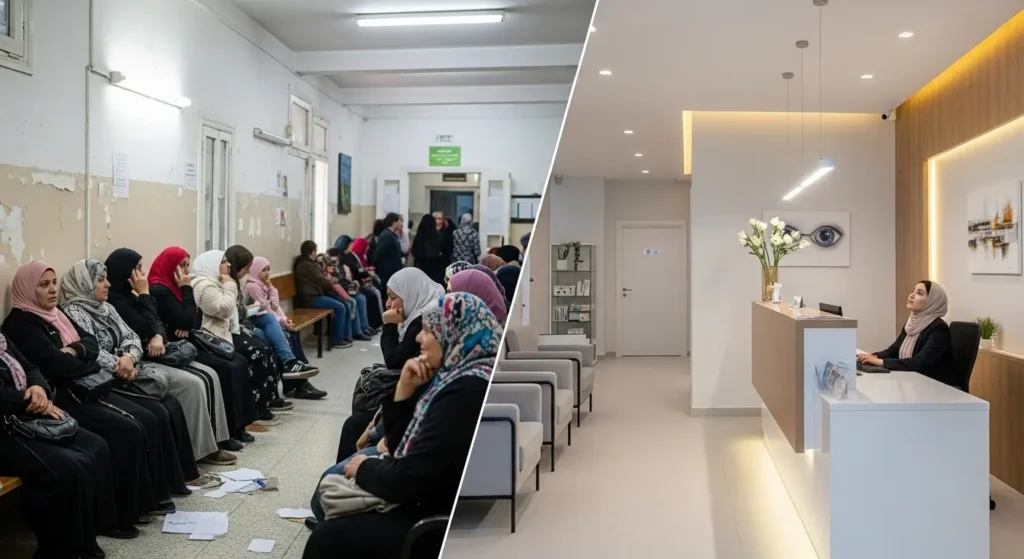
This decision dramatically affects what you’ll pay. Let’s break down the real differences.
Public Hospital Costs
Consultation fees: 20-100 MAD
Morocco’s public hospitals offer the most affordable eye care:
Pros:
- Extremely affordable consultations
- Surgery costs heavily subsidized (2,000-5,000 MAD vs. 10,000-20,000 MAD private)
- Free for RAMED cardholders
- Qualified specialists, especially at university hospitals (CHU)
- Modern equipment at major facilities
Cons:
- Wait times can be 2-8 weeks for appointments
- Rushed consultations (high patient volume)
- Limited appointment flexibility
- Sometimes outdated facilities in smaller cities
- Longer surgical wait lists (3-6 months for non-urgent procedures)
Best for:
- Budget-conscious patients who can wait
- RAMED beneficiaries
- Surgical procedures (huge cost savings)
- Patients with chronic conditions needing regular monitoring
Private Clinic Costs
Consultation fees: 200-500 MAD
Pros:
- Same-day or next-day appointments
- Comfortable waiting areas
- More consultation time with doctor
- Latest diagnostic equipment
- Quick surgical scheduling
- English-speaking staff at some clinics
Cons:
- 3-5x higher costs across the board
- Out-of-pocket expenses even with insurance
- Some clinics over-prescribe tests
- Premium pricing doesn’t always mean better care
Best for:
- Urgent eye problems
- Patients who value convenience and comfort
- Those with good private insurance coverage
- Complex cases requiring latest technology
University Hospitals (CHU)
The middle ground that many Moroccans overlook:
Consultation fees: 100-250 MAD
Available in: Casablanca (Ibn Rochd), Rabat, Fes, Marrakech, Oujda
Why they’re worth considering:
- Teaching hospitals with experienced faculty
- Access to latest techniques and research
- More affordable than private clinics
- Better availability than regular public hospitals
- Students supervised by senior specialists means thorough examinations
The tradeoff:
- Longer consultation times (teaching component)
- May see residents before the attending specialist
- Wait times better than public hospitals, not as fast as private
Smart strategy: Use CHU for initial diagnosis and complex procedures, then follow up at smaller public clinics for routine monitoring.
Which Option Is Right for Your Budget?
Choose public hospitals when:
- You need surgery and want to save 5,000-15,000 MAD
- You have RAMED coverage
- Your condition isn’t urgent
- You’re managing chronic conditions (yearly cost savings: 2,000-5,000 MAD)
Choose private clinics when:
- You have urgent symptoms (sudden vision loss, severe pain, trauma)
- You need quick surgical scheduling (private surgeries happen within 1-2 weeks)
- Your insurance covers 70%+ of private care
- Time and convenience are priorities
Choose CHU when:
- You want quality care at moderate prices
- You have a complex or rare condition
- You’re seeking a second opinion
- You want teaching hospital expertise without full private pricing
Does Insurance Cover Ophthalmologist Visits in Morocco?
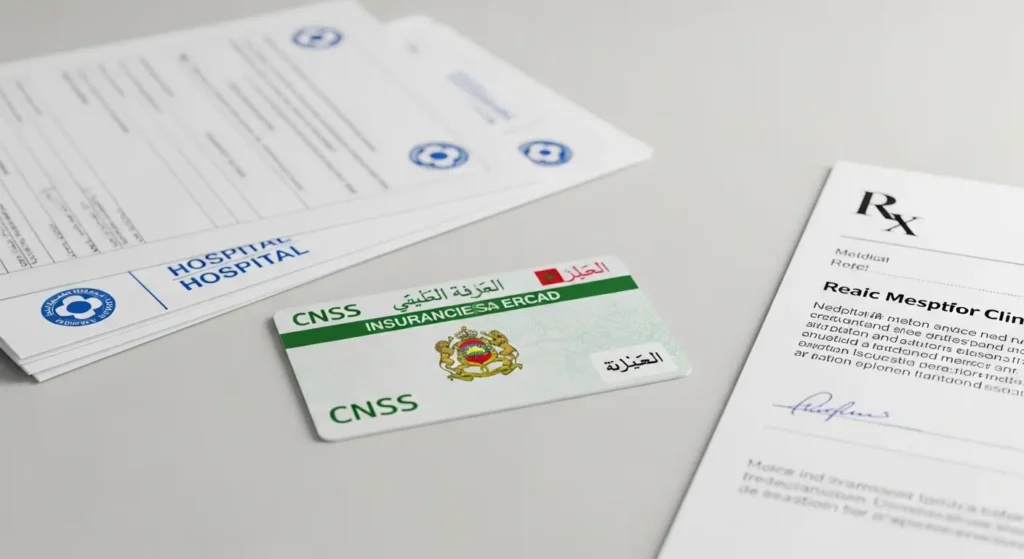
Understanding your insurance benefits can save you thousands of dirhams. Here’s the complete breakdown.
CNSS Coverage for Eye Care
The Caisse Nationale de Sécurité Sociale covers private sector employees.
What’s covered:
- Consultations: 70% reimbursement
- Surgery (cataracts, glaucoma): 70-80% reimbursement
- Diagnostic tests: 60-70% reimbursement
- Prescription medications: 70% reimbursement
What’s NOT covered:
- LASIK and cosmetic procedures
- Premium lens upgrades
- Non-prescription glasses and contacts
Your out-of-pocket cost examples:
- 400 MAD consultation → You pay 120 MAD
- 12,000 MAD cataract surgery → You pay 2,400-3,600 MAD
- 400 MAD OCT scan → You pay 120-160 MAD
Required documentation:
- Doctor’s prescription (ordonnance)
- Original invoices (factures)
- CNSS card
- Submit claims within 6 months
Processing time: 2-4 weeks for reimbursement
CNOPS Coverage
The Caisse Nationale des Organismes de Prévoyance Sociale covers public sector employees and often provides better benefits.
Coverage levels:
- Consultations: 80% reimbursement
- Major surgery: 80-90% reimbursement
- Diagnostic tests: 70-80% reimbursement
- Medications: 80% reimbursement
Additional benefits:
- Often covers family members
- Higher reimbursement ceilings
- Faster processing than CNSS
Your out-of-pocket cost examples:
- 400 MAD consultation → You pay 80 MAD
- 12,000 MAD cataract surgery → You pay 1,200-2,400 MAD
Private Insurance (Mutuelles) Coverage
Private supplemental insurance varies widely by provider and plan level.
Basic plans (200-400 MAD/month):
- Cover the gaps CNSS/CNOPS leave
- Consultation reimbursement: 80-90%
- Surgery: 80-85%
Premium plans (500-1,000+ MAD/month):
- Near-complete coverage for consultations
- Surgery: 90-100% coverage
- May include international coverage
- Some cover LASIK partially
What’s rarely covered even with premium plans:
- Purely cosmetic procedures
- Experimental treatments
- Premium lens upgrades beyond medical necessity
Pro tip: If you’re considering LASIK (15,000-25,000 MAD), check if your employer offers flexible health spending accounts that can offset costs.
RAMED for Low-Income Families
The Régime d’Assistance Médicale provides free healthcare for qualifying low-income Moroccans.
Eligibility:
- Monthly household income below poverty threshold
- Moroccan citizenship
- Registration through local authorities
What’s covered:
- All consultations at public hospitals: FREE
- All surgeries: FREE
- Medications on essential drug list: FREE
- Diagnostic tests: FREE
How to access ophthalmology:
- Visit your local public hospital with RAMED card
- Register at ophthalmology department
- Wait for appointment (typically 2-6 weeks)
- All services provided at no cost
Important limitation: RAMED only works at public facilities. Private clinics don’t accept it.
Out-of-Pocket Costs After Insurance
Let’s be realistic about what you’ll actually pay:
With CNSS/CNOPS at private clinic:
- Routine consultation: 80-150 MAD
- Cataract surgery: 1,500-4,000 MAD
- LASIK: Full cost (no coverage)
- Annual eye care budget with chronic condition: 1,000-3,000 MAD
With private insurance (good plan):
- Routine consultation: 40-80 MAD
- Cataract surgery: 500-2,000 MAD
- Annual eye care budget: 500-1,500 MAD
With RAMED at public hospital:
- Everything: FREE
- Only cost: transportation to hospital
Hidden Costs: What Else Will You Pay?
Beyond the consultation fee, be prepared for these additional expenses that catch many Moroccans by surprise.
Additional Diagnostic Tests
Your ophthalmologist may order specialized tests not included in the basic consultation:
When extra tests are necessary:
- You have diabetes (need OCT and fundus photography: 400-800 MAD)
- Suspected glaucoma (need visual field test: 200-400 MAD)
- Considering LASIK (need corneal topography: 250-500 MAD)
- Floaters or flashes (need detailed retinal exam: 300-600 MAD)
How to know if a test is essential:
Ask your doctor these questions:
- “What will this test show that you can’t determine from the basic exam?”
- “Will the results change my treatment plan?”
- “Can we start treatment and do this test only if I don’t improve?”
Sometimes tests are precautionary. If budget is tight, prioritize the tests that directly impact your treatment decisions.
Medications and Eye Drops
Prescription costs vary dramatically:
Common eye drop prices:
- Antibiotic drops (conjunctivitis): 30-80 MAD
- Glaucoma drops (monthly): 150-600 MAD
- Artificial tears (dry eyes): 50-200 MAD
- Anti-inflammatory drops: 80-250 MAD
Generic vs. brand-name:
- Generic versions cost 40-60% less
- Same active ingredients, equal effectiveness
- Always ask your pharmacist: “Do you have a generic version?”
What insurance covers:
- CNSS/CNOPS: 70-80% of prescription medications
- You’ll typically pay 20-100 MAD out of pocket for most eye drops
Budget reality: Chronic conditions like glaucoma can cost 200-400 MAD monthly for medications even after insurance.
Follow-Up Visits
Many eye conditions require ongoing monitoring:
Post-surgery checkups:
- Week 1: Usually included in surgery package
- Month 1: May be included or cost 100-200 MAD
- Month 3-6: Typically 100-250 MAD each
Monitoring chronic conditions:
- Glaucoma: Every 3-6 months (400-800 MAD yearly)
- Diabetic retinopathy: Every 6-12 months (500-1,000 MAD yearly)
- After LASIK: 3-4 visits first year (300-800 MAD total)
Money-saving strategy: Some ophthalmologists bundle follow-up visits into the surgical price. Always ask: “Are post-operative visits included in the surgery cost?”
Surgical Facility Fees
If you need surgery, the consultation and surgeon’s fee are just part of the total:
What a “12,000 MAD cataract surgery” actually includes:
- Surgeon’s fee: 40-50% (4,800-6,000 MAD)
- Facility and operating room: 30-40% (3,600-4,800 MAD)
- Anesthesia: 10-15% (1,200-1,800 MAD)
- Implanted lens: 10-15% (1,200-1,800 MAD)
- Post-operative care: 5-10% (600-1,200 MAD)
At public hospitals: The total package is subsidized to 2,000-5,000 MAD because facility costs are government-funded.
Glasses and Contact Lenses
These are never included in ophthalmologist consultations:
Eyeglasses (complete with frames):
- Basic: 150-400 MAD
- Mid-range: 400-1,000 MAD
- Premium brands: 1,000-3,000 MAD
Contact lenses:
- Monthly disposable (annual cost): 600-1,200 MAD
- Daily disposable (annual cost): 1,200-2,400 MAD
- Specialized lenses: 1,500-4,000 MAD annually
Where to buy affordably:
- Local optical shops (souk): 150-500 MAD complete glasses
- Chain stores (Optical Center, Attik): 400-1,200 MAD
- Ophthalmologist’s office: Usually most expensive option
Insurance reimbursement:
- CNSS/CNOPS: Usually 200-400 MAD toward glasses every 2 years
- Private insurance: Some plans cover 50% up to certain limits
What Determines Ophthalmologist Prices in Morocco?
Understanding these factors helps you make informed decisions about where to spend your money.
Doctor’s Experience and Reputation
Not all ophthalmologists charge the same, and here’s why:
General ophthalmologist:
- 5-10 years experience: 200-300 MAD consultations
- Basic eye care and common conditions
- Can handle 80% of routine eye problems
Specialist ophthalmologist:
- 10-20 years experience: 300-400 MAD consultations
- Subspecialty training (retina, cornea, pediatric)
- Handles complex cases
Renowned specialists:
- 20+ years experience: 400-500+ MAD consultations
- International training or fellowships
- Published research, teaching positions
- Treating complex or rare conditions
Is paying more worth it?
- For routine exams and glasses prescriptions: NO
- For complex surgery or rare conditions: YES
- For second opinions on surgery: Often YES
Location and Facility
Where the clinic is located dramatically affects pricing:
Premium locations (high overhead):
- Anfa, Maarif (Casablanca): +30-50% price premium
- Agdal, Hassan (Rabat): +25-40% price premium
- Guéliz (Marrakech): +20-35% price premium
Standard locations:
- Average neighborhood clinics: Base pricing
- Hospital-adjacent areas: Slightly lower
Rural areas:
- Limited specialists: 30-40% cheaper but fewer options
Facility factors:
- New, modern clinic: Higher rent = higher fees
- Older established practice: Lower overhead = lower fees
- Hospital-based practice: Often mid-range pricing
Smart strategy: If you need a simple consultation or prescription update, consider ophthalmologists in less trendy neighborhoods. Same qualifications, lower prices.
Equipment and Technology
Advanced diagnostic and surgical equipment costs millions of dirhams, and clinics pass those costs to patients:
Clinics with latest technology:
- Femtosecond laser for bladeless LASIK
- High-resolution OCT machines
- Advanced surgical microscopes
- Premium price: +20-40%
Standard equipment clinics:
- Traditional diagnostic tools
- Proven surgical techniques
- Adequate for most conditions
- Base price
When advanced equipment matters:
- Complex retinal surgery: YES
- Bladeless LASIK: Marginal improvement, significant cost
- Routine cataract surgery: Standard equipment is excellent
- Basic eye exams: Equipment differences minimal
Reality check: A 350 MAD consultation with advanced imaging may prevent complications worth thousands in treatment. Sometimes the premium is worth it.
Complexity of Your Condition
Straightforward problems cost less to diagnose and treat:
Simple conditions (lower cost):
- Nearsightedness, farsightedness
- Minor infections
- Dry eyes
- Simple cataracts
Complex conditions (higher cost):
- Diabetic retinopathy requiring laser
- Advanced glaucoma
- Retinal detachment
- Corneal diseases requiring specialized treatment
Multiple visits factor:
- Simple prescription update: 1 visit (200-400 MAD total)
- Managing glaucoma: 3-4 visits yearly (1,000-2,000 MAD)
- Pre- and post-surgical care: 4-6 visits (1,500-3,000 MAD)
How to Find Affordable Ophthalmologists in Morocco
Quality eye care doesn’t always require premium prices. Here’s how to find excellent care within your budget.
Public Hospital Eye Departments
Morocco’s public hospitals provide surprisingly good ophthalmology services:
How to book appointments:
- Visit the hospital’s ophthalmology department in person (most don’t take phone bookings)
- Bring your CIN (national ID card)
- Bring insurance documentation if applicable
- Register at the reception desk
- Receive appointment date (typically 2-6 weeks out)
For urgent issues:
- Go directly to the emergency department
- Same-day evaluation for acute problems
- Triage system prioritizes serious conditions
Expected wait times:
- Non-urgent appointments: 2-8 weeks
- Post-operative follow-ups: 1-2 weeks
- Emergency consultations: 2-6 hours
Cities with best public facilities:
- Casablanca: CHU Ibn Rochd (excellent retina and glaucoma departments)
- Rabat: Hôpital des Spécialités (comprehensive eye care)
- Fes: CHU Hassan II (strong surgical program)
- Marrakech: CHU Mohammed VI (modern equipment)
- Tangier: Hôpital Mohammed V (growing ophthalmology department)
Cost savings example:
- Private cataract surgery: 12,000 MAD
- Public hospital cataract surgery: 3,000 MAD
- You save: 9,000 MAD
University Hospital Clinics (CHU)
Teaching hospitals offer the sweet spot between cost and quality:
Why CHU ophthalmology departments excel:
- Faculty are experienced specialists
- Access to research and latest techniques
- Thorough examinations (teaching component means detailed evaluations)
- Modern equipment at major facilities
- Residents provide extra attention to detail
Major CHU locations:
Casablanca – CHU Ibn Rochd
- Largest ophthalmology department in Morocco
- Subspecialists for every eye condition
- Consultation: 150-250 MAD
- Surgery: 2,500-6,000 MAD
Rabat – CHU Ibn Sina
- Strong glaucoma and pediatric ophthalmology programs
- Well-equipped surgical suites
- Consultation: 100-200 MAD
Marrakech – CHU Mohammed VI
- Growing reputation
- Modern facility
- Consultation: 100-200 MAD
Fes – CHU Hassan II
- Established ophthalmology program
- Good surgical outcomes
- Consultation: 100-200 MAD
The teaching hospital experience:
- Expect 45-60 minute appointments (vs. 15-20 minutes private)
- May see a resident first, then attending physician
- More detailed explanation of your condition
- Lower pressure to do unnecessary tests
NGO Programs and Free Screening Campaigns
Several organizations provide subsidized or free eye care:
Regular screening programs:
- Lions Club Morocco: Periodic free cataract surgery camps in underserved areas
- Opération Lumière: Free screenings and surgeries for low-income patients
- Rotary Club initiatives: Eye health campaigns in rural regions
- Ministry of Health programs: School vision screening, diabetes eye screening events
How to find upcoming campaigns:
- Check with your local health center (Centre de Santé)
- Visit provincial health delegation websites
- Contact Lions or Rotary clubs in major cities
- Ask at public hospitals about scheduled screening days
Who qualifies:
- Income requirements vary by program
- Priority to RAMED cardholders
- Some programs target specific populations (children, elderly, diabetics)
What’s typically offered:
- Free eye exams
- Free or heavily subsidized glasses
- Free cataract surgery for qualifying patients
- Diabetic eye screening
Reality check: These programs have limited capacity. Getting on the list early (when campaigns are announced) is essential.
Negotiating Payment Plans
Many Moroccans don’t realize that ophthalmology clinics often offer payment flexibility:
Clinics that commonly offer installment options:
- Larger private ophthalmology centers (especially in Casablanca, Rabat)
- Clinics specializing in LASIK and cataract surgery
- Hospital-affiliated practices
Typical payment plan structure:
- 30-50% down payment
- Remaining balance over 3-6 months
- Little to no interest for short-term plans
- May require post-dated checks
What to ask before committing:
- “Do you offer payment plans for surgery?”
- “What’s the down payment requirement?”
- “Are there any additional fees for installment payments?”
- “Can I pay with post-dated checks?”
Procedures where payment plans are common:
- LASIK surgery (15,000-25,000 MAD)
- Cataract surgery (10,000-15,000 MAD)
- Retinal surgery (8,000-20,000 MAD)
Alternative financing:
- Some banks offer medical procedure loans
- Credit card payment (if accepted) gives you built-in payment flexibility
- Ask employer about health advance programs
Medical Tourism Within Morocco
Sometimes the best deal isn’t in your city:
When traveling to another city saves money:
Example scenario: You live in Essaouira and need cataract surgery.
Local option:
- Limited specialists
- Private clinic: 15,000 MAD
- No public hospital ophthalmology department
Casablanca option:
- CHU Ibn Rochd: 3,000 MAD surgery
- Transportation: 400 MAD (round trip bus or train)
- Accommodation for follow-up: 500-800 MAD
- Total: 3,900-4,200 MAD
- Savings: 10,800-11,100 MAD
Best cities for affordable quality care:
- Casablanca – Most specialists, most competition, CHU Ibn Rochd
- Rabat – Government-subsidized facilities, good CHU
- Fes – Lower cost of living, strong CHU program
- Oujda – Surprisingly affordable, less crowded than coastal cities
When travel makes sense:
- Surgery (savings offset travel costs easily)
- Complex diagnosis requiring subspecialist (unavailable locally)
- Second opinion on expensive procedure
When to stay local:
- Routine consultations
- Follow-up appointments
- Emergency situations
- Management of chronic conditions (too many trips)
Practical tips for medical travel:
- Book accommodation near the hospital (some hospitals have nearby budget hotels)
- Schedule multiple follow-ups on same trip if possible
- Bring complete medical records to avoid duplicate tests
- Consider traveling with family member for support
Ophthalmologist Price Guide by City
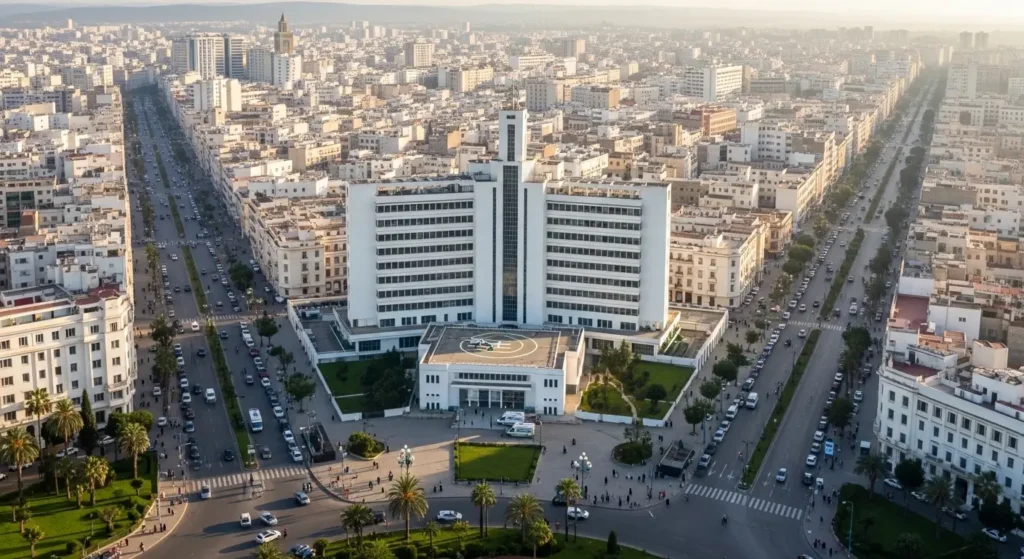
Let’s break down what you’ll actually pay in Morocco’s major cities.
Casablanca Ophthalmologist Prices
Morocco’s economic capital has the most ophthalmologists and the widest price range.
Consultation fees:
- Budget clinics (Hay Mohammadi, Derb Sultan): 200-300 MAD
- Mid-range (Maarif, Bourgogne): 300-400 MAD
- Premium (Anfa, California): 400-500 MAD
Where to find affordable care:
- CHU Ibn Rochd (Boulevard Lalla Meryem): 100-150 MAD consultations, 2,500-5,000 MAD surgeries
- Hôpital 20 Août (Hay Hassani): Public rates, good eye department
- Clinique des Yeux (various locations): Mid-range private option, 300-350 MAD
Casablanca advantages:
- Most subspecialists in Morocco
- Competitive pricing due to numerous practitioners
- Latest equipment available
- Easy to get second opinions
Casablanca disadvantages:
- Traffic makes appointments time-consuming
- Premium neighborhoods overpriced for routine care
- Can be overwhelming to choose among dozens of options
Smart strategy for Casablanca: Use CHU Ibn Rochd for major procedures, neighborhood clinics for routine care.
Rabat Ophthalmologist Costs
The capital offers government-affiliated hospitals and diplomatic community clinics.
Consultation fees:
- Public hospitals: 50-100 MAD
- CHU facilities: 100-200 MAD
- Private clinics (Agdal, Hassan): 300-450 MAD
- Standard neighborhoods: 250-350 MAD
Top affordable options:
- CHU Ibn Sina (Hay Riad): Excellent teaching hospital, 100-180 MAD
- Hôpital des Spécialités (Souissi): Public rates, strong ophthalmology
- Clinique Al Madina (centre ville): Mid-range private, 280-320 MAD
Rabat characteristics:
- Good balance of public and private options
- Less congested than Casablanca
- Government employee discounts at some facilities
- Strong CNOPS acceptance
Marrakech Eye Care Pricing
Tourist city with mix of local and expatriate-focused services.
Consultation fees:
- Medina area: 200-300 MAD
- Guéliz/Hivernage: 350-500 MAD (tourist pricing)
- New city neighborhoods: 250-350 MAD
Avoid tourist traps:
- Clinics advertising in multiple languages often charge 30-40% premium
- Ask locals for recommendations rather than hotel concierge
- “International clinic” doesn’t mean better care, just higher prices
Best value in Marrakech:
- CHU Mohammed VI (Route de l’Ourika): Modern facility, 120-200 MAD
- Local ophthalmologists in Massira or Daoudiate: 200-280 MAD
- Avoid Hivernage area unless you have generous insurance
Marrakech tip: If you’re a resident (not tourist), always mention it. Some clinics have two-tier pricing.
Tangier, Fes, and Agadir
- Consultation range: 200-400 MAD
- Growing private clinic market
- Hôpital Mohammed V: Public option, improving facilities
- Proximity to Spain means some ophthalmologists trained in Europe
Fes:
- Consultation range: 200-350 MAD
- CHU Hassan II: Excellent teaching hospital, 100-200 MAD
- Lower cost of living translates to lower medical fees
- Strong medical tradition, experienced practitioners
Agadir:
- Consultation range: 250-400 MAD
- Tourist areas (Marina, beach hotels): 350-500 MAD
- Local neighborhoods: More reasonable pricing
- Limited subspecialists (may need to travel for complex cases)
Smaller Cities (Oujda, Kenitra, Tetouan, Nador)
General pricing: 150-300 MAD consultations
Challenges:
- Fewer ophthalmologists (longer waits)
- Limited advanced diagnostic equipment
- May need referral to larger city for surgery
- Public hospitals primary option for affordable care
When to stay local:
- Routine eye exams
- Simple prescriptions
- Follow-up care after surgery elsewhere
When to travel:
- Retinal problems
- Complex cataracts
- LASIK (often unavailable)
- Pediatric ophthalmology subspecialty care
Money-saving approach for smaller city residents:
- Initial consultation locally (150-250 MAD)
- Get referral and medical records
- Travel to Casablanca/Rabat/Fes for surgery
- Follow-up care back home (saves 200-300 MAD per visit)
When Should You See an Ophthalmologist? (And Budget Accordingly)
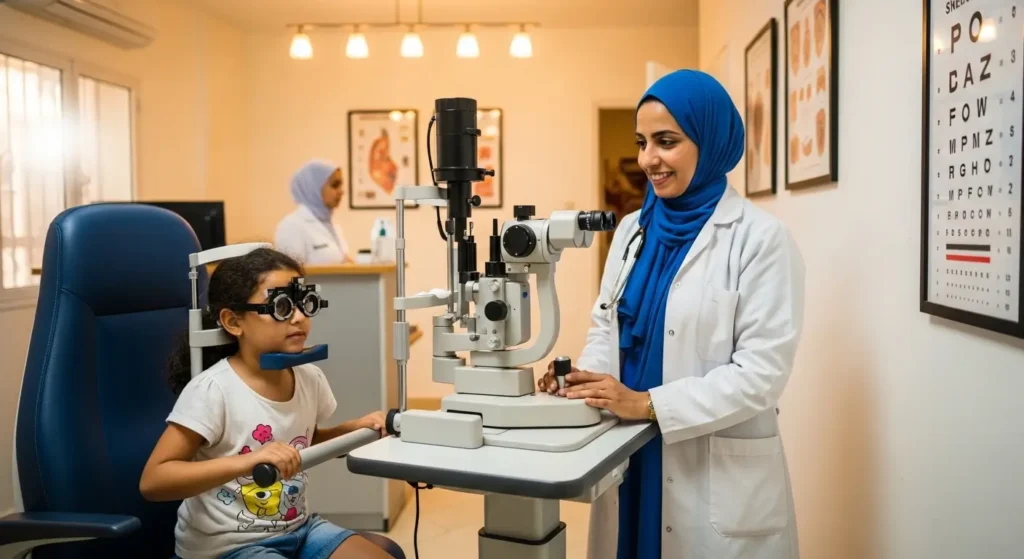
Knowing when eye care is necessary helps you budget appropriately throughout the year.
Routine Eye Exams
Recommended frequency:
- Ages 20-39: Every 2-3 years (if no vision problems)
- Ages 40-64: Every 1-2 years
- Ages 65+: Annually
- Children: Ages 6 months, 3 years, before school, then every 2 years
Expected annual costs:
- Young adults: 200-400 MAD every 2-3 years = 70-200 MAD yearly average
- Middle age: 200-400 MAD every 1-2 years = 200-400 MAD yearly
- Seniors: 250-450 MAD annually (may need additional tests)
- Children: 180-350 MAD every 2 years = 90-175 MAD yearly average
Why routine exams save money:
- Early glaucoma detection prevents blindness (treatment: 200 MAD/month vs. 0 MAD/month)
- Catching cataracts before hypermature stage makes surgery easier and cheaper
- Diabetic retinopathy caught early: simple laser treatment (3,000 MAD) vs. complex vitrectomy (20,000+ MAD)
Prevention is cheaper: Spending 300 MAD annually on checkups can prevent 10,000-50,000 MAD in treatment costs later.
Warning Signs That Need Immediate Attention
Don’t wait for a scheduled appointment if you experience:
Emergency symptoms (go immediately):
- Sudden vision loss in one or both eyes
- Sudden appearance of floaters with flashes of light
- Eye injury or chemical exposure
- Severe eye pain with nausea
- Curtain or shadow across your vision
Urgent care pricing:
- Emergency department: 100-300 MAD (public)
- Private emergency consultation: 400-800 MAD
- Better to spend 500 MAD today than 20,000 MAD on emergency retinal surgery next week
Semi-urgent symptoms (schedule within days):
- Persistent redness lasting more than 2-3 days
- Discharge from eyes
- Significant increase in floaters
- Double vision
- New pain around eyes
Cost of delays:
- Untreated retinal detachment: Can become inoperable, permanent blindness
- Untreated glaucoma attack: Permanent vision loss within hours to days
- Untreated severe infection: Corneal scarring, vision loss
Don’t gamble with eyesight to save 300-500 MAD on consultation.
Chronic Conditions Requiring Regular Monitoring
If you have these conditions, budget for ongoing ophthalmology care:
Diabetes:
- Screening frequency: Every 6-12 months
- Annual eye care cost: 500-1,000 MAD (consultations + tests)
- With complications requiring treatment: 2,000-5,000 MAD annually
- Why it matters: Diabetic retinopathy is leading cause of blindness in Morocco
Glaucoma:
- Monitoring frequency: Every 3-6 months
- Annual eye care cost: 800-2,000 MAD (visits + tests)
- Medications: 150-600 MAD monthly (1,800-7,200 MAD yearly)
- Total annual budget: 2,600-9,200 MAD
- Why it matters: Glaucoma damage is irreversible but preventable with treatment
High myopia (very nearsighted):
- Screening frequency: Annually
- Annual cost: 300-600 MAD
- Why it matters: Higher risk of retinal detachment
Family history of eye disease:
- Screening frequency: More frequent than general population
- Annual cost: 400-800 MAD
- Why it matters: Early detection when genetically predisposed
Budgeting tip for chronic conditions: Set aside 200-500 MAD monthly in a separate account for eye care. Unexpected procedures won’t become financial crises.
Children’s Eye Health
Parents often neglect children’s eye exams, but vision problems affect school performance.
When to take kids to ophthalmologist:
- Age 6 months: First screening (especially if family history of eye problems)
- Age 3: Pre-school vision check
- Before starting school (age 5-6): Comprehensive exam
- When teacher reports: Squinting, sitting too close to board, holding books close
- If child complains of: Headaches, eye pain, seeing double, blurry vision
Pediatric exam costs:
- Public hospital: 20-80 MAD
- Private clinic: 180-350 MAD
- CHU pediatric ophthalmology: 100-200 MAD
Common childhood eye issues and costs:
- Eyeglasses for myopia: 200-600 MAD (child-resistant frames + lenses)
- Amblyopia (lazy eye) treatment: 200-400 MAD consultation + 150-300 MAD for patching supplies
- Strabismus (crossed eyes) evaluation: 250-450 MAD
- Strabismus surgery if needed: 6,000-12,000 MAD
Investment in future: Undiagnosed vision problems can cause:
- Poor school performance (affecting educational trajectory)
- Behavioral issues (misdiagnosed as learning disabilities)
- Permanent vision loss if amblyopia not treated before age 7-8
Spending 200-350 MAD on a comprehensive pediatric exam is one of the best investments in your child’s future.
School screening limitations: Free school vision screenings are basic. If your child fails screening, follow up with ophthalmologist within 1-2 months. Don’t assume “they’ll outgrow it.”
Common Mistakes That Cost You More
Avoid these expensive errors that many Moroccans make.
Skipping Public Hospital Options
The mistake: Assuming public hospitals offer inferior care and going straight to expensive private clinics.
The reality: Major CHU hospitals in Casablanca, Rabat, Fes, and Marrakech have:
- Board-certified ophthalmologists (same training as private doctors)
- Modern equipment (especially at teaching hospitals)
- Excellent surgical outcomes for standard procedures
- Experienced surgeons (they do higher volumes than many private surgeons)
What this costs you:
- Cataract surgery: Paying 12,000 MAD private vs. 3,000 MAD public = 9,000 MAD wasted
- Annual glaucoma monitoring: 1,500 MAD private vs. 400 MAD public = 1,100 MAD wasted annually
When public is excellent:
- Cataract surgery (standardized procedure, outcomes equal to private)
- Glaucoma surgery and monitoring
- Diabetic retinopathy screening
- Basic consultations and prescriptions
When private may be worth it:
- Complex retinal detachment requiring cutting-edge equipment
- If your schedule can’t accommodate 3-6 week wait times
- When comprehensive insurance covers 80%+ of private costs
Smart approach: Try public/CHU first. You can always switch to private if you’re unsatisfied. Starting with private means you’ll never know you could have saved thousands.
Not Asking About Total Costs Upfront
The mistake: Accepting treatment without understanding complete pricing, then being shocked by the bill.
The reality: What sounds like “400 MAD consultation” becomes:
- 400 MAD consultation
- 500 MAD OCT scan (“necessary for your condition”)
- 300 MAD visual field test (“to rule out glaucoma”)
- 250 MAD imaging (“for our records”)
- Total: 1,450 MAD (over 3x what you expected!)
Questions to ask before ANY appointment:
For consultations:
- “What is the total consultation fee?”
- “What does this fee include?”
- “Are there additional tests I should budget for?”
- “What’s the total I should expect to pay today?”
For procedures:
- “What is the all-inclusive cost for this surgery?”
- “Does this include pre-operative tests, the procedure, and post-operative care?”
- “How many follow-up visits are included?”
- “What additional costs should I expect?”
- “Can I have an itemized quote in writing?”
For diagnostic tests:
- “Is this test necessary for my diagnosis, or is it precautionary?”
- “Will the result change my treatment plan?”
- “What happens if we skip this test?”
Pro tip: Don’t feel embarrassed asking about costs. Responsible financial planning is smart, not cheap. Good doctors respect patients who want to understand expenses.
What this saves you: By asking upfront, you:
- Avoid surprise bills
- Can comparison shop
- Make informed decisions about which tests are truly necessary
- Sometimes negotiate package pricing
Paying for Unnecessary Tests
The mistake: Agreeing to every diagnostic test without understanding if it’s essential.
The reality: Some (not all) private clinics over-prescribe tests to increase revenue. Common unnecessary tests:
Often unnecessary for routine cases:
- OCT scan for simple nearsightedness (you just need a prescription)
- Corneal topography when LASIK isn’t being considered
- Visual field test for young patients with no symptoms
- Fundus photography when direct examination is adequate
Usually necessary:
- OCT for diabetes, glaucoma suspects, or macular problems
- Visual field for glaucoma diagnosis/monitoring
- Corneal topography before LASIK
- Specialized imaging for complex conditions
How to spot over-testing:
Red flags:
- Doctor orders 3-4 tests before even examining your eyes
- No explanation of why each test is needed
- Tests ordered “for the record” or “just to be complete”
- Rushed appointment with heavy emphasis on testing
Green flags:
- Doctor examines you thoroughly first
- Explains why each test is necessary for your specific condition
- Willing to discuss alternatives
- Focuses on history and symptoms before tests
What to say: “I’m concerned about costs. Which of these tests are absolutely essential for diagnosing my condition?”
What this saves you:
- 300-1,000 MAD per appointment by avoiding 1-3 unnecessary tests
- Over years of eye care: 2,000-5,000+ MAD
Important caveat: Don’t refuse medically necessary tests to save money. The goal is eliminating unnecessary testing, not skipping essential diagnostics.
Ignoring Insurance Benefits
The mistake: Not filing for reimbursement because “it’s too complicated” or not knowing what’s covered.
The reality: You’re literally throwing away money that belongs to you.
Common insurance mistakes:
- Not keeping receipts:
- You need: Original invoices (factures), prescription forms (ordonnances), payment receipts
- Lost receipts = lost reimbursement
- Missing filing deadlines:
- CNSS/CNOPS: Usually 6-month window to file
- Miss deadline = lose 70-80% of your costs
- Not understanding coverage:
- “I thought insurance didn’t cover that” → Actually does
- Result: Never filing claims you’re entitled to
- Not using insurance card:
- Some clinics do direct billing (tiers payant)
- You pay only your 20-30% copay upfront
- Without using card: You pay 100%, wait 2-4 weeks for reimbursement
What this costs you:
- 500 MAD consultation → 350 MAD unreimbursed = 150 MAD lost
- 12,000 MAD surgery → 8,400 MAD unreimbursed = 3,600 MAD lost
- Over lifetime: Tens of thousands of dirhams
Insurance maximization checklist:
- ☐ Always bring insurance card to appointments
- ☐ Ask if clinic does direct billing (tiers payant)
- ☐ Keep all receipts in dedicated folder
- ☐ File claims within 30 days (don’t wait until deadline)
- ☐ Follow up if reimbursement doesn’t arrive in 4-6 weeks
- ☐ Review your insurance booklet annually (coverage changes)
Time investment: 15-30 minutes filing claims = 150-3,600 MAD recovered = 600-7,200 MAD/hour return on time. Better than any job.
Delaying Treatment
The mistake: Putting off eye appointments because “it’s not that bad” or “I’ll wait until I can afford it.”
The reality: Eye conditions worsen over time. Early treatment is always cheaper.
Real-world cost comparisons:
Glaucoma:
- Early detection and treatment: 200-400 MAD/month for drops = 2,400-4,800 MAD/year
- Late-stage requiring surgery: 8,000-15,000 MAD + potential blindness
- Delay cost: 10,000-20,000+ MAD plus possible permanent vision loss
Diabetic Retinopathy:
- Early laser treatment: 3,000-6,000 MAD
- Advanced proliferative disease: 15,000-30,000 MAD vitrectomy
- Delay cost: 12,000-25,000 MAD
Cataracts:
- Regular cataract: 8,000-12,000 MAD
- Hypermature cataract (too hard): 15,000-20,000 MAD + higher complication risk
- Delay cost: 7,000-10,000 MAD plus worse outcome
Retinal Detachment:
- Fresh detachment (within 48 hours): 10,000-15,000 MAD, excellent success rate
- Old detachment (weeks later): 20,000-30,000+ MAD, poor prognosis, possible blindness
- Delay cost: 10,000-15,000 MAD plus likely permanent vision loss
The “I can’t afford it” paradox: Can’t afford 300 MAD consultation today → Results in 15,000 MAD emergency surgery later.
Budget solutions if money is tight:
- Public hospital or CHU (20-150 MAD consultations)
- Payment plans at private clinics
- NGO screening programs
- Ask family for small loan rather than delaying (300 MAD borrowed now saves 15,000 MAD later)
- RAMED if you qualify (completely free)
Bottom line: Delaying eye care to save money is the most expensive mistake you can make.
Questions to Ask Before Booking Your Appointment
Save yourself money and stress by getting clear information upfront.
About Pricing
Essential questions:
“What is your consultation fee?”
- Straightforward question
- Should get clear answer: “300 MAD” or “250-350 MAD depending on…”
- If evasive answer: Red flag
“What does this price include?”
- Basic exam and diagnosis
- Prescription if needed
- Any diagnostic tests
- Follow-up consultations
“Are there any additional costs I should expect?”
- Separate fees for special tests
- Medications not included
- Follow-up visit costs
- What’s extra
“Do you offer payment plans for procedures?”
- For surgery or expensive treatments
- Down payment amount
- Interest charges
- Payment schedule options
“Can I get an itemized written estimate?”
- For surgeries or complex treatments
- Helps compare options
- Ensures no surprises
- Shows professionalism
Advanced pricing questions for surgery:
“Does the surgery price include:”
- Pre-operative tests and consultations
- The surgical procedure itself
- Anesthesia fees
- Implants or devices (like IOLs for cataracts)
- Facility fees
- Post-operative care and follow-ups (how many)
- Medications
“What happens if complications occur?”
- Included in original price
- Additional charges
- Insurance coverage for complications
About Insurance
“Do you accept my insurance (CNSS/CNOPS/specific mutuelle)?”
- Verify acceptance before booking
- Not all private clinics accept all insurance
- Saves wasted trips
“Do you offer direct billing (tiers payant)?”
- You pay only your copay
- Clinic bills insurance directly
- Much more convenient than filing later
- Ask which insurance plans qualify for tiers payant
“What percentage of the cost will be covered?”
- For your specific procedure
- With your specific insurance
- Based on experience with similar cases
“How do I file for reimbursement?”
- What documents needed
- Where to submit
- Typical processing time
- Whether clinic assists with paperwork
“Are there any services my insurance won’t cover?”
- Know upfront what you’ll pay entirely out-of-pocket
- Can budget accordingly
- Can decide if worth it
Pro tip: If receptionist doesn’t know insurance details, ask to speak with billing department. Getting accurate insurance information upfront prevents financial surprises.
About Procedures
“What is the total cost for this procedure?”
- All-inclusive number
- Not just surgeon’s fee
“Are there less expensive alternatives?”
- Different surgical techniques
- Medication vs. surgery options
- Public hospital alternative
“What happens if I need follow-up care?”
- Included visits vs. additional charges
- Typical number of follow-ups
- Timeline of appointments
- When complications require extra visits
“How many times have you performed this procedure?”
- Experience matters
- Comfort level question
- Realistic expectations
“What’s the success rate?”
- For your specific condition
- In this ophthalmologist’s practice
- Realistic outcome expectations
“What are the risks I should know about?”
- Informed consent
- Rare complications
- When to seek emergency care
- Financial implications of complications
Myths About Ophthalmologist Prices in Morocco
Let’s correct common misconceptions that cost Moroccans money.
Myth: Public Hospitals Always Mean Poor Quality
What people believe: “Public hospitals are for poor people who can’t afford real care. The doctors are incompetent, equipment is broken, and outcomes are terrible.”
The reality:
Public hospitals, especially CHU (teaching hospitals), provide excellent ophthalmology care:
Qualifications:
- All ophthalmologists completed same medical training
- CHU faculty are often more experienced (teaching requires expertise)
- Many private ophthalmologists also work part-time at public hospitals
- Public hospital surgeons do higher volumes (more practice = better skills)
Equipment:
- Major CHU hospitals have modern surgical suites
- Diagnostic equipment adequate for 95% of conditions
- Regular government investment in equipment
- Teaching hospitals get priority for new technology
Outcomes data:
- Cataract surgery success rates at CHU Ibn Rochd (Casablanca): Comparable to private clinics
- Glaucoma surgery outcomes: Similar between public and private
- Complication rates: Not significantly different
Where public excels:
- High-volume procedures (cataracts, glaucoma, basic retinal surgery)
- Residents supervised by experienced faculty (extra layer of safety)
- No financial pressure to over-treat or unnecessary surgery
Where private may have edge:
- Latest cutting-edge equipment (months to years newer)
- Comfort and convenience
- Faster appointment availability
- More time per patient
- Customer service
Success stories:
“I was scared to get cataract surgery at CHU Ibn Rochd because everyone said public hospitals are bad. I couldn’t afford private (12,000 MAD). Finally went to CHU – paid 3,500 MAD, surgery went perfectly, vision is 10/10 now. I tell everyone: public hospitals for surgery, save your money!” – Fatima, 68, Casablanca
Bottom line: Public hospital quality is often excellent, especially for standard procedures. The main trade-offs are wait times and comfort, not medical outcomes.
Myth: Higher Price Always Means Better Care
What people believe: “The 500 MAD ophthalmologist must be better than the 200 MAD one. You get what you pay for.”
The reality:
Price reflects many factors unrelated to medical skill:
What you’re paying for at high-price clinics:
- Location rent (Anfa vs. Hay Mohammadi: huge difference)
- Fancy waiting room and decor (doesn’t help your eyes)
- Marketing and reputation building
- Lower patient volume (doctor sees 10 patients/day vs. 30)
- Premium customer service
- Brand name
- Sometimes: Latest equipment (but often standard equipment works fine)
What you’re NOT necessarily paying for:
- Better surgical outcomes
- More knowledge
- Better diagnosis
- Caring attitude
- Follow-up care
How to evaluate ophthalmologist quality (regardless of price):
Good indicators:
- Board certification in ophthalmology
- Years of experience (10+ years)
- Subspecialty training if needed for your condition
- Teaches at medical school (sign of expertise)
- Published research (academic credibility)
- Patient referrals from other doctors
- Time spent listening to your concerns
- Thorough examination (not rushed)
- Clear explanations
Bad indicators:
- Pushes expensive tests immediately
- Recommends surgery without trying conservative treatment
- Won’t answer questions
- No clear fee schedule
- Can’t explain risks and benefits
- Dismissive of concerns
Red flags for overpricing:
- 500 MAD consultation in neighborhood where others charge 250 MAD
- “Luxury” services that don’t improve medical care
- Heavy focus on aesthetics over medicine
- Every patient gets same battery of expensive tests
- Pressure tactics (“you need surgery immediately”)
The sweet spot: Often the best value is the experienced ophthalmologist charging mid-range prices (250-350 MAD) who’s been practicing 15-20 years in a standard neighborhood clinic. They’re confident in their skills, don’t need to overcharge, and focus on medicine over marketing.
Myth: Eye Surgery Is Only for the Wealthy
What people believe: “Cataract surgery, LASIK, and other eye operations cost tens of thousands of dirhams. Only rich people can afford them.”
The reality:
Multiple pathways make eye surgery accessible:
Public Hospital Surgery:
- Cataract surgery: 2,000-5,000 MAD (vs. 10,000-15,000 private)
- Glaucoma surgery: 3,000-6,000 MAD
- Retinal procedures: 4,000-10,000 MAD
- That’s 60-70% cheaper than private
Payment Plans: Many private clinics offer:
- 30-50% down payment
- 3-6 months to pay balance
- Minimal or no interest
- Makes 12,000 MAD surgery become 4,000 MAD down + 8,000 MAD over 4 months = 2,000 MAD/month
Insurance Coverage:
- CNSS covers 70-80% of medically necessary surgery
- 12,000 MAD surgery → You pay 2,400-3,600 MAD
- More affordable than many realize
NGO Programs:
- Free cataract surgery for qualifying low-income patients
- Lions Club, Rotary International programs
- Ministry of Health initiatives
- Reach thousands of Moroccans annually
RAMED Coverage:
- Completely free surgery at public hospitals
- For qualifying low-income families
- Covers all major eye surgeries
Real-world example:
Hassan, 62, retired teacher (Meknes):
- Needed cataract surgery both eyes
- Estimated private cost: 24,000 MAD (12,000 per eye)
- His path:
- CNOPS coverage: 80%
- Payment plan: 6 months
- Actual out-of-pocket: 4,800 MAD (20% of 24,000)
- Monthly payments: 800 MAD over 6 months
- Totally affordable on modest pension
The actual barrier: It’s not wealth – it’s information. Many Moroccans don’t know about:
- Public hospital pricing
- Payment plan availability
- True insurance coverage
- NGO programs
- RAMED qualification
Bottom line: Eye surgery is accessible to Moroccans across income levels. The real challenge is navigating the system to find your affordable option.
Myth: Insurance Never Covers Eye Care
What people believe: “Health insurance is useless for ophthalmology. They’ll deny everything and I’ll pay full price anyway.”
The reality:
Most Moroccan insurance covers substantial eye care:
CNSS Coverage (private sector employees):
- Consultations: 70% reimbursed ✓
- Diagnostic tests: 60-70% reimbursed ✓
- Surgery (cataracts, glaucoma, retinal): 70-80% reimbursed ✓
- Prescription medications: 70% reimbursed ✓
- Eyeglasses: Partial coverage (200-400 MAD every 2 years) ✓
CNOPS Coverage (public sector employees):
- Even better: 80-90% coverage for most services
- Lower copays
- Broader coverage
What’s NOT covered:
- LASIK and purely cosmetic procedures ✗
- Premium lens upgrades beyond medical necessity ✗
- Designer eyeglass frames ✗
- Some experimental treatments ✗
Why the myth persists:
People don’t file claims:
- “Too complicated” → Actually straightforward
- “Takes too long” → Worth 2-3 hours for 1,000-5,000 MAD back
- “I lost my receipts” → Preventable with organization
People don’t understand coverage:
- Never read insurance booklet
- Assume coverage worse than it is
- Don’t ask insurance questions at clinic
People confuse “not covered” with “requires pre-authorization”:
- Some procedures need approval first
- Not denied, just need paperwork
- Clinic usually helps with this
Success story:
Aicha, 45, accountant (Rabat):
- Needed glaucoma surgery: 10,000 MAD
- Assumed insurance wouldn’t cover
- Almost gave up on surgery
- Friend convinced her to check
- CNSS covered 8,000 MAD (80%)
- She paid 2,000 MAD
- Surgery happened because she asked instead of assuming
How to maximize insurance:
- Read your coverage booklet (boring but valuable)
- Call insurance with questions before expensive procedures
- Keep impeccable records of all receipts
- File claims promptly (within 30-60 days)
- Follow up if reimbursement delayed
- Use clinics offering tiers payant (direct billing)
Bottom line: Moroccan health insurance covers much more eye care than people realize. Don’t leave thousands of dirhams on the table by assuming coverage doesn’t exist.
Price Comparison Table: Ophthalmology Services in Morocco
Here’s a quick reference for what you’ll actually pay across different settings:
| Service | Public Hospital | CHU (Teaching Hospital) | Private Clinic | With CNSS Insurance (Private) |
|---|---|---|---|---|
| Basic Consultation | 20-100 MAD | 100-200 MAD | 250-500 MAD | 75-150 MAD (you pay 30%) |
| Comprehensive Eye Exam | 50-120 MAD | 120-250 MAD | 300-450 MAD | 90-135 MAD |
| Children’s Eye Exam | 20-80 MAD | 100-200 MAD | 180-350 MAD | 54-105 MAD |
| OCT Scan | 100-200 MAD | 150-300 MAD | 300-600 MAD | 90-180 MAD |
| Visual Field Test | 80-150 MAD | 100-250 MAD | 200-400 MAD | 60-120 MAD |
| Cataract Surgery (one eye) | 2,000-5,000 MAD | 2,500-6,000 MAD | 8,000-15,000 MAD | 1,600-4,500 MAD |
| Premium Cataract (better lens) | Not available | Not available | 15,000-25,000 MAD | 3,000-7,500 MAD |
| LASIK (per eye) | Not available | Not available | 8,000-15,000 MAD | Usually not covered |
| Glaucoma Surgery | 2,500-5,000 MAD | 3,000-6,000 MAD | 8,000-15,000 MAD | 1,600-4,500 MAD |
| Retinal Laser Treatment | 1,500-4,000 MAD | 2,000-5,000 MAD | 3,000-8,000 MAD | 900-2,400 MAD |
| Diabetic Eye Screening | 80-150 MAD | 150-300 MAD | 250-450 MAD | 75-135 MAD |
| Emergency Consultation | 100-300 MAD | 150-350 MAD | 400-800 MAD | 120-240 MAD |
| Follow-up Visit | 20-80 MAD | 80-150 MAD | 100-250 MAD | 30-75 MAD |
Notes:
- RAMED cardholders: All public hospital services are FREE
- CNOPS coverage: Generally 10% better than CNSS
- Private insurance (mutuelles): Varies widely, often covers 80-100%
- Prices vary by city: Add 20-30% in Casablanca premium areas, subtract 20-30% in smaller cities
Annual cost examples for common conditions:
| Condition | Public Hospital Route | Private Clinic Route | Hybrid Approach |
|---|---|---|---|
| Diabetes (monitoring only) | 300-600 MAD | 1,000-2,000 MAD | 500-1,000 MAD (CHU screening + private urgent care) |
| Glaucoma (stable, on drops) | 2,000-3,500 MAD | 4,000-7,000 MAD | 2,500-4,500 MAD |
| Post-cataract surgery (first year) | 200-500 MAD | 800-1,500 MAD | 400-800 MAD |
| Routine care (healthy adult) | 100-200 MAD | 300-500 MAD | 200-350 MAD |
Biggest savings opportunities:
- Surgery at public hospital: Save 5,000-10,000 MAD per procedure
- Chronic disease monitoring at CHU: Save 1,500-3,000 MAD annually
- Using insurance properly: Recover 1,000-5,000 MAD per year
- Avoiding unnecessary tests: Save 500-1,500 MAD per visit
Frequently Asked Questions About Ophthalmologist Prices
How much is an eye doctor visit in Morocco?
An ophthalmologist consultation in Morocco costs between 20 MAD and 500 MAD depending on the type of facility and location:
- Public hospitals: 20-100 MAD (free with RAMED)
- CHU teaching hospitals: 100-200 MAD
- Private clinics (smaller cities): 200-350 MAD
- Private clinics (Casablanca, Rabat premium areas): 350-500 MAD
The consultation typically includes a basic eye examination, visual acuity testing, and prescription if needed. Additional diagnostic tests (OCT scans, visual field tests) cost extra.
Most common scenario: A middle-class Moroccan visiting a private ophthalmologist in a major city will pay 250-400 MAD for a standard consultation.
Is ophthalmology covered by CNSS?
Yes, CNSS covers ophthalmology services with 70-80% reimbursement for most treatments:
What CNSS covers:
- Consultations: 70% (you pay 30%)
- Diagnostic tests: 60-70%
- Surgery (cataracts, glaucoma, retinal procedures): 70-80%
- Prescription eye medications: 70%
- Eyeglasses: Partial coverage (200-400 MAD every 2 years)
What CNSS doesn’t cover:
- LASIK and cosmetic eye surgery
- Premium intraocular lens upgrades
- Designer frames
- Non-medical services
Example:
- 400 MAD consultation → CNSS reimburses 280 MAD → You pay 120 MAD
- 12,000 MAD cataract surgery → CNSS reimburses 8,400-9,600 MAD → You pay 2,400-3,600 MAD
How to use CNSS coverage:
- Ask if clinic offers tiers payant (direct billing) – you pay only your 30% copay
- If not, pay full amount and file reimbursement claim with original receipts
- Keep: invoices (factures), prescription (ordonnance), CNSS card copy
- Submit within 6 months
- Reimbursement arrives in 2-4 weeks
How much does LASIK cost in Morocco?
LASIK eye surgery in Morocco costs 8,000-15,000 MAD per eye, making the total for both eyes 15,000-25,000 MAD (clinics often discount the second eye).
Factors affecting LASIK price:
- Technology: Bladeless (femtosecond laser) costs more than traditional blade LASIK
- Surgeon experience: Top specialists charge premium rates
- Clinic location: Casablanca/Rabat cost more than smaller cities
- Package inclusions: Pre-op testing, post-op care visits included or extra
LASIK pricing breakdown by city:
- Casablanca premium clinics: 12,000-15,000 MAD per eye
- Rabat/Casablanca standard: 9,000-12,000 MAD per eye
- Secondary cities: 8,000-10,000 MAD per eye
Insurance coverage:
- CNSS/CNOPS: Usually NOT covered (considered cosmetic)
- Some premium private insurance: Partial coverage (20-30% maximum)
- Most patients: Pay full price out-of-pocket
Payment options: Many LASIK centers offer payment plans:
- 30-50% down payment (4,500-7,500 MAD for 15,000 MAD surgery)
- Remaining balance over 3-6 months
- Minimal or no interest
Alternative: PRK surgery costs slightly less (7,000-12,000 MAD per eye) with longer recovery but same vision outcome.
Where can I find cheap eye care in Morocco?
The most affordable quality eye care in Morocco is available through:
1. Public Hospital Ophthalmology Departments (20-100 MAD consultations)
- Best for: Surgery, chronic disease monitoring, routine care
- How to access: Walk into ophthalmology department, register with CIN
- Wait times: 2-6 weeks for appointments
- Free for RAMED cardholders
Major public hospitals with eye care:
- Casablanca: CHU Ibn Rochd
- Rabat: Hôpital des Spécialités
- Fes: CHU Hassan II
- Marrakech: CHU Mohammed VI
- Tangier: Hôpital Mohammed V
2. CHU Teaching Hospitals (100-200 MAD consultations)
- Best balance: Quality care at moderate prices
- Better than regular public hospitals: Faster appointments, modern equipment
- Teaching component: Thorough examinations
3. NGO Programs and Free Screening Camps
- Lions Club Morocco: Periodic free cataract surgery for low-income patients
- Ministry of Health: Diabetes eye screening programs
- Local health centers: Free vision screening campaigns
- How to find: Check with local Centre de Santé or provincial health delegation
4. RAMED (For Qualifying Low-Income Families)
- Completely free ophthalmology at public hospitals
- Eligibility: Household income below poverty threshold
- Apply: Through local authorities (commune)
- Coverage: All consultations, tests, surgery, medications
Money-saving strategies:
- Start with public hospital diagnosis (cheap)
- Get referral and medical records
- If surgery needed, stay at public hospital (save 5,000-10,000 MAD)
- Follow-up at public facilities
- Buy generic medications (40-60% cheaper)
Where NOT to go for cheap care:
- Premium neighborhood clinics (overpriced)
- Tourist-oriented facilities in Marrakech/Agadir
- Clinics advertising “international standards” (premium pricing)
Do I need a referral to see an ophthalmologist in Morocco?
Generally NO, you don’t need a referral to see an ophthalmologist in Morocco. You can book directly.
However, referrals can help with:
1. Insurance reimbursement:
- Some CNSS/CNOPS plans reimburse more if you have a GP referral
- Check your specific insurance policy
- Usually a difference of 10-20% reimbursement rate
2. Public hospital priority:
- Referral from general practitioner may reduce wait times
- Not required but sometimes helpful
3. Subspecialists:
- If you need a retina specialist or pediatric ophthalmologist
- General ophthalmologist referral shows medical necessity
- Helps insurance approve coverage
When you definitely DON’T need referral:
- Private clinic consultations (book directly)
- Emergency eye care (go straight to hospital)
- Routine exams and glasses prescriptions
- Follow-up appointments
Practical approach:
- With insurance: Ask your insurance if referral increases reimbursement
- Without insurance: Go directly to ophthalmologist
- Public hospital: Referral sometimes helpful but rarely required
- Emergency: Never wait for referral
How much do glasses cost in Morocco?
Complete eyeglasses (frames + lenses) in Morocco cost 150-3,000 MAD depending on where you buy and quality level:
Budget options (150-400 MAD):
- Local optical shops in souks
- Basic frames + standard lenses
- Adequate quality for most people
- Limited frame styles
Mid-range (400-1,200 MAD):
- Chain optical stores (Optical Center, Attik, Afflelou)
- Wider frame selection
- Better lens coatings (anti-glare, scratch-resistant)
- Professional fitting and adjustments
Premium (1,200-3,000+ MAD):
- Designer frames (Ray-Ban, Gucci, etc.)
- High-index lenses (thinner for strong prescriptions)
- Progressive lenses (bifocals without lines)
- Premium coatings
Cost breakdown:
- Frames only: 50-1,500 MAD
- Basic lenses: 100-300 MAD
- Anti-reflective coating: +50-150 MAD
- Blue light filtering: +100-200 MAD
- Progressive lenses: +300-800 MAD
Insurance coverage:
- CNSS/CNOPS: Typically 200-400 MAD reimbursement every 2 years
- Private insurance: Some plans cover 50% up to 500-800 MAD
- You’ll still pay: 150-2,000+ MAD out-of-pocket depending on choices
Money-saving tips:
- Get prescription from ophthalmologist (200-400 MAD)
- Shop around – prices vary dramatically between optical shops
- Consider budget frames + quality lenses (better value than expensive frames + cheap lenses)
- Ask about promotions (buy one get one, student discounts)
- Skip premium coatings if budget tight – basic lenses work fine
Contact lenses (annual cost):
- Monthly disposable: 600-1,200 MAD
- Daily disposable: 1,200-2,400 MAD
- Plus solution: 200-400 MAD annually
- Plus contact lens fitting fee: 150-300 MAD (one-time)
Bottom line: Adequate glasses are available for 250-500 MAD total. Spending more buys comfort and style, not necessarily better vision.
Can I negotiate ophthalmologist fees?
Short answer: Sometimes, but not always. Success depends on the situation and facility type.
Where negotiation rarely works:
- Large hospital systems (fixed pricing)
- Premium private clinics (brand positioning)
- Initial consultations (standard rates)
- CHU teaching hospitals (government-set fees)
Where negotiation sometimes works:
- Independent private ophthalmologists (have flexibility)
- Payment plans for surgery (structured installments)
- Package deals (multiple procedures, both eyes)
- Follow-up visit pricing (long-term patient relationships)
What you CAN negotiate:
1. Payment plans:
- “Can I pay for the surgery over 3-6 months?”
- “What’s your down payment requirement – can we adjust it?”
- Success rate: High – many clinics accommodate
2. Package pricing:
- “What’s your price if I do both eyes?”
- “If I need 4 follow-up visits, can you give me a package rate?”
- Success rate: Moderate – worth asking
3. Follow-up visit discounts:
- “I’ll be seeing you every 3 months for a year. Can you offer a reduced rate?”
- Success rate: Moderate with independent practitioners
What you SHOULD NOT negotiate:
- Emergency care (inappropriate timing)
- Complex surgery quality (don’t choose cheapest surgeon for eyes)
- Necessary diagnostic tests (false economy)
Better than negotiating price – ask about:
- Payment plans (no negotiation needed, just offered)
- What’s included vs. extra (ensures no surprise costs)
- Generic medication alternatives (saves 40-60%)
- Public hospital alternative (dramatic savings without negotiation)
Cultural consideration: Direct aggressive price negotiation can backfire with doctors. Better approach:
Poor approach: “Your price is too high. I’ll pay 50%.”
Better approach: “I really need this treatment but it’s stretching my budget. Do you have any payment flexibility or alternative options?”
Reality check: Rather than negotiating a 400 MAD consultation down to 350 MAD, you’ll save more by:
- Choosing CHU over private (save 200 MAD)
- Using insurance properly (save 280 MAD on 400 MAD visit)
- Avoiding unnecessary tests (save 300-600 MAD)
Bottom line: Focus on choosing the right facility for your budget and maximizing insurance rather than negotiating individual prices.
What’s the difference between an optometrist and ophthalmologist in Morocco?
Ophthalmologist (Ophtalmologiste):
- Medical doctor (completed medical school + residency)
- Can: Diagnose and treat all eye diseases, prescribe medications, perform surgery
- Education: 6 years medical school + 4-5 years ophthalmology residency = 10-11 years
- Consultation cost: 200-500 MAD (private), 20-200 MAD (public)
- When to see: Eye diseases, surgery, medical problems, complex prescriptions
Optometrist:
- Not a medical doctor (specialized training in vision)
- Can: Basic eye exams, prescribe glasses/contacts, detect some eye problems
- Education: 3-4 years specialized study
- Less common in Morocco than in Western countries
- Consultation cost: 100-300 MAD (where available)
- When to see: Simple glasses prescription updates, contact lens fitting
In Morocco specifically:
Ophthalmologists dominate eye care:
- Morocco doesn’t have well-established optometry profession
- Most eye care delivered by medical doctors (ophthalmologists)
- Optical shops have technicians (opticiens) who fit glasses but don’t examine eyes
Practical workflow in Morocco:
- Vision problem → See ophthalmologist (200-400 MAD)
- Get prescription for glasses
- Take prescription to optical shop
- Opticien (technician) helps select frames and fits glasses
- No separate “optometrist” step
Key difference – who can do what:
| Task | Ophthalmologist | Optometrist | Opticien (Optical Shop) |
|---|---|---|---|
| Comprehensive eye exam | ✓ Yes | ✓ Yes (basic) | ✗ No |
| Diagnose eye diseases | ✓ Yes | Limited | ✗ No |
| Prescribe glasses | ✓ Yes | ✓ Yes | ✗ No (uses your prescription) |
| Prescribe medications | ✓ Yes | ✗ No | ✗ No |
| Perform surgery | ✓ Yes | ✗ No | ✗ No |
| Fit glasses to prescription | ✓ Yes | ✓ Yes | ✓ Yes |
| Sell glasses | Sometimes | Sometimes | ✓ Yes |
Cost implications:
- Ophthalmologist more expensive but can handle any problem
- In Morocco, going straight to ophthalmologist is standard
- No separate “optometrist visit” to save money
Bottom line for Moroccans: You’ll see an ophthalmologist (medical doctor) for eye exams and prescriptions, then take that prescription to an optical shop for glasses. This is different from countries where optometrists handle routine vision care separately from ophthalmologists.
How often should I see an ophthalmologist?
Depends on your age, health conditions, and risk factors:
Healthy adults with no eye problems:
Ages 20-39:
- Every 2-3 years (or when vision changes)
- Cost: 200-400 MAD every 2-3 years = 70-200 MAD annually
- Why: Detect early signs of conditions before symptoms appear
Ages 40-54:
- Every 2-4 years (start of presbyopia/reading vision changes)
- Cost: 200-400 MAD every 2-4 years = 50-200 MAD annually
- Why: Presbyopia begins, early glaucoma risk increases
Ages 55-64:
- Every 1-3 years
- Cost: 200-400 MAD every 1-3 years = 70-400 MAD annually
- Why: Increased risk of cataracts, glaucoma, macular degeneration
Ages 65+:
- Every 1-2 years (annually if possible)
- Cost: 250-450 MAD annually
- Why: Highest risk period for age-related eye diseases
People with chronic conditions:
Diabetes:
- Every 6-12 months (ESSENTIAL)
- Cost: 500-1,000 MAD annually
- Why: Diabetic retinopathy develops silently, early detection prevents blindness
- Don’t skip these – diabetes is leading cause of blindness in Morocco
High blood pressure:
- Every 1-2 years
- Cost: 200-400 MAD every 1-2 years
- Why: Hypertension damages retinal blood vessels
Glaucoma:
- Every 3-6 months once diagnosed
- Cost: 800-2,000 MAD annually (visits + tests)
- Why: Monitor disease progression, adjust treatment
- Critical: Glaucoma damage is irreversible
Family history of eye disease:
- Every 1-2 years (more frequent than general population)
- Cost: 200-500 MAD annually
- Why: Genetic predisposition requires monitoring
High myopia (very nearsighted):
- Every 1-2 years
- Cost: 300-600 MAD annually
- Why: Higher risk of retinal detachment
Children:
- Age 6 months: First screening (especially if family history)
- Age 3: Pre-school vision check
- Age 5-6: Before starting school
- Every 2 years: Through childhood if no problems
- Cost: 180-350 MAD every 2 years = 90-175 MAD annually
- Why: Vision problems affect learning and development
After eye surgery:
- Follow surgeon’s schedule (typically 4-6 visits first year)
- Then annual checks
- Cost: Included in surgery package or 100-300 MAD per visit
Warning signs requiring immediate visit (don’t wait for scheduled exam):
- Sudden vision loss
- Floaters with flashes of light
- Eye pain
- Double vision
- Injury to eye
- Red eye lasting more than 2-3 days
Cost planning based on frequency:
| Situation | Recommended Frequency | Annual Eye Care Budget |
|---|---|---|
| Healthy young adult (20-39) | Every 2-3 years | 70-200 MAD |
| Healthy middle age (40-64) | Every 1-3 years | 70-400 MAD |
| Senior (65+) | Annually | 250-450 MAD |
| Diabetic | Every 6-12 months | 500-1,000 MAD |
| Glaucoma patient | Every 3-6 months | 1,500-3,500 MAD |
| High myopia | Every 1-2 years | 200-600 MAD |
| Children | Every 2 years | 90-175 MAD |
Budget tip: Set aside 50-300 MAD monthly in savings for eye care depending on your risk category. Prevents financial stress when appointments needed.
Bottom line: Regular eye exams are investment in preventing expensive problems. Spending 300-500 MAD annually on prevention is dramatically cheaper than 15,000-30,000 MAD treating advanced disease.
Are there free eye exams in Morocco?
Yes, several options exist for free or nearly-free eye care:
1. RAMED (Régime d’Assistance Médicale)
Who qualifies:
- Moroccan citizens with household income below poverty threshold
- Vulnerable populations (elderly, disabled, orphans)
- Calculated based on family size and income
What’s free with RAMED:
- All ophthalmology consultations at public hospitals: FREE
- All diagnostic tests: FREE
- All eye surgeries (cataracts, glaucoma, retinal): FREE
- All prescription medications on essential drug list: FREE
How to get RAMED:
- Apply through your local commune (municipal office)
- Provide: CIN, proof of address, income documentation
- Wait for approval (2-4 weeks typically)
- Receive RAMED card
- Present card at any public hospital
Where to use RAMED:
- Public hospitals only (not private clinics)
- Available throughout Morocco
- No expiration date while you remain eligible
2. Free Screening Campaigns
Ministry of Health programs:
- Periodic diabetes eye screening campaigns
- School vision screening (ages 6-12)
- Senior citizen eye health days
- Announced through local health centers (Centres de Santé)
NGO initiatives:
Lions Club Morocco:
- Free cataract surgery camps in underserved areas
- Screening events in rural regions
- Free or subsidized glasses for children
- Check: www.lionsclubs.org or local Lions Club
Opération Lumière:
- Mobile eye care units
- Free screenings in remote areas
- Subsidized surgery for qualifying patients
- Visit provincial health delegations for schedule
Rotary International:
- Vision screening programs
- Eyeglass distribution
- Partnership with local ophthalmologists
- Contact local Rotary clubs
Medical student clinics:
- Some medical schools offer free screening days
- Supervised by faculty ophthalmologists
- Watch for announcements at CHU hospitals
How to find free programs:
- Visit your local Centre de Santé and ask about upcoming campaigns
- Check with provincial health delegation (Délégation Provinciale de la Santé)
- Contact Lions or Rotary clubs in major cities
- Ask at public hospital ophthalmology departments
- Follow Ministry of Health social media/website
3. Public Hospital Minimal Cost Care
Not completely free but very affordable:
- Consultations: 20-100 MAD
- Diagnostic tests: 50-200 MAD
- Surgery: 2,000-5,000 MAD (90% less than private)
Who benefits:
- Anyone (RAMED not required)
- No income restrictions
- Just show up with CIN
4. University Research Studies
Occasionally:
- Medical research programs offer free examinations
- Testing new diagnostic techniques
- Announced through CHU hospitals
- Participants examined at no cost
Important limitations:
Free programs usually:
- Have limited capacity (first-come, first-served)
- Focus on specific conditions (cataracts, diabetes screening)
- Require qualification criteria (age, income, location)
- May have waiting lists
They DON’T typically cover:
- LASIK or cosmetic procedures
- Premium lens upgrades
- Designer eyeglasses
- Non-essential services
How to maximize free care access:
- Apply for RAMED if you qualify – comprehensive coverage
- Register early when campaigns announced – spots fill fast
- Follow up promptly if screening detects problems – treatment may be included
- Keep documentation – bring CIN, any previous medical records
- Be flexible – free programs may not offer immediate appointments
Reality check: Free care exists but requires:
- Meeting eligibility criteria
- Patience with wait times
- Flexibility with appointment scheduling
- Willingness to use public facilities
For those who qualify, it’s genuinely accessible. For those who don’t qualify for RAMED, free screening campaigns are periodic opportunities worth watching for.
Conclusion
Understanding ophthalmologist prices in Morocco empowers you to make smart decisions about your eye health without financial stress. Whether you choose a public hospital at 20-100 MAD for consultations or a private clinic at 250-500 MAD, quality eye care exists for every budget and medical need.
Key takeaways to save money:
Remember these strategies:
- Public hospitals and CHU teaching facilities provide excellent care at 60-80% lower costs than private clinics
- Always ask about total costs upfront before procedures to avoid surprise bills
- CNSS and CNOPS insurance covers 70-80% of most ophthalmology services – use your benefits
- Generic medications cost 40-60% less than brand names with identical effectiveness
- Early treatment always costs less than delayed care – don’t wait until problems worsen
Your action plan:
- For routine care: Start with public hospitals or CHU – save thousands annually
- Before expensive procedures: Get itemized quotes, ask about payment plans, verify insurance coverage
- For chronic conditions: Budget 100-500 MAD monthly based on your needs
- Keep all receipts: File insurance claims promptly to recover your reimbursements
- Don’t delay symptoms: 300 MAD consultation today prevents 15,000 MAD emergency surgery tomorrow
Finding quality ophthalmologists within your budget:
- Casablanca: CHU Ibn Rochd (100-150 MAD), neighborhood clinics (250-350 MAD)
- Rabat: CHU Ibn Sina, Hôpital des Spécialités (100-200 MAD)
- Marrakech: CHU Mohammed VI (120-200 MAD), avoid tourist-area premiums
- Other cities: Public hospitals first choice, private for convenience
Special circumstances:
- RAMED cardholders: All public hospital ophthalmology completely FREE
- Diabetics: Budget 500-1,000 MAD annually for essential screenings
- Need surgery: Public hospitals save 5,000-15,000 MAD with equal outcomes
- LASIK candidates: Expect 15,000-25,000 MAD, ask about payment plans
Your vision is priceless, but protecting it doesn’t require unlimited money. Smart navigation of Morocco’s healthcare system gives you access to excellent ophthalmology care at prices that fit your budget.
Ready to book your appointment? Use the price ranges and facility recommendations in this guide to find quality eye care at fair prices. Your eyesight deserves attention – and now you know exactly what it will cost.