
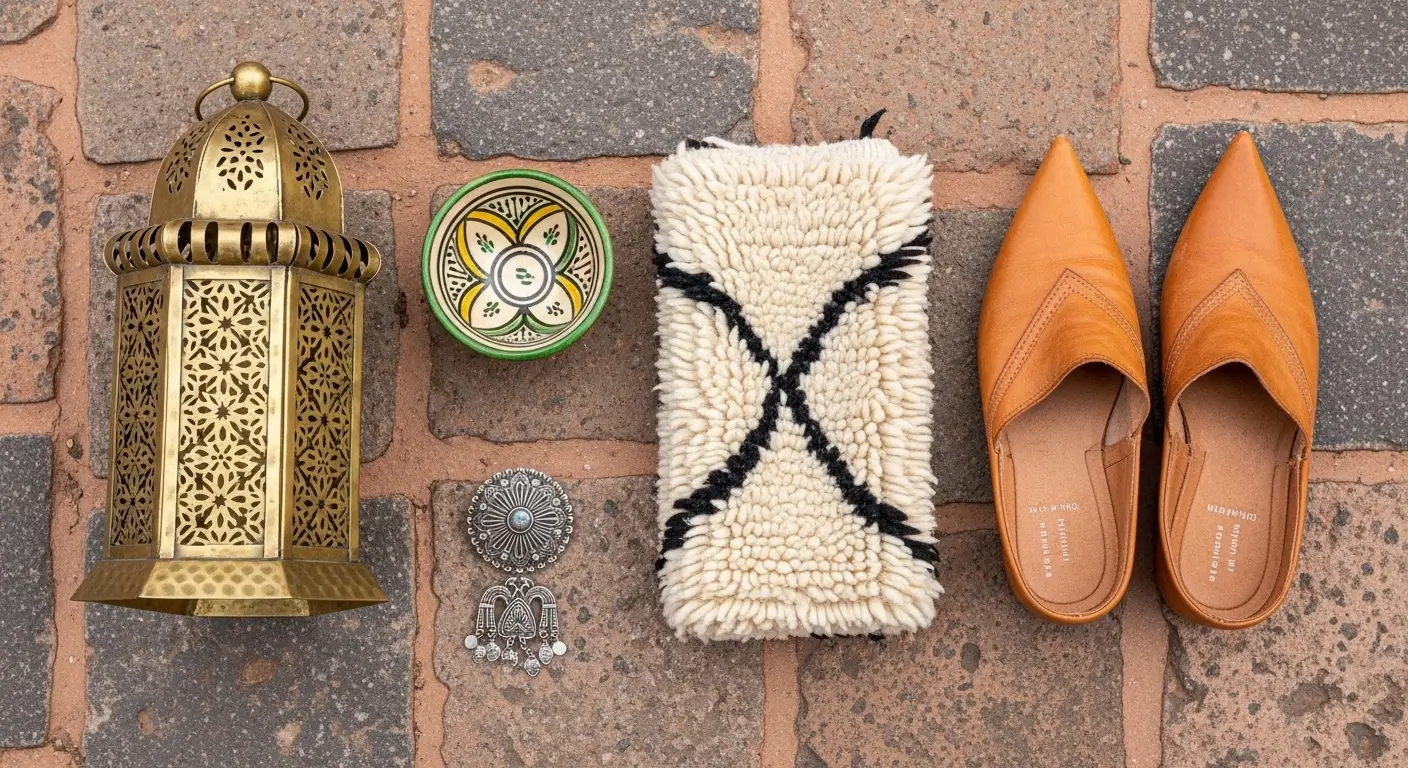
Moroccan artisanat is not just a product category. It is a living, breathing expression of who Moroccans are — their history, their regions, their hands, and their stories. Whether you are buying your first piece, decorating your home, looking for the perfect gift, or trying to sell your craft to the world, this guide covers everything you need to know about Moroccan artisanat from start to finish.
Table of Contents
What Is Moroccan Artisanat? Definition, History and Cultural Identity
A Definition That Goes Beyond Souvenirs
Most people think of Moroccan artisanat as the objects sold in souks to tourists. That picture is incomplete. Moroccan artisanat is officially defined under Moroccan law (Loi 50-17) as handmade or semi-handmade production that carries cultural, aesthetic, or functional value — and it is divided into three legal categories:
- Artisanat d’art — craft with high cultural and artistic value (zellige, carved plaster, marquetry)
- Artisanat utilitaire — functional objects for daily use (tagines, babouches, woven baskets)
- Artisanat de service — repair, restoration, and maintenance of craft objects
But definitions only go so far. At its core, Moroccan artisanat is a visual language. Every pattern on a Berber rug, every geometric tile on a riad wall, every silver bracelet from Tiznit carries meaning that connects generations. Exploring it is a way of reconnecting with your origins — or discovering them for the first time.
The Cultural Roots: Four Traditions, One Identity
Moroccan artisanat draws from four distinct cultural streams that have fused over centuries:
| Cultural Thread | Main Contributions to Moroccan Artisanat |
|---|---|
| Amazigh (Berber) | Tribal carpet patterns, silver jewelry, pottery, doum palm weaving |
| Arab | Geometric zellige tilework, carved plaster, calligraphic motifs |
| Andalusian | Refined woodwork, marquetry, silk embroidery, ceramic glaze traditions |
| Jewish | Silversmithing techniques, jewelry filigree, certain embroidery styles |
No single tradition owns Moroccan artisanat. It is the product of centuries of exchange, conflict, migration, and creativity — which is exactly what makes it impossible to replicate elsewhere in the world.
A Brief History: From Dynasty Workshops to Global E-Commerce
Moroccan artisanat did not emerge from a single moment. It evolved through layers:
- Neolithic origins — pottery and weaving were practiced by local Berber populations long before Arab arrival
- Medieval dynasties — Almoravid, Almohad, and Merinid rulers used craft production as both statecraft and cultural expression; great medinas like Fès became organized production ecosystems with fondouks (craft inns), guilds, and souks arranged by trade
- Post-independence modernization — the Moroccan state invested in institutionalizing the sector through organizations like the Maison de l’Artisan, training centers, and quality certification programs
- The digital shift — today, over 660,000 active artisans sell through Instagram, Etsy, dedicated e-commerce platforms, and international cooperatives, reaching buyers in the USA, France, the Gulf, and beyond
Why Moroccans Are Rediscovering Their Own Artisanat
Something important has shifted in recent years among urban Moroccan consumers. A generation that grew up surrounded by imported furniture and mass-produced objects is now actively turning back toward Moroccan artisanat — not out of nostalgia, but out of identity.
- The “beldi chic” aesthetic — stripped-back, natural, and quietly Moroccan — has taken over interior design conversations on social media
- Young Moroccans are using artisanat objects to signal cultural pride, not just aesthetic taste
- Moroccans living abroad are among the most active online buyers of Moroccan artisanat — searching for objects that bring home to them
The Regional Craft Map: Which Moroccan City Makes What
Why Geography Defines Moroccan Craft
Moroccan artisanat is deeply geographic. Each city and region developed specific expertise based on the raw materials available locally and the cultural traditions of its population. Understanding this geography is the single most important thing you can know before buying or studying Moroccan artisanat.
A babouche from Fès is not the same as a babouche from Marrakech. A carpet from Rabat tells a completely different story from a Berber rug from Ouarzazate. Buying with geographic awareness means buying authentically — and it protects you from imitations.
City-by-City Breakdown
Fès — The Artisanat Capital
Fès is Morocco’s undisputed craft center. It excels in:
- Zellige (geometric mosaic tilework) — Fès is where master tile-cutters, or maalemîn, produce the country’s finest zellige for palaces, mosques, and riads
- Maroquinerie (leather goods) — the Chouara tannery is the oldest in the world; Fassi leather is Morocco’s most prized
- Blue-and-white ceramics — the iconic cobalt glaze originated in Fès and remains its signature
- Carved plaster (naqsh hadida) — decorative plaster sculpting found in every historic interior
Marrakech — The Metalwork and Textile Hub
- Brass and copper lanterns, trays, and candleholders (dinanderie)
- Hand-painted leather poufs and babouches
- Woven textiles and embroidered cushion covers
- Contemporary Moroccan artisanat boutiques mixing tradition and modern design
Safi — The Pottery Capital
- Morocco’s primary center for terracotta and glazed earthenware
- Clay extracted from local rivers and fired in traditional kilns at 900–1000°C
- Known for vivid painted ceramics in yellow, green, blue, and brown
Essaouira — Wood and Coastal Craft
- Thuya burr wood from the surrounding Atlas forests — unique grain, natural fragrance, used for jewelry boxes, chess sets, and furniture
- Camel bone inlay combined with thuya in marquetry objects
- A strong contemporary art scene that has blended artisanat with modern design
Tiznit and Tan-Tan — Silver Amazigh Jewelry
- The heartland of Berber silver jewelry: fibula brooches, anklets, headpieces, and hand of Fatima pendants
- Silver 925 hallmark is the standard; find the best silver at Tiznit’s central jewelry souk
- Distinct from Fès gold jewelry — these pieces carry Amazigh tribal identity
Tamegroute — Green Pottery
- A small desert oasis south of Zagora producing one of Morocco’s most distinctive ceramics
- The unique green glaze comes from copper oxide and magnesium — each piece is one of a kind
- Rough texture, organic shape, highly collectible
Rabat and the Rif Mountains — Structured Carpets
- Rabat produces urban carpets with structured floral patterns around a central medallion
- Rif Mountain weavers create dense, geometric textiles with their own tribal color palette
- Distinct from southern Berber rugs in both technique and visual language
Ouarzazate and Beni Mellal — Berber Tribal Rugs
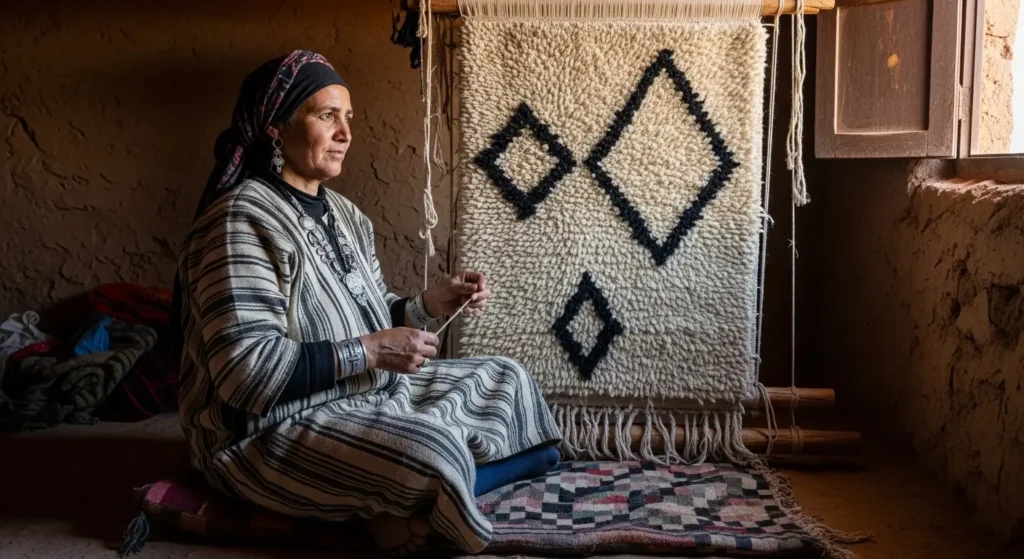
- Home of the Beni Ouarain rug: natural undyed cream wool with bold black geometric motifs
- Azilal rugs: colorful, abstract, woven by women as personal creative expression
- Kilim flatweave: lighter, reversible, often used as wall hangings or runners
Tetouan and Chefchaouen — Northern Embroidery Tradition
- Tetouan embroidery (Tétouanaise): Moorish-influenced, fine silk thread on white or cream linen
- Fès-style embroidery also practiced here with local variations in color and pattern
- Chefchaouen: woven wool garments and accessories in the blue city’s distinctive aesthetic
Taroudant — Silver, Leather, and Pottery
- Often called “little Marrakech” for its diverse artisanat production
- Known for silver jewelry distinct from Tiznit’s, local leather tanning, and regional pottery
The Main Product Families: A Deep-Dive Reference
Tapis and Carpets — Morocco’s Most Sought-After Export
Moroccan carpets are the category with the highest online demand and the widest variety. Before buying, understand the two fundamental categories:
Urban carpets:
- Produced in Rabat and Fès
- Structured, symmetrical, floral or geometric central medallion
- Higher knot count per cm² = higher quality and price
- Usually wool pile on cotton warp
Rural Berber carpets:
- Produced by Amazigh women across the Atlas and southern regions
- Each tribe has its own symbols, colors, and patterns — a Berber rug is literally a woven autobiography
- Key types:
| Type | Origin | Visual Style | Key Feature |
|---|---|---|---|
| Beni Ouarain | Middle Atlas | Cream/black geometric | Natural undyed wool |
| Azilal | High Atlas | Colorful, abstract | Women’s personal expression |
| Kilim | Nationwide | Flatweave, geometric | Reversible, lightweight |
| Boucherouite | Nationwide | Recycled fabric strips | Upcycled, bohemian |
| Rabat | Rabat | Formal, medallion | High knot count |
Quality indicators to check:
- Knots per cm² (higher = finer, more durable)
- Natural vs. synthetic dyes (pull a thread and check for bleeding)
- Wool quality — run your hand across it; real wool has a soft spring
- Back of the rug should mirror the front pattern clearly in hand-knotted pieces
Zellige — Geometric Mosaic Tilework
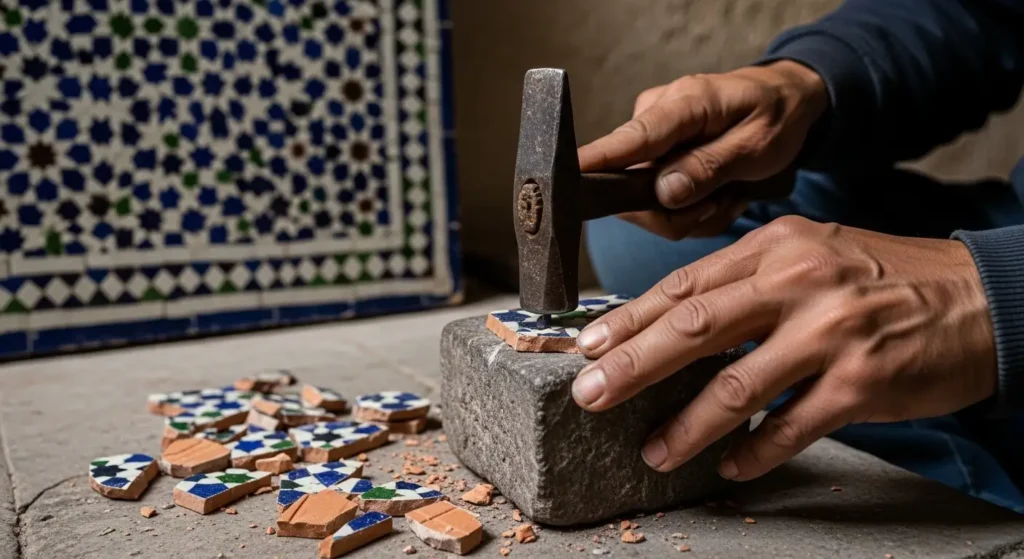
Zellige is Morocco’s most internationally recognized architectural craft. Here is how it works:
- Clay is mixed, fired in traditional kilns, and glazed with mineral oxides
- A master craftsman (maalem) uses an ancient axe-hammer tool called a menkach to hand-cut each tile into its precise geometric shape
- Hundreds of cut pieces are assembled face-down into complex geometric compositions
- The assembled panel is then fixed into walls, floors, fountains, and table surfaces
What zellige is used for:
- Riad fountains and courtyard floors
- Hammam and bathroom walls
- Table tops and decorative frames
- Wall panels in contemporary interiors
Important: the Zellige de Fès carries legal geographic protection in Morocco. Imitation machine-made tiles exist on the market — real zellige has slight size variation, tonal inconsistency, and small chips that are considered part of its beauty, not defects.
Maroquinerie — Leather Goods
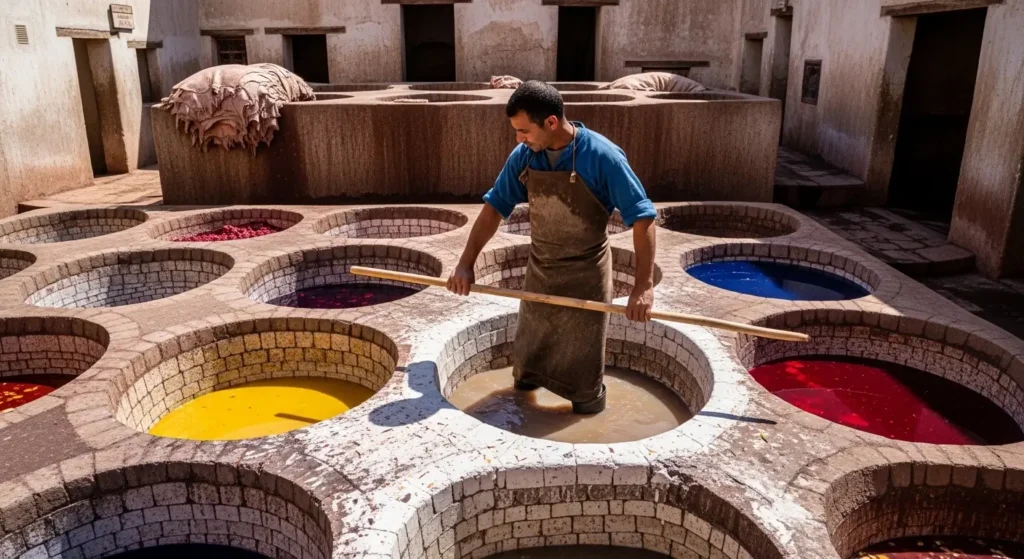
The Chouara tannery in Fès is the oldest working tannery in the world. Hides (cow, goat, and sheep) arrive raw, pass through stone vats of lime and pigeon dung for softening, then enter the famous colored dye vats. The entire process is still done by hand.
Key leather products in Moroccan artisanat:
- Babouches — traditional leather slippers; men’s (pointed, no back) vs. women’s (embroidered, backless or heeled); Fassi leather babouches are the finest
- Leather poufs — round or ottoman-style, sold unfilled for easy shipping; cow vs. goat leather, natural vs. chemical dyes
- Bags and satchels — from camel leather messenger bags to small coin purses
- Belts and accessories — tooled and carved leather in traditional geometric motifs
How to identify genuine leather:
- Real leather smells strongly and distinctively — synthetic has no smell or a chemical one
- Natural dyes fade gradually and age beautifully; chemical dyes crack and peel
- Stitching on handmade pieces is slightly irregular — that is correct
Poterie and Céramique — Pottery and Ceramics
Morocco has several distinct pottery traditions, each tied to its city:
| City | Style | Signature Characteristic |
|---|---|---|
| Safi | Brightly painted earthenware | Vivid colors, hand-painted floral and geometric |
| Fès | Blue-and-white stoneware | Cobalt oxide glaze, fine detail |
| Tamegroute | Desert green pottery | Rough texture, copper-green glaze, unique imperfections |
| Marrakech | Functional terracotta | Tagines, tangia pots, everyday serveware |
| Chefchaouen | Blue-toned ceramics | Echoes the city’s iconic blue-white palette |
Functional pottery buying tips:
- Check that tagines are food-safe (lead-free glaze — ask the seller)
- Unglazed terracotta is more porous and best for cooking, not serving liquids
- Hand-painted pieces will show slight variation between pieces — this is the point
Dinanderie — Brasswork and Copperwork
Dinanderie refers to metalwork in brass, copper, and silvered copper. It is one of the most visible elements of Moroccan artisanat, found in every riad, restaurant, and home.
Common products:
- Lanterns (carved geometric patterns cast dramatic shadows)
- Serving trays (round, hammered, engraved)
- Teapots and tea glasses holders (berrad)
- Door knockers and handles
- Candleholders and incense burners
Hand-hammered vs. machine-pressed:
- Hand-hammered pieces have irregular hammer marks visible on the surface — no two are identical
- Machine-pressed pieces are perfectly uniform and much cheaper
- Weight is a useful indicator — genuine brass is heavy; thin stamped metal feels light
Bijouterie — Amazigh and Moroccan Jewelry
Moroccan jewelry has two distinct traditions that rarely overlap:
Amazigh (Berber) silver jewelry:
- Made in Tiznit, Tan-Tan, Rissani, and Taroudant
- Materials: silver 925, coral, amber, enamel, semi-precious stones
- Key pieces: fibula (large circular brooches), khamsa (hand of Fatima), ankle bracelets, head ornaments
- Each tribal group has its own designs — these pieces carry identity, not just beauty
Fassi and urban gold jewelry:
- Made in Fès and Casablanca
- Arabic calligraphy motifs, fine filigree work
- More formal and associated with weddings and high occasions
Buying silver jewelry safely:
- Look for the 925 hallmark (or 900 for older Moroccan silver standards)
- Test weight — silver feels substantial; plated metal feels light
- Reputable sellers in Tiznit’s central souk are generally trustworthy
Menuiserie — Cedar, Thuya, and Woodwork
Moroccan woodwork is divided into two main traditions:
Architectural woodwork (Cedar):
- Found in medina doors, mosque ceilings, mashrabiya screens, and carved panels
- Cities of Fès, Meknès, Salé, and Tetouan are the main production centers
- Cedar carving involves chisels, mallets, and decades of apprenticeship
Artisanal objects (Thuya burr wood):
- Unique to the region around Essaouira
- The burr (root burl) of the thuya tree produces an extraordinary swirling grain
- Products: jewelry boxes, chess sets, picture frames, furniture, decorative bowls
- Has a natural fragrance that fades slowly over years
Broderie and Textiles — Embroidery and Woven Fabrics
Moroccan embroidery traditions by city:
| City | Style | Common Use |
|---|---|---|
| Fès | Red silk on white linen, geometric | Table covers, curtains, cushions |
| Rabat | Multi-colored silk, floral | Decorative panels, clothing |
| Tetouan | Moorish geometric, fine thread | Household textiles |
| Meknès | Yellow gold thread on white | Ceremonial textiles |
| Azemmour | Blue on white, unique stitch | Collectible decorative pieces |
Cactus silk (ḥarir sabbar):
- Produced by women’s cooperatives in the Atlas mountains
- Silk fibers are manually extracted from the cactus plant and hand-dyed with natural pigments
- Lightweight, slightly shiny, very soft — used for cushion covers, scarves, and throws
- Look for the cooperative label to ensure fair-trade sourcing
Caftan marocain as artisanat:
- The Moroccan caftan is considered a form of artisanat in its own right
- Key artisanal elements: Sfifa (decorative braid), Aakad (decorative buttons), hand embroidery
- Modern “beldi chic” versions simplify the silhouette while keeping the handcraft elements
How to Buy Authentic Moroccan Artisanat Online: The Trust Guide
The Authenticity Checklist: 7 Things to Verify Before Buying
Buying Moroccan artisanat online requires a specific set of checks that do not apply to ordinary e-commerce. Here is what to look for:
- Imperfections are a positive sign — handmade stitching is never perfectly uniform; slight irregularity in pattern, glaze, or weaving is the artisan’s signature, not a defect
- Real leather has a powerful, distinctive smell — genuine Moroccan leather (especially natural-dyed) has an unmistakable animal and vegetable smell; synthetic leather smells like chemicals or nothing at all
- Ask for origin details — a credible seller should be able to tell you the city, the workshop name, or the cooperative that produced the piece
- Verify material descriptions — full-grain leather (not split or bonded), natural wool (not acrylic blend), silver 925 (not silver-plated), real thuya burr (not composite wood)
- Look for official labels — the “Madmoun” quality stamp or the “Moroccan Heritage” designation are government-backed quality indicators
- Be suspicious of very low prices — authentic Moroccan artisanat requires skilled labor and quality materials; a price that seems too good is usually a counterfeit flag
- Check the product photography — sellers of genuine artisanat typically show close-up macro shots of texture, stitching, glaze, and grain; generic stock-style images are a red flag
Best Platforms to Buy Moroccan Artisanat Online
Within Morocco:
- Established cooperatives with physical locations and online shops (look for Ministry-affiliated cooperatives)
- Instagram artisan accounts with consistent post history, visible workshop photos, and real customer reviews
- Local Moroccan e-commerce platforms that vet their sellers
Internationally:
- Etsy sellers based in Morocco with detailed provenance descriptions and high review scores
- Specialist Moroccan artisanat e-commerce stores with transparent supply chain information
Questions to ask any online seller:
- Where exactly was this made?
- Who made it — an individual artisan, a cooperative, or a factory?
- What materials were used and how were they sourced?
- Is there a return policy if the item does not match the description?
Red Flags: How to Spot Industrial Imitations
The Moroccan artisanat market includes many mass-produced imitations sold as handmade. Watch for:
- Machine-perfect metalwork — if every hammer mark is identical and the surface is perfectly uniform, it was machine-stamped, not hand-hammered
- Vague provenance — “made in Morocco” with no city, no workshop, and no artisan = industrial production
- PVC or PU leather — sold as “Moroccan leather” but made entirely from plastic; has no smell and peels under use
- Industrial zellige imitations — machine-cut tiles with perfect uniformity and no tonal variation; genuine zellige has slight inconsistencies in size, glaze depth, and color
Labels, Loi 50-17 and the Fight Against Counterfeiting
What Loi 50-17 Changed for Moroccan Artisanat
Before Loi 50-17, the Moroccan artisanat sector had no unified legal framework. Anyone could call anything “artisanal.” The law changed that fundamentally:
- Defined the three categories of artisanat (d’art, utilitaire, de service) with specific criteria for each
- Created a formal artisan registration system — the RCAM (Registre de Commerce des Artisans du Maroc), giving artisans legal identity and access to state support programs
- Established consumer protection standards for labeling, material disclosure, and origin marking
- Created the legal basis for geographic protection of specific craft traditions tied to specific cities
The Madmoun Quality Label
The Madmoun label (مضمون) is Morocco’s primary quality certification for artisanat products. It guarantees:
- The product is genuinely handmade
- Materials meet declared quality standards
- The artisan or cooperative is officially registered
- The declared origin is verified
How to use it when buying:
- Ask the seller if their products carry or are eligible for Madmoun certification
- Products sold through official Ensemble Artisanal cooperatives are generally certified or held to equivalent standards
The Moroccan Heritage Label and UNESCO Protection
Morocco has gone further than domestic certification by pursuing international recognition for its craft traditions:
- Several Moroccan craft practices have been nominated for UNESCO Intangible Cultural Heritage designation
- The Ministry of Tourism and Artisanat, in collaboration with the Ministry of Culture, developed the “Moroccan Heritage” label for international market positioning
- The Comité National de la Propriété Industrielle et Anti-Contrefaçon (CONPIAC) actively pursues legal action against counterfeiters
Two landmark protection cases:
- Zellige de Fès — the Ministry brought legal action against manufacturers misrepresenting industrial tiles as authentic Fassi zellige
- Vannerie de Taza-Taounate — geographic protection was pursued for the distinctive basket-weaving tradition of the Taza-Taounate region
Price Guide: What Moroccan Artisanat Actually Costs
Why Prices Vary — and How to Read Them
No fixed price list exists for Moroccan artisanat because price depends on multiple variables:
- Region of production — Fassi leather costs more than mass-produced leather for a reason
- Material quality — natural dyes vs. chemical, full-grain vs. split leather, real wool vs. synthetic
- Artisan reputation and certification — a master craftsman with a registered workshop commands higher prices
- Point of sale — souk price, cooperative price, and online price can vary significantly for the same object
Transparent Price Ranges by Category
| Product | Entry Level (MAD) | Mid-Range (MAD) | Premium (MAD) |
|---|---|---|---|
| Babouches (pair) | 80–150 | 200–400 | 500–1,000+ |
| Leather pouf (unfilled) | 200–350 | 400–700 | 800–1,500+ |
| Small ceramic bowl | 30–60 | 80–150 | 200–500 |
| Tagine pot (functional) | 80–150 | 200–400 | 500–1,200 |
| Beni Ouarain rug (small) | 800–1,500 | 2,000–5,000 | 6,000–20,000+ |
| Kilim rug (medium) | 400–800 | 1,000–2,500 | 3,000–8,000 |
| Brass lantern (small) | 80–150 | 200–500 | 600–2,000 |
| Silver bracelet (Amazigh) | 100–200 | 300–600 | 700–3,000+ |
| Thuya wood jewelry box | 100–200 | 300–600 | 800–2,500 |
| Zellige decorative tile (per unit) | 15–30 | 40–80 | 100–300 |
Prices are indicative ranges for the Moroccan domestic market.
How to Negotiate in a Moroccan Souk
Negotiation is part of the souk experience — but it has rules:
- Start at 50–60% of the opening price for most categories
- Be respectful and unhurried — aggressive bargaining is considered rude
- Know when to walk away — a polite exit often brings the seller back with a lower offer
- Fixed-price cooperatives (Ensemble Artisanal) exist for a reason — use them if you prefer certainty over negotiation
- Never negotiate a price you are not willing to pay — agreeing to a price then walking away is considered deeply disrespectful
Moroccan Artisanat in Interior Design: The Beldi Chic Guide
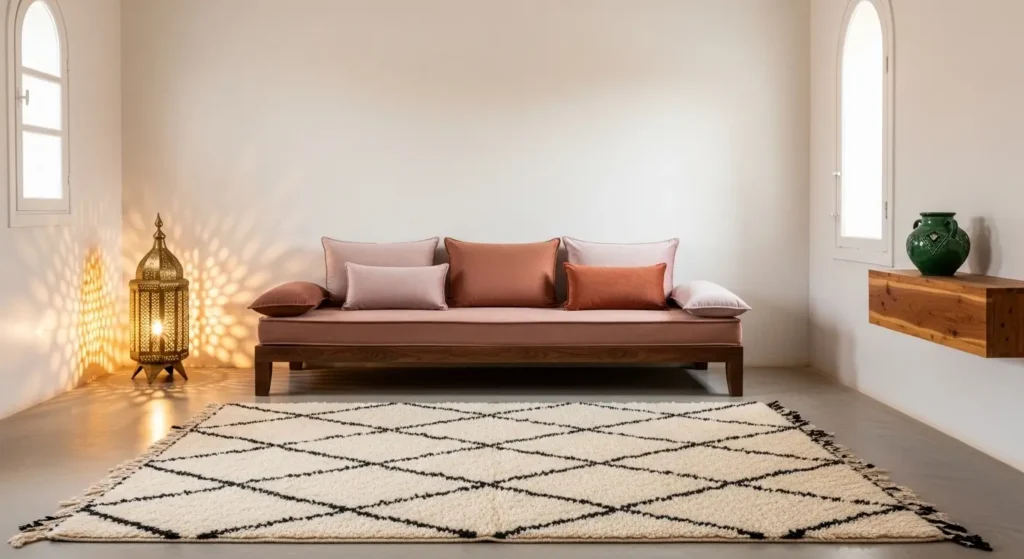
What “Beldi Chic” Means — and Why It Took Over Moroccan Interiors
“Beldi” in Moroccan Arabic means traditional, authentic, from the homeland. “Beldi chic” is the design aesthetic that takes the rawness of traditional Moroccan craft and strips it of excess ornamentation, resulting in interiors that feel grounded, natural, and unmistakably Moroccan.
Key characteristics of the beldi chic aesthetic:
- Natural, unbleached, or earth-toned color palettes (ochre, ivory, terracotta, forest green, indigo)
- Raw textures: hammered metal, rough pottery, undyed wool, unfinished wood
- Geometric Moroccan motifs used selectively — one statement piece, not every surface
- Mix of old and new — a Beni Ouarain rug under a minimalist sofa, a brass tray on a concrete coffee table
What beldi chic is NOT:
- The maximalist souk aesthetic with lanterns, mirrors, and carpets in every corner
- Tourist-facing “1001 nights” fantasy interiors
- Purely traditional rooms where nothing modern is allowed
Room-by-Room Integration Guide
Living room:
- Anchor the space with one large Beni Ouarain or Azilal rug as the foundation
- Add 2–3 brass or copper lanterns at different heights for warm ambient light
- Use doum palm baskets for storage — stack them in a corner or hang them on the wall
- A single Safi or Tamegroute pottery piece on a shelf is enough
- Kilim cushion covers on a neutral sofa tie the palette together
Kitchen and dining:
- Hand-painted Safi ceramic serveware as your everyday set — the slight variations between pieces make a beautiful table
- A thuya wood serving tray for cheese, bread, and charcuterie boards
- Embroidered Fès-style linen placemats
- A copper berrad (teapot) displayed on the counter — functional and decorative
Bathroom:
- Hand-hammered brass or copper faucets and sink as the statement piece (Marrakech workshops produce excellent options)
- Zellige accent tiles as a border, around the mirror, or as a feature wall — does not need to be the full room
- Hand-woven cotton hammam towels (fouta) in natural undyed or single-color
Outdoor and courtyard:
- Terracotta pots in varying sizes grouped together
- A small brass or copper fountain as a courtyard focal point
- Handwoven doum or alfa grass mats for seating areas
Mixing Artisanat with Contemporary Design: Practical Rules
- The 1-in-3 rule: one artisanat piece for every two contemporary objects in a zone — this prevents the space from feeling like a museum
- Limit your palette: choose 2–3 natural tones from the same family and let the artisanat pieces provide the accent
- Layer textures deliberately: rough zellige + smooth brass + soft wool creates contrast that makes each material look more beautiful
- Scale matters: one large rug is more impactful than five small pieces scattered across the room
Global Recognition: Craftcore, Sustainability and Moroccan Artisanat’s World Stage
The “Craftcore” Global Trend — and Why Morocco Leads It
Craftcore is a global design and lifestyle trend that celebrates handmade objects, natural materials, visible imperfection, and the connection between maker and user. It is the antithesis of mass production.
Moroccan artisanat maps onto craftcore better than almost any other craft tradition in the world because:
- Every category involves genuine handwork — no industrial shortcuts
- Imperfection is built into the aesthetic and the value system
- Materials are natural: clay, wool, leather, brass, silver, wood, cactus fiber
- The objects carry human stories — you can trace a rug back to a specific tribe, a bowl back to a specific kiln
This is precisely why Moroccan artisanat is performing so strongly on global markets. The demand for authenticity in a world of identical mass-produced objects plays directly to Morocco’s strengths.
Moroccan Artisanat’s Performance on Global Markets
The numbers tell a clear story:
- Exports have more than doubled compared to figures from a decade ago, crossing 1.23 billion dirhams in the most recently reported period
- The USA is the #1 export market, representing nearly half of all international sales
- France is the second-largest market, driven by the large Moroccan diaspora
- Customer satisfaction globally stands at 91% — the top three drivers are product design, delivery conditions, and overall product quality
- The most internationally sought Moroccan artisanat products, in order: carpets, jewelry, zellige
- Instagram is the #1 social channel for Moroccan artisanat discovery, accounting for over a quarter of all online mentions
Sustainability: Why Moroccan Artisanat Is the Original Ethical Consumption
Before “ethical consumption” became a marketing term, Moroccan artisanat was already practicing it:
Environmental:
- Natural dyes from plants, minerals, and organic compounds replace chemical industrial dyes
- Clay, wool, leather, and plant fibers are biodegradable raw materials
- Small-batch production generates no industrial waste
- Many craft processes (pottery, weaving) have near-zero carbon footprints
Social:
- Over 660,000 artisans work in the sector — it is one of Morocco’s largest employment categories
- Women represent 54% of the workforce — cooperatives in particular have been transformative for women’s economic independence in rural areas
- The craft economy supports entire villages and regions that have few other economic alternatives
Cultural:
- Every purchase preserves a technique that could otherwise disappear
- Buying from registered artisans and cooperatives keeps craft knowledge alive and economically viable for the next generation
The Moroccan Artisanat Gift Guide: By Occasion and Budget
Gifts by Occasion
Eid Al-Fitr and Eid Al-Adha:
- Traditional clothing items (caftan, djellaba with artisanal Sfifa detailing)
- Hand-painted ceramic serving sets for Eid gatherings
- Silver-plated tea service or traditional copper berrad set
- Embroidered table linens for family dining
Moroccan Wedding (3aras):
- Large engraved copper or silver-plated serving trays (siniya)
- Embroidered bed linens or towel sets from Fès or Tetouan
- Pairs of handmade leather babouches (traditional gift)
- Zellige-decorated decorative item for the new home
Housewarming (Dkhoul Dar):
- Objects with positive symbolism: khamsa (hand of Fatima) in silver or brass, geometric wall art
- A quality piece of Safi pottery — practical and beautiful
- Doum palm storage baskets — functional and deeply Moroccan
- Aromatic home products: beeswax candles, Moroccan incense (bkhour) in a brass burner
Gifts for Moroccan Diaspora:
- Lightweight but culturally rich: embroidered cushion covers, cactus silk scarves, small brass pieces
- Tamegroute pottery bowls — small, stackable, extraordinarily distinctive
- A collection of Moroccan artisanal spices in hand-painted ceramic jars
Gifts by Budget
| Budget (MAD) | Suggested Moroccan Artisanat Gifts |
|---|---|
| Under 100 | Small ceramic bowl, thuya key holder, embroidered pouch, incense set, Tamegroute espresso cup |
| 100–300 | Hand-painted Safi tea glasses set, leather coin purse, small brass lantern, cactus silk cushion cover |
| 300–800 | Leather pouf, Safi 4-piece ceramic bowl set, Tamegroute serving bowl, Amazigh silver bracelet |
| 800–2,000 | Medium Beni Ouarain rug, custom zellige decorative tray, full Amazigh silver necklace set, thuya marquetry cabinet |
| 2,000+ | Large hand-knotted Berber carpet, custom zellige installation, master-crafted brass fountain, collector ceramics piece |
How to Sell Moroccan Artisanat Online: A Guide for Artisans and Small Sellers
Choosing the Right Platform
Not all platforms work the same way for Moroccan artisanat. Here is an honest breakdown:
| Platform | Best For | Key Requirement |
|---|---|---|
| Etsy | International buyers, USA/Europe | English listings, high-quality photos, shipping setup |
| Instagram Shop | Moroccan and diaspora buyers | Consistent visual content, product tagging |
| Facebook Marketplace | Local Moroccan sales | Arabic/French descriptions, local delivery |
| Own e-commerce site | Brand building, long-term | SEO, payment setup, logistics |
| Moroccan cooperatives | Collective selling, certification | Cooperative membership, quality standards |
The most common mistake artisans make: trying to be on every platform at once before mastering one. Pick the platform that matches your audience and product type, master it, then expand.
Photography and Storytelling: Selling Authenticity Visually
Your photos are your souk stall. They need to do the job a physical visit would do.
Essential shots for every product:
- Hero shot — full product in natural light, clean neutral background
- Detail shot — close-up of texture, stitching, glaze, grain, or pattern
- Scale shot — product in context (rug in a room, pouf with a person seated)
- Imperfection shot — a deliberate close-up of a handmade irregularity (this builds trust)
- Story shot — the workshop, the artisan’s hands, the raw materials
Writing product descriptions that convert:
- Start with where it was made and who made it
- Describe the materials precisely (not “leather” — “full-grain naturally-dyed cow leather from Fès”)
- Explain the process briefly — buyers of artisanat want to know the story
- State dimensions, weight, and practical care instructions clearly
Pricing, Shipping, and Legal Basics
How to price fairly:
- Calculate your total material cost
- Estimate time in hours × your hourly rate
- Add platform commission (Etsy takes 6.5%; Instagram varies)
- Add packaging and shipping costs
- Add a margin for your business sustainability (minimum 20–30%)
Never price to compete with mass production. Authentic Moroccan artisanat sells on value and story, not on low price. Buyers who want cheap will always find cheaper. Your buyer is paying for the real thing.
Shipping within Morocco:
- Amana (Poste Maroc) — affordable but slower
- Chronopost Maroc — faster, trackable, better for fragile items
- CTM and private couriers — reliable for intercity
Registering as an artisan: Registering with the RCAM (Registre de Commerce des Artisans du Maroc) gives you:
- Legal professional identity
- Access to training and state support programs
- Eligibility for quality labels like Madmoun
- Better credibility with platform sellers and international buyers
Moroccan Artisanat in Numbers: The Sector’s Economic Weight
Key Economic Figures
The scale of Moroccan artisanat’s economic contribution is frequently underestimated. Here is what the data shows:
| Indicator | Figure |
|---|---|
| Contribution to national GDP | ~7% |
| Share of national exports | ~7.6% |
| Share of tourism revenues | ~10% |
| Active artisans | 660,000+ |
| Share of national employment | 20% |
| Female workforce share | 54% |
| Most recent annual export revenue | 1.23 billion MAD (record) |
| #1 export market | USA (49% of exports) |
| #2 export market | France (10.5%) |
Online Market Data and Consumer Satisfaction
The Maison de l’Artisan conducted a comprehensive analysis of over 4,400 reviews from international buyers of Moroccan artisanat online. The findings are striking:
- 91% overall satisfaction rate — among the highest of any artisanat sector globally
- Top satisfaction factors:
- Product design: 20.6% of positive mentions
- Delivery conditions: 13.7%
- Product quality: 13.6%
- Best-performing categories online: traditional clothing, carpets, and brassware (dinanderie)
- 48% of online sellers of Moroccan artisanat are Morocco-based; 14% are France-based; 10% Italy-based
- Nearly 5 million global online mentions of Moroccan handmade products in the reference period
- Facebook leads for artisanat mentions (36%), followed by Instagram (27%)
Government Strategy and Institutional Support
Morocco’s institutional framework for artisanat is one of the most developed in Africa:
- Maison de l’Artisan — conducts market intelligence, manages quality certification, and runs the Madmoun labeling system
- Ministry of Tourism, Artisanat and Social Economy — funds R&D into traditional techniques, supports export development, and manages international positioning
- Centres de Formation aux Métiers (CFM) — vocational training centers across Morocco that teach traditional craft techniques to new generations
- Market Intelligence program — launched to track e-reputation, monitor international trends, and inform craft sector strategy in real time
Where to Buy Moroccan Artisanat: City-by-City Buying Guide
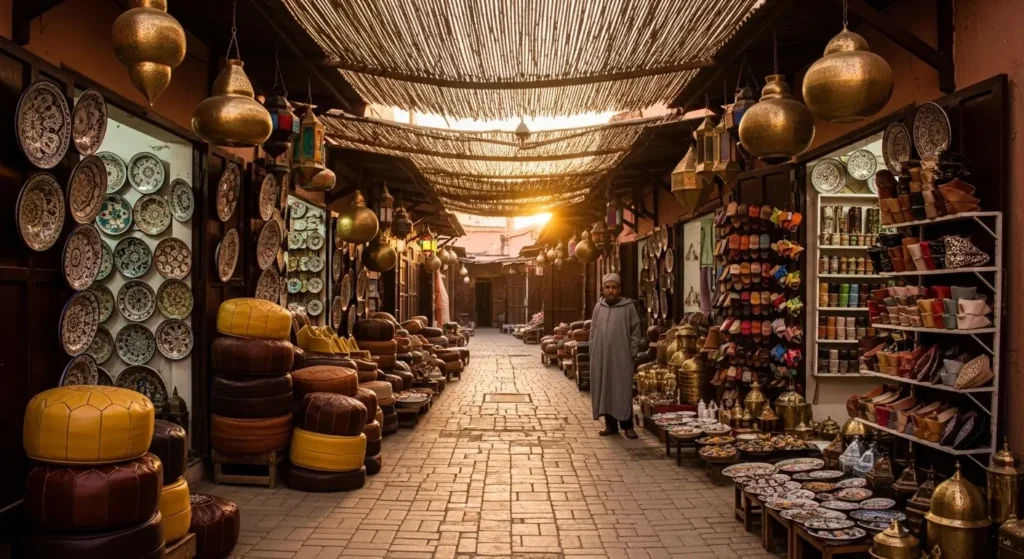
Marrakech: Souks, Cooperatives, and Vetted Boutiques
Marrakech is Morocco’s most visited artisanat destination. Navigating it well requires a little preparation.
The main souks by craft:
| Souk Name | Craft Specialization |
|---|---|
| Souk Semmarine | Textiles, clothing, mixed artisanat |
| Souk des Babouches | Leather slippers, all styles and colors |
| Souk des Dinandiers | Brass and copper metalwork |
| Souk des Teinturiers | Dyed wools and textiles (also visually spectacular) |
| Souk Cherifa (rooftop) | Contemporary Moroccan artisanat boutiques |
Tips for buying in Marrakech:
- The Ensemble Artisanal on Avenue Mohammed V offers fixed-price certified artisanat — ideal if you want to skip negotiation entirely
- Prices in the immediate vicinity of Jemaa el-Fna are typically inflated for tourists; walk 10 minutes deeper into the medina for better prices and more genuine craft
- Request a receipt with the seller’s name and product description for expensive purchases
Fès: The Artisanat Capital
Fès is where serious buyers go. The medina of Fès el-Bali is a UNESCO World Heritage Site and the world’s largest car-free urban area — a living artisanat museum.
What to seek out in Fès:
- Chouara tannery — visit from the surrounding leather shops’ terraces (free with any purchase); the view of the dye vats is one of Morocco’s most iconic sights
- Souk Attarine — the perfume and brass souk at the heart of the medina
- Hay Andalous district — where zellige workshops are concentrated
- The Andalusian quarter — embroidery and textile workshops
Tips for Fès:
- Hire a local guide for your first medina visit — the warren of 9,000+ streets has consumed many confident navigators
- The potters’ village of Ain Nokbi on the edge of the medina is worth visiting for direct-from-workshop purchases
Other Key Artisanat Destinations
Casablanca:
- Modern artisanat boutiques in the Gauthier and Racine neighborhoods
- The Central Market (Marché Central) for ceramics and daily craft objects
- Derb Ghallef for vintage and antique Moroccan artisanat pieces
Rabat:
- The Ensemble Artisanal in the city center — one of the best in the country for certified, fixed-price pieces
- The medina carpet market — smaller than Marrakech but less overwhelming for first buyers
- The Kasbah des Oudaias neighborhood for independent artisan boutiques
Essaouira:
- Thuya wood workshops concentrated in and around the medina
- The Gnawa craft tradition produces distinctive musical instruments (guembri, qraqeb) alongside visual art
- Contemporary art galleries that blend artisanat with modern visual art
Tanger:
- The northern Moroccan craft tradition is distinct — embroidery patterns, silver styles, and leather differ visibly from southern Morocco
- The Grand Socco and Petit Socco areas have established craft shops
- Look specifically for local embroidery and woven goods not easily found elsewhere in Morocco
Practical Tips for Buying in Moroccan Souks
Negotiation etiquette:
- Always respond to an opening price with a counter — silence is awkward and a nod means acceptance
- Start your counter at 50% of the opening price for most categories; 60–70% for ceramics and smaller items
- Stay friendly throughout — the goal is a transaction you both feel good about
- If you genuinely want an item, a small joke or compliment about the craft goes a long way
Fixed-price options: The Ensemble Artisanal network exists across most Moroccan cities. These government-affiliated cooperatives offer certified products at fixed, non-negotiable prices. They are generally 10–30% more expensive than souk prices but offer:
- Quality guarantees
- Receipts
- Packaging for fragile items
- No negotiation stress
Payment and logistics:
- Cash (Dirhams) is preferred and sometimes required in traditional souks
- For large or fragile items, ask the seller about safe packing and shipping; many Fès and Marrakech shops ship internationally
- For very large pieces (carpets, zellige installations), use a licensed Moroccan freight agent
Moroccan artisanat is a sector that rewards knowledge. The more you understand about where things come from, how they are made, and what marks quality — the better your purchases, the more you support the artisans who deserve it, and the more your objects mean to you. Every piece of Moroccan artisanat carries a piece of the country that made it.