
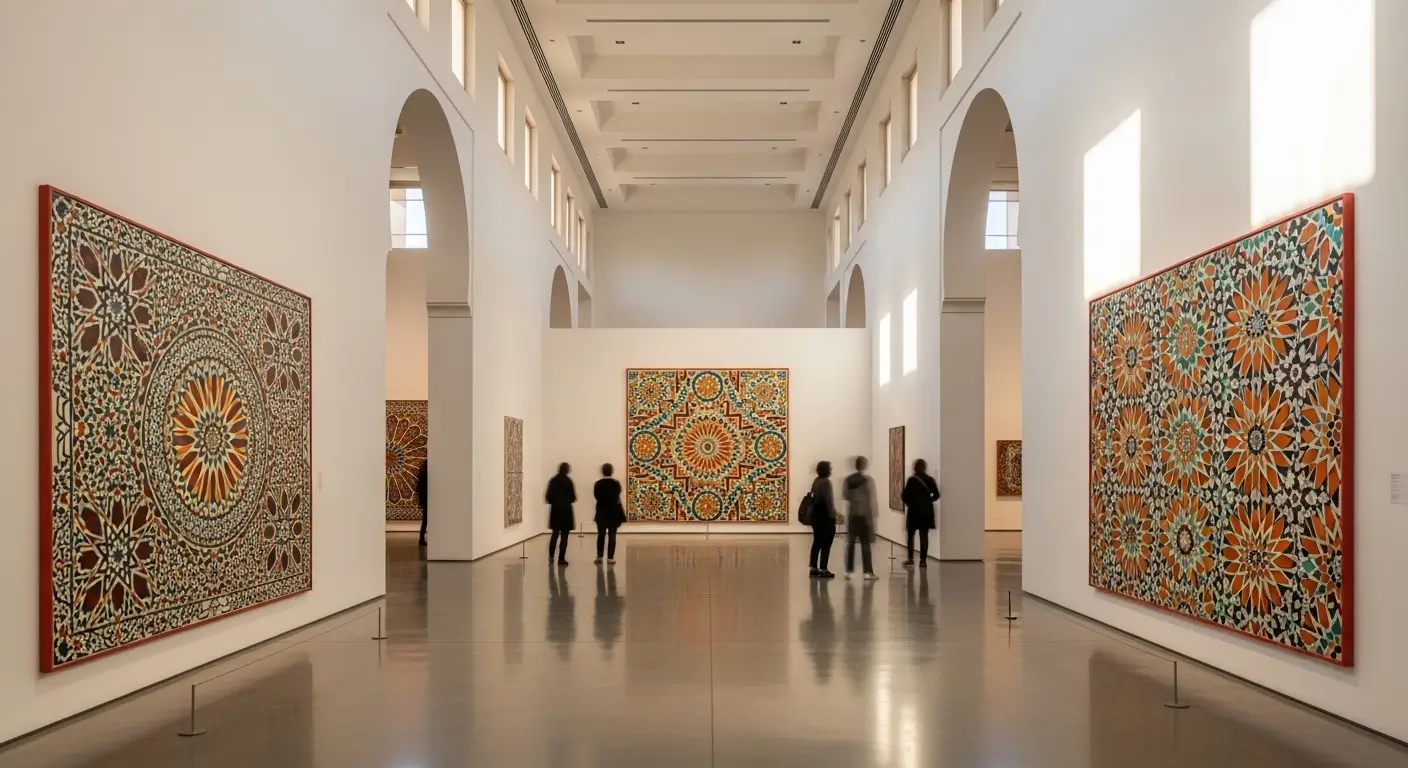
Morocco has always been more than a destination. It is a feeling — a collision of colors, textures, sounds, and stories that no camera can fully capture. And for centuries, it has been the painters who came closest to capturing it.
From the medinas of Fez to the Atlantic coastline of Essaouira, Moroccan painters have turned their homeland into art that now hangs in some of the most prestigious museums in the world. Their work has moved audiences in Paris, New York, London, and Doha. Yet many Moroccans still don’t know their names.
This guide is here to change that.
Whether you are a student looking for a school project, an art lover discovering your heritage, or simply someone proud of what Morocco has contributed to the world — this is everything you need to know about the most famous Moroccan painters of all time.
Table of Contents
The Story Behind Moroccan Painting: A Heritage Worth Knowing
Before we get to the names, it helps to understand why Moroccan painting looks and feels the way it does. The art did not appear from nowhere. It was born out of history, struggle, and a fierce desire to define a national identity on canvas.
The colonial era and the artistic resistance
During the decades of French and Spanish rule, the art promoted in Morocco was largely Orientalist — a style created by European artists who painted Morocco from the outside, through a colonial lens. These paintings often depicted Moroccan people and landscapes as exotic, passive, and timeless in a way that served the colonial narrative.
Moroccan artists rejected this completely. They saw Orientalist painting not as art, but as occupation by another means.
Independence and the explosion of Moroccan modern art
When Morocco regained its independence, a generation of young painters seized the moment. They studied in Paris, Warsaw, Rome, and New York — but came back determined to create something that was neither European nor a copy of the past. They wanted art that was Moroccan at its core.
The founding of the École des Beaux-Arts in Casablanca and Tétouan gave them the institutional base they needed. What followed was one of the most exciting periods in African art history.
The Casablanca School — a movement that changed everything
At the heart of this revolution was the Casablanca School, a group of artists and teachers who believed art should belong to everyone, not just the elite. They drew inspiration from Islamic geometric patterns, Amazigh cultural symbols, and the abstract movements sweeping Europe — and merged them into something entirely new.
Their famous manifesto declared that art must be accessible, social, and deeply rooted in Moroccan identity.
From the 1980s to today
The generations that followed built on these foundations. Today’s Moroccan painters work across abstraction, figurative art, street art, digital media, and installation — exhibiting everywhere from Marrakech to the Guggenheim. The scene is more vibrant, more visible, and more internationally respected than at any point in history.
The Pioneer Painters — The Founding Generation of Moroccan Art
These are the artists who built modern Moroccan painting from the ground up. Each one of them left a mark not just on Morocco, but on the global art world.
Farid Belkahia — The Master of Moroccan Identity
Born: Marrakech | Era: Mid-to-late 20th century
Farid Belkahia is widely considered the most important figure in modern Moroccan painting. He trained in Prague and Warsaw, absorbing the techniques of European modernism — then returned to Morocco and did something extraordinary: he threw out the canvas.
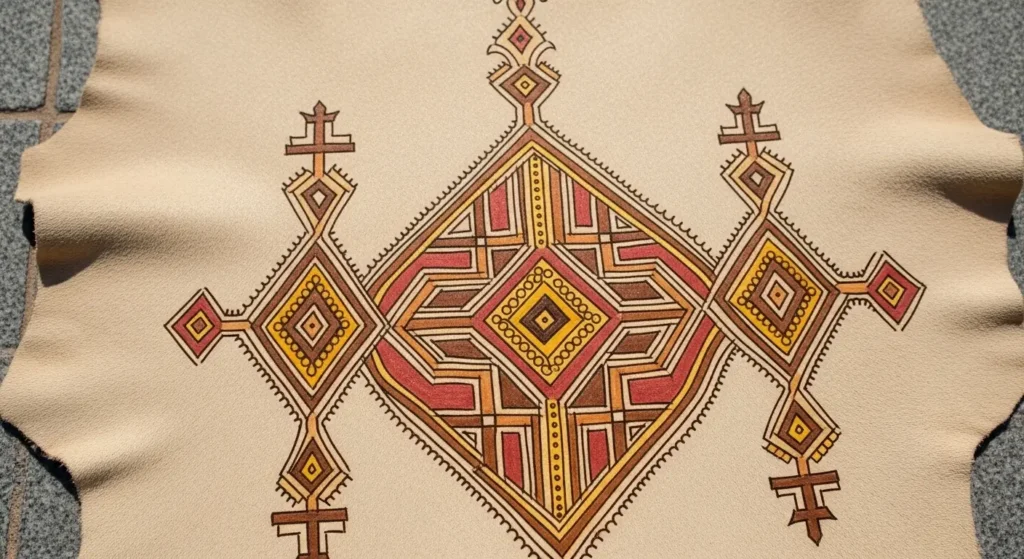
Instead, Belkahia worked on copper, leather, and sheepskin — traditional Moroccan materials used by artisans for generations. He painted with henna, saffron, and natural pigments. He integrated Tifinagh script and Amazigh symbols into geometric compositions of stunning beauty.
Why he matters:
- He was the director of the École des Beaux-Arts in Casablanca, reshaping how a generation of Moroccan artists were trained
- He transformed traditional Moroccan craftsmanship into high contemporary art
- His works are held in major international collections, including the Mathaf Arab Museum of Modern Art in Qatar
Most famous works: His large-scale copper pieces featuring geometric compositions and Amazigh symbols remain his most recognized legacy.
| Key Facts | Details |
|---|---|
| Style | Geometric abstraction, Amazigh symbolism |
| Materials | Copper, leather, henna, natural pigments |
| Major role | Director, École des Beaux-Arts Casablanca |
| Often called | Father of modern Moroccan painting |
Jilali Gharbaoui — The Tragic Genius
Born: Jorf, near Safi | Era: Mid-20th century
Jilali Gharbaoui led one of the most dramatic lives of any famous Moroccan painter. He studied in Paris, became deeply embedded in the European avant-garde scene, and struggled his entire life between two worlds — the Morocco he came from and the Paris he lived in.
His paintings reflect that internal tension. Early works show bold geometric forms. Later works integrate Arabic calligraphy into swirling, spiritual compositions. His brushwork is raw and emotional — the mark of an artist who painted to survive.
Why he matters:
- Among the first Moroccan painters to achieve recognition in European galleries during his lifetime
- His integration of Arabic calligraphy as visual abstraction influenced a generation of artists who came after him
- Considered one of the most original voices in 20th-century African painting
Style: Abstract expressionism with calligraphic elements — passionate, unstable, deeply personal.
Ahmed Cherkaoui — The Bridge Between Two Worlds
Born: Boujad | Era: Mid-20th century
Ahmed Cherkaoui studied in Paris and Warsaw and emerged as one of the most intellectually rigorous painters of his generation. His work is a careful dialogue between Moroccan visual culture — particularly Berber tattoos, Quranic calligraphy, and rural textile patterns — and the abstract modernism he absorbed in Europe.
Unlike painters who chose one or the other, Cherkaoui held both worlds in precise balance. His canvases are quiet but dense, full of signs and symbols drawn from the deep roots of Moroccan identity.
Why he matters:
- His work represented Morocco in major European exhibitions during a critical period of national identity formation
- He pioneered the use of Berber visual culture as a legitimate fine art language
- Died young, leaving behind a small but extraordinarily important body of work
Style: Abstract painting rooted in Moroccan folk symbols and Berber visual traditions.
Mohamed Melehi — The Architect of the Casablanca School
Born: Asilah | Era: Mid-to-late 20th century
Mohamed Melehi is perhaps the most intellectually complete of all famous Moroccan painters. Trained in Seville, Rome, Paris, and New York, he returned to Morocco with a global vision and a Moroccan soul.
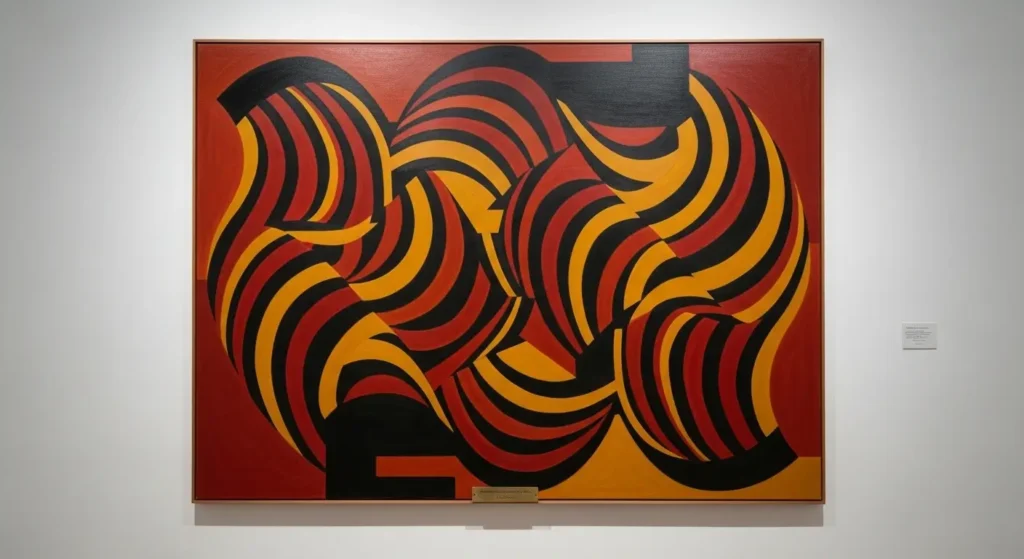
His signature style — bold optical waves, geometric forms, and striking color contrasts — became the visual language of the Casablanca School. His paintings look almost like they are in motion, pulling the eye across the canvas in a rhythm that echoes the patterns of traditional Moroccan crafts.
Melehi was also a cultural activist. He co-founded the Asilah cultural festival, which turned a small northern Moroccan town into an international art destination every summer.
Why he matters:
- Core member and theorist of the Casablanca School
- His work bridges Islamic geometric art, op art, and international modernism
- The Asilah festival he helped create remains one of North Africa’s most important cultural events
| Key Facts | Details |
|---|---|
| Style | Geometric op art, bold chromatic waves |
| Training | Seville, Rome, Paris, New York |
| Cultural role | Co-founder of Asilah Arts Festival |
| Recognition | Exhibited across Europe, North Africa, the Americas |
Hassan El Glaoui — The Painter of Horses and Power
Born: Marrakech | Era: 20th century
Hassan El Glaoui came from one of Morocco’s most powerful families — his father was the famous Pasha of Marrakech. But he chose painting over politics, and in doing so became one of the most distinctive Moroccan painters of his generation.
His most celebrated works are his depictions of horses — muscular, dynamic, almost mythological animals that carry the weight of Moroccan history in their stride. His paintings capture ceremony, power, and the deep cultural bond between Moroccan people and the horse.
Why he matters:
- His work was exhibited in major galleries in France, the United States, and across the Arab world
- He represents the aristocratic thread of Moroccan painting — art rooted in the traditions of the royal court
- His depictions of fantasia (the traditional equestrian display) are among the most iconic images of Moroccan cultural life
Style: Figurative painting with an expressive, energetic brushwork — particularly horses and ceremonial scenes.
Mohamed Chabâa — The Designer of Moroccan Modernism
Born: Casablanca | Era: Mid-to-late 20th century
Mohamed Chabâa was a co-founder of the Casablanca School alongside Melehi and Belkahia. A painter, graphic designer, and teacher, he was one of the key thinkers behind the idea that Moroccan art could be both modern and deeply rooted in its own tradition.
His paintings use flat geometric forms, bold primary colors, and a visual logic drawn from Islamic tilework and Amazigh weaving. They are clean, deliberate, and impossible to mistake for the work of anyone else.
Why he matters:
- Key figure in connecting Moroccan fine art to Moroccan craft traditions
- His graphic design work influenced the visual identity of post-independence Morocco
- A crucial teacher whose students went on to define the next generation of Moroccan contemporary art
Mohammed Ben Ali R’bati — The Pioneer of Moroccan Realism
Born: Tetouan | Era: Late 19th to early 20th century
Long before independence, before the schools and manifestos, there was Mohammed Ben Ali R’bati. He is one of the earliest known Moroccan painters to work in a Western academic tradition, and one of the very first to depict Moroccan daily life with warmth and documentary precision.
His paintings show the streets of Tetouan, the markets of the north, and the domestic life of ordinary Moroccan families — rendered in rich colors and careful detail.
Why he matters:
- Among the first Moroccan painters to be recognized internationally in his own era
- His work offers a rare visual record of northern Moroccan life before modernization
- A founding ancestor of the Moroccan figurative painting tradition
Famous Moroccan Women Painters — A Legacy Long Overdue
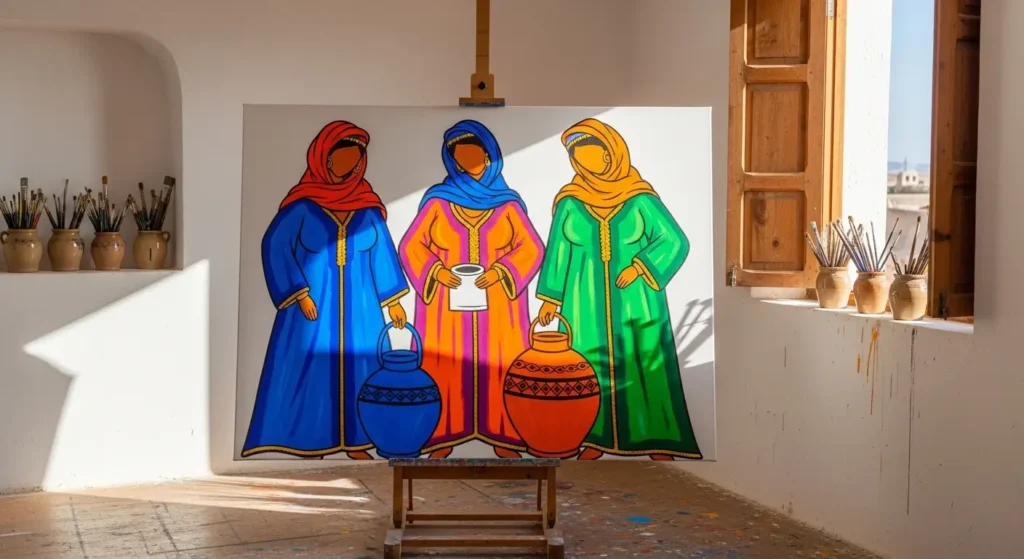
Most lists of famous Moroccan painters underrepresent women. That is a failure of the lists, not of the artists. Moroccan women have been painting masterpieces for decades — and the world is finally catching up.
Chaïbia Talal — Morocco’s Most Famous Painter
If there is one name every Moroccan should know, it is Chaïbia Talal.
She was born in a small village near El Jadida. She was married young and widowed shortly after, left to raise a child alone with no formal education. She had never held a paintbrush until her mid-thirties.
What happened next is one of the great stories in African art history.
When a French art critic named Pierre Gaudibert visited her home and saw her work, he could not believe what he was looking at. Within a year, Chaïbia had solo exhibitions at the Goethe-Institut in Casablanca, at a major gallery in Paris, and at the Salon des Surindépendants inside the Museum of Modern Art in Paris.
A self-taught woman from a Moroccan village had walked into the global art world — and it stood up to applaud.
What her paintings look like:
- Brightly colored, joyful, large-scale compositions
- Women at the center — Moroccan women living, dancing, gathering
- A visual style that critics compared to the CoBrA movement in Europe, though she had never heard of it
- Flat forms, bold outlines, colors that seem to vibrate off the canvas
Why she is the most famous Moroccan painter:
| Achievement | Detail |
|---|---|
| Self-taught | No formal training — pure instinct and vision |
| International debut | Solo shows in Paris within one year of being discovered |
| Subject | Moroccan women — their strength, beauty, and daily life |
| Legacy | Among the most internationally recognized African women artists of the 20th century |
Chaïbia Talal did not fit into any category. That was her power.
Safaa Erruas — The Language of Silence
Safaa Erruas graduated from the Institut des Beaux-Arts in Tétouan and has built one of the most internationally respected careers of any Moroccan artist of her generation.
Her work is immediately recognizable: almost entirely white. She works with paper, cotton, gauze, broken glass, and metal wire — materials that feel domestic, fragile, and charged with meaning.
Her installations and works on paper explore the invisible borders between private and public life — a particularly resonant theme for Moroccan women.
Key exhibitions:
- Biennials of Rabat, Dakar, Havana, and Alexandria
- International galleries across Europe and the Arab world
Style: Abstract, minimal, and deeply conceptual — silence as a visual statement.
Fatima Hassan El Farrouj — Art as Advocacy
Fatima Hassan El Farrouj is one of Morocco’s most important contemporary women painters and one of the most vocal advocates for gender equality in the Moroccan art world.
Her paintings explore what it means to be a woman in Moroccan society — navigating tradition, modernity, identity, and expectation. Her style blends traditional Moroccan visual references with contemporary painting techniques, creating works that feel both timeless and urgently present.
She has exhibited nationally and internationally, and continues to push for greater institutional visibility for women artists in Morocco.
Why she matters:
- Her work opens conversations that Moroccan society is still having
- She represents a generation of women artists who refuse to paint in the background
- A model for young Moroccan women who want to pursue art professionally
Contemporary Moroccan Painters — The Generation Changing Everything
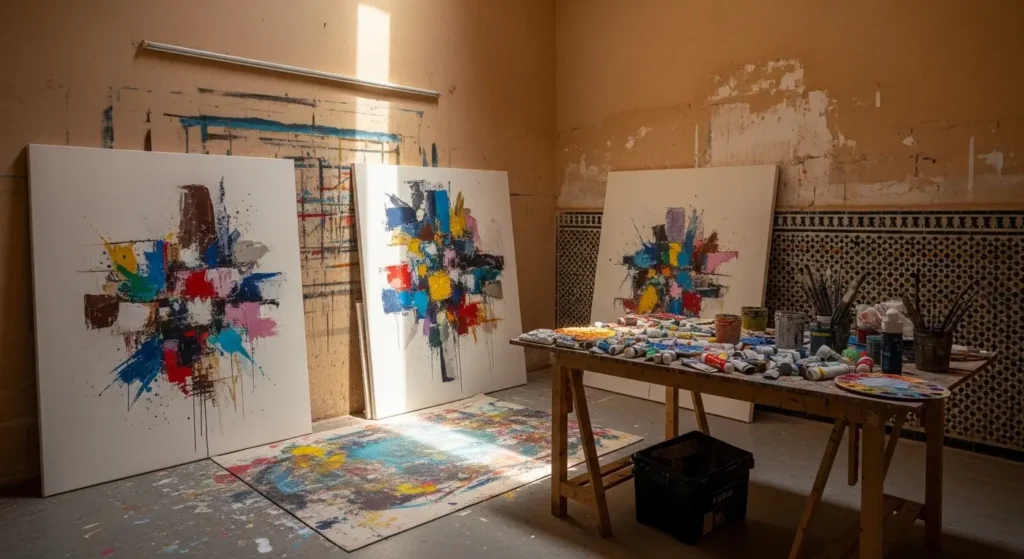
The pioneers built the foundation. The contemporary generation is building the world on top of it. These are the famous Moroccan painters currently shaping the international art scene.
Mahi Binebine — From Literature to Canvas
Mahi Binebine is known in Morocco as a novelist first. But his paintings have earned him a separate and equally powerful reputation internationally.
His visual work is raw and confrontational — figures that dissolve at the edges, bodies in states of tension or collapse, compositions that speak directly to poverty, migration, and marginalization. He does not paint for comfort. He paints to bear witness.
Recognition:
- Works held in the collection of the Guggenheim Museum
- Exhibited across Europe, the United States, and the Arab world
- One of the most internationally collected Moroccan painters alive today
Hassan Hajjaj — The Andy Warhol of Marrakech
Hassan Hajjaj is perhaps the most globally famous Moroccan artist currently working. Born in Larache and raised partly in London, he moves between photography, fashion, design, and painting with equal ease.
His work is an explosion of pattern, color, and pop culture — Moroccan street style meets global visual language. His famous Kesh Angels series, which portrays young Moroccan women on motorbikes in traditional dress, became an international sensation.
Why he is essential:
- Works held at the Brooklyn Museum, Los Angeles County Museum of Art (LACMA), Victoria and Albert Museum, and Guggenheim Abu Dhabi
- Has photographed global celebrities in his distinctive Moroccan-pop aesthetic
- Represents the new face of Moroccan art: globally fluent, culturally grounded, impossible to ignore
Mounir Fatmi — Art That Asks Hard Questions
Mounir Fatmi was born in Tangier and works across painting, video, installation, and sculpture. His work engages directly with politics, religion, technology, and the tension between the Islamic world and the West.
He is one of the most critically discussed Moroccan artists on the international circuit — shown at major biennials, collected by major institutions, and consistently provoking important conversations.
Style: Conceptual and multimedia — painting is one tool among many in his practice.
Zakaria Ramhani — Calligraphy as Protest
Zakaria Ramhani works with Arabic calligraphy the way some artists work with paint — as a formal, expressive, and political gesture. His large-scale canvases use text as image, creating compositions that are visually powerful even to viewers who cannot read Arabic.
His work landed him in controversy when a painting depicting police brutality in Cairo’s Tahrir Square was censored at Art Dubai — a moment that brought him significant international attention.
Recognition:
- Became the youngest Moroccan citizen to receive a residency at the Cité Internationale des Arts in Paris
- Exhibited internationally across Europe, North America, and the Gulf
Abdellatif Zine — The Painter of Moroccan Daily Life
Abdellatif Zine is a Marrakech-born painter whose work celebrates the rhythms of everyday Moroccan existence — music, ceremony, markets, and movement. His style sits between figuration and abstraction, with bright colors and layered strokes that build into scenes of remarkable energy.
He has described his own approach as “expressive figuration” — neither fully realistic nor fully abstract, but driven by the emotional and rhythmic pulse of Moroccan life.
Recognition: International exhibitions and collections across Europe and beyond.
Moroccan Art Styles Simply Explained
You do not need an art degree to understand what makes Moroccan painting special. Here are the five main styles — in plain language.
| Style | What It Looks Like | Famous Examples |
|---|---|---|
| Abstract expressionism | Emotional, free brushwork — feeling over realism | Gharbaoui, Cherkaoui |
| Naïve / folk art | Self-taught, flat forms, vivid colors, no perspective rules | Chaïbia Talal |
| Geometric / op art | Patterns, optical effects, Islamic geometry | Melehi, Chabâa |
| Calligraphic abstraction | Arabic script used as a visual element, not just words | Belkahia, Ramhani |
| Contemporary figurative | Recognizable subjects filtered through a Moroccan cultural lens | Binebine, Zine |
What unites all Moroccan painting, regardless of style:
- The tension between tradition and modernity — always present, never resolved
- The influence of Islamic geometric art and Amazigh visual culture
- The light of Morocco itself — Mediterranean, Atlantic, Saharan — which gives Moroccan painting its distinctive color temperature
- A deep awareness of where Morocco sits in the world: between Africa, the Arab world, and Europe
Morocco’s Painters on the World Stage — Global Recognition
This is perhaps the section Moroccan readers most deserve to see. Because the world has been paying attention — even when Moroccans themselves have not always known it.
Moroccan painters in major international museums:
| Museum | Country | Artist(s) |
|---|---|---|
| Brooklyn Museum | United States | Hassan Hajjaj |
| Los Angeles County Museum of Art (LACMA) | United States | Hassan Hajjaj |
| Victoria and Albert Museum | United Kingdom | Hassan Hajjaj |
| Guggenheim Abu Dhabi | UAE | Hassan Hajjaj |
| Mathaf Arab Museum of Modern Art | Qatar | Farid Belkahia, multiple pioneers |
| Musée d’Art Moderne, Paris | France | Chaïbia Talal |
Landmark exhibitions that put Moroccan painting on the global map:
- Moroccan Trilogy 1950–today — Over 250 paintings by 60 artists, shown at the Mathaf in Qatar in collaboration with Qatar Foundation. The most comprehensive survey of Moroccan painting ever assembled.
- Chaïbia Talal at the Salon des Surindépendants — MoMA Paris — her debut on the world stage remains one of the great discovery stories in art history
- Zakaria Ramhani at the Cité Internationale des Arts, Paris — he became the youngest Moroccan ever to receive this prestigious French government residency
Morocco’s own world-class art institutions:
- MACAAL (Museum of African Contemporary Art Al Maaden), Marrakech — one of the most important contemporary art museums on the African continent
- Musée Mohammed VI d’Art Moderne et Contemporain, Rabat — the national institution for modern and contemporary art
- Musée Yves Saint Laurent Marrakech — a landmark museum that connects Moroccan craft, fashion, and fine art in a single building
Where to See Moroccan Paintings in Morocco Today
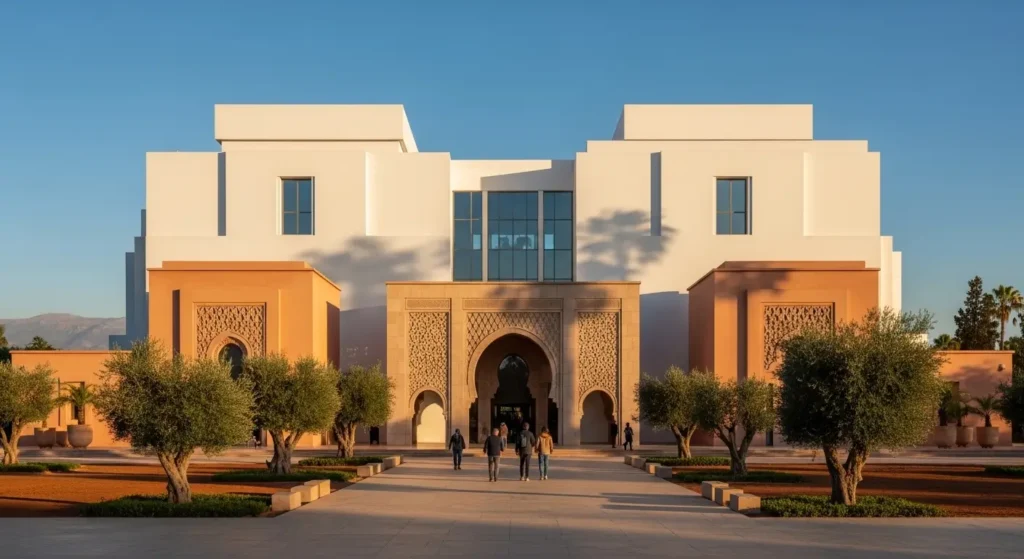
If this article has made you want to stand in front of the real thing, here is where to go.
By city:
Rabat
- Musée Mohammed VI d’Art Moderne et Contemporain — the largest collection of modern and contemporary Moroccan art in the country
- Bank Al-Maghrib Museum of Arts — a hidden gem with significant works from the pioneer generation
Marrakech
- MACAAL — rotating exhibitions of African and Moroccan contemporary art
- Musée Yves Saint Laurent Marrakech — stunning permanent collection and rotating shows
- Dar Si Said — traditional arts that give context to the modernist revolution
Casablanca
- Villa des Arts — one of the longest-running contemporary art spaces in Morocco
- Musée de la Fondation ONA — works from the modern period
Tangier
- Musée de la Kasbah — art and history in the city that defined Morocco’s cosmopolitan spirit
- Multiple independent galleries in the Ville Nouvelle
Annual art events to know:
- Marrakech Art Week — the most important contemporary art showcase in Morocco
- 1-54 Contemporary African Art Fair (Marrakech edition) — connects Moroccan artists to the international African art market
- Asilah Arts Festival — founded by Mohamed Melehi himself, still running every summer, still transforming a small coastal town into an open-air gallery
Online resources:
- Bank Al-Maghrib digital collection at bkam.ma
- MACAAL online exhibitions and artist profiles
- Artnet and Artsper for auction records and artist biographies
Frequently Asked Questions About Famous Moroccan Painters
Who is the most famous Moroccan painter of all time?
Most art historians point to either Chaïbia Talal or Farid Belkahia depending on the criteria. Chaïbia is the most internationally recognized name — a self-taught painter who reached the Museum of Modern Art in Paris without a single formal lesson. Belkahia is considered the most important figure in the development of Moroccan modern art, shaping both the art itself and the institutions that taught it.
Who is the father of modern Moroccan painting?
Farid Belkahia holds this title most widely. As director of the Casablanca School of Fine Arts, co-founder of the Casablanca movement, and the artist who most radically redefined what Moroccan painting could be — using copper, leather, henna, and Amazigh symbols instead of European canvas and oil — his influence on every Moroccan painter who followed him is immeasurable.
Are there famous female Moroccan painters?
Absolutely — and they are among the most important artists in Moroccan history. Chaïbia Talal is the most famous Moroccan painter of any gender, male or female. Safaa Erruas is one of the most internationally exhibited contemporary Moroccan artists alive today. Fatima Hassan El Farrouj has spent decades advocating for women’s visibility in Moroccan art institutions. The story of Moroccan painting cannot be told without these women.
What style do famous Moroccan painters typically use?
There is no single style — which is what makes Moroccan painting so rich. The main traditions include abstract expressionism (Gharbaoui), naïve folk art (Chaïbia Talal), geometric op art (Melehi, Chabâa), calligraphic abstraction (Belkahia, Ramhani), and contemporary figurative painting (Binebine, Zine). What unites them is a shared grounding in Moroccan cultural identity, even when the styles are radically different.
Which Moroccan painters are in international museums?
Hassan Hajjaj’s work is in the Brooklyn Museum, LACMA, the Victoria and Albert Museum, and the Guggenheim Abu Dhabi. Farid Belkahia and the pioneer painters are represented at the Mathaf Arab Museum of Modern Art in Qatar. Mahi Binebine is in the Guggenheim collection. Chaïbia Talal exhibited at the Museum of Modern Art in Paris. The list grows every year.
Where can I see Moroccan paintings in Morocco?
The best places are the Musée Mohammed VI in Rabat, MACAAL in Marrakech, and the Villa des Arts in Casablanca. For a broader picture of the contemporary scene, Marrakech Art Week and the Asilah Arts Festival are the events not to miss.
Who are the best contemporary Moroccan painters working today?
The names to know right now are Hassan Hajjaj (internationally the most collected), Mahi Binebine (Guggenheim collection, powerful figurative work), Zakaria Ramhani (calligraphic abstraction with political edge), Mounir Fatmi (conceptual and multimedia practice), and Abdellatif Zine (celebratory depictions of Moroccan daily life). Each one is building on the legacy of the pioneers while taking Moroccan painting in entirely new directions.