
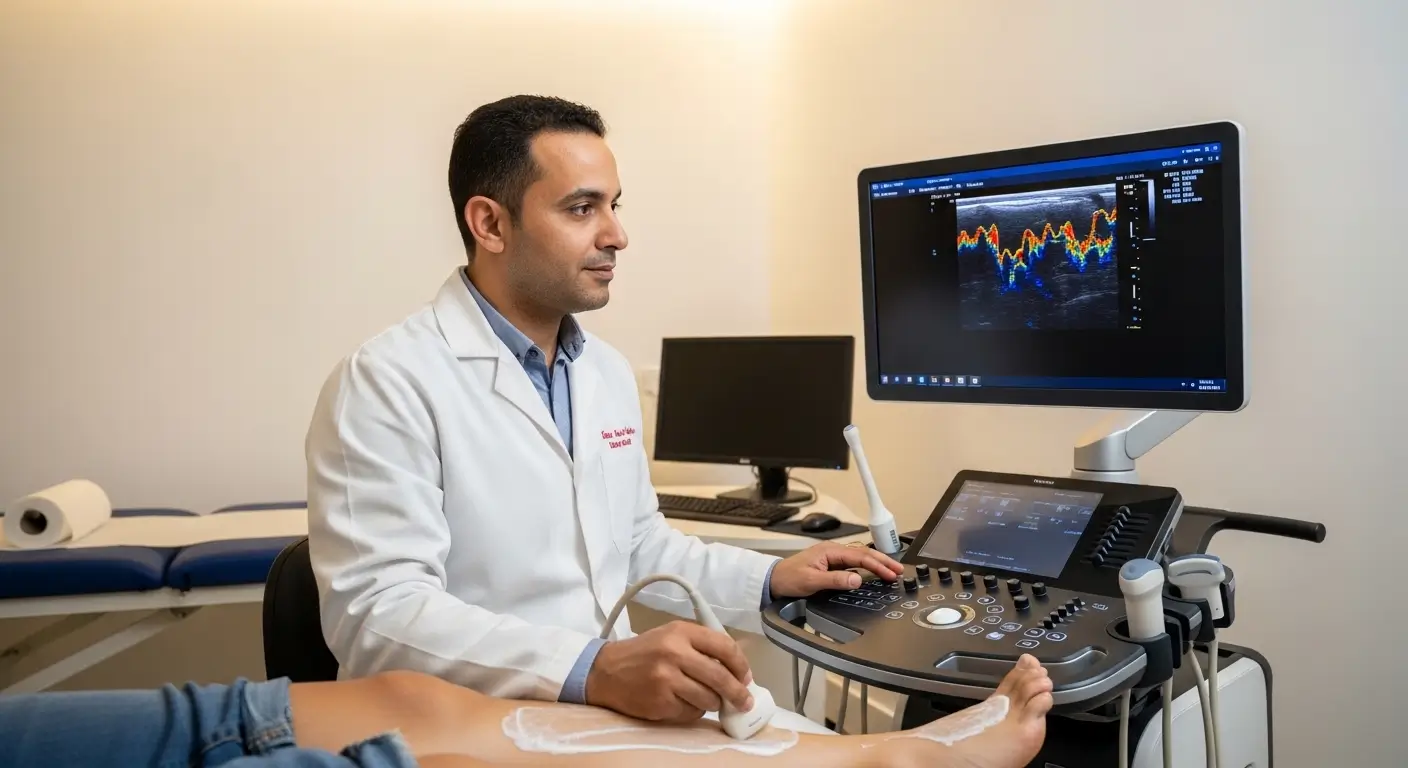
If you’re looking for the doppler ultrasound price in Morocco, here is the short answer: it ranges from 350 to 750 MAD in the private sector, depending on the exam type. Public sector prices are significantly lower — between 100 and 200 MAD — but come with longer waiting times.
Table of Contents
Important: A valid prescription (ordonnance) from a licensed doctor is required before booking any Doppler ultrasound. Without it, the exam will not be reimbursed by your insurance.
1. Doppler Ultrasound Prices in Morocco — Full Breakdown by Exam Type
The most common reason people search for doppler ultrasound price in Morocco is simple: they have a prescription and want to know what it will cost before they walk into a clinic.
The table below covers all major Doppler exam types with real price ranges across both the public and private sectors.
Price Table: Doppler Ultrasound in Morocco
| Exam Type | French Name | Private Sector (MAD) | Public Sector (MAD) | Typical Duration |
|---|---|---|---|---|
| Cardiac Doppler ultrasound | Écho-Doppler cardiaque | 450 – 650 | 150 – 200 | 30–45 min |
| Lower-limb arterial Doppler | Écho-Doppler artériel des membres inférieurs | 550 – 700 | ~200 | 30–45 min |
| Venous Doppler ultrasound | Écho-Doppler veineux | 400 – 600 | ~150 | 20–30 min |
| Renal artery Doppler | Écho-Doppler des artères rénales | 500 – 650 | ~200 | 30–40 min |
| Carotid / neck vessel Doppler | Écho-Doppler des troncs supra-aortiques (TSA) | 600 – 750 | ~200 | 30–40 min |
| Obstetric / fetal Doppler | Écho-Doppler obstétrical | 350 – 500 | ~100 | 20–30 min |
Note: These prices are for reference. Always call the clinic before booking to confirm the exact price. Differences of 30–40% for the same exam between clinics in the same city are common.
Why Do Prices Vary?
Doppler ultrasound prices in Morocco differ for several reasons:
- Type of equipment — newer digital systems cost more to operate
- Radiologist specialisation — a vascular or cardiac specialist charges more than a general radiologist
- City — Casablanca tends to have the most competitive market; smaller cities may have fewer options
- Clinic tier — a premium private clinic charges more than a neighborhood center
- Conventionné status — clinics approved by AMO (Agence Nationale de l’Assurance Maladie) follow official reference tariffs (TNR)
💡 Pro tip: Call 3 to 4 clinics and ask for the prix total de l’examen — not just the displayed tariff. The total price is what matters for your budget.
2. Insurance Reimbursement — How Much Will You Actually Pay?
Knowing the doppler ultrasound price is only half the story. If you have AMO, CNSS, CNOPS, or a private mutuelle, your actual out-of-pocket cost could be much lower.
Here is exactly how each scheme works.
CNSS (Private-Sector Employees)
If you are employed in the private sector and contribute to CNSS, here is what to know:
- Reimbursement rate: 70% of the TNR (Tarif National de Référence)
- What you get back: between 105 and 280 MAD depending on the exam type
- What you pay out of pocket: the difference between the clinic’s actual price and the 70% reimbursement
How to submit a CNSS claim:
- Get your prescription and the clinic’s detailed invoice (facture détaillée)
- Submit via the CNSS mobile app or at your nearest CNSS branch
- The deadline to submit is 6 months from the date of the exam
- Reimbursement is processed within 2 to 4 weeks
CNOPS (Civil Servants / Fonctionnaires)
CNOPS follows the same reimbursement logic as CNSS but through its own network.
- Required documents: original prescription + detailed invoice + CNOPS card
- Reimbursement timeframe: typically 2 to 6 weeks
- Key step: confirm that the clinic is on the CNOPS-approved list before booking
AMO Indépendants (Self-Employed Workers)
Self-employed workers enrolled under the AMO reform now benefit from similar coverage:
- Register through CNSS before making any claim
- Reimbursement rates are comparable to CNSS employees
- The exam must be performed at a conventionné center to qualify
Private Mutuelles (Complementary Insurance)
Many employers and banks offer mutuelle coverage that covers the ticket modérateur — the remaining co-payment after CNSS or CNOPS reimburse their share.
- Check your mutuelle contract under the section: “actes de radiologie et imagerie médicale”
- In many cases, combining CNSS + mutuelle brings your out-of-pocket cost close to zero
⚠️ Critical Rule for All Insurance Schemes
A valid prescription is mandatory for reimbursement. Without an ordonnance from a licensed doctor, neither CNSS nor CNOPS will process your claim — regardless of which clinic you used.
The prescription must specify the exact exam type using standard medical terminology.
3. Types of Doppler Ultrasound Explained — Which One Were You Prescribed
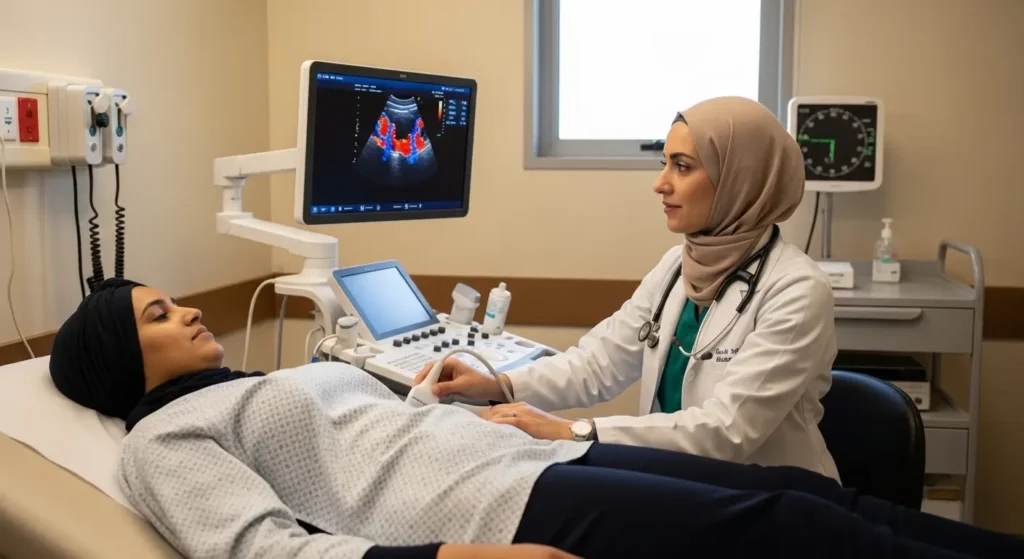
Prescriptions are often written in technical French or Arabic medical terminology. This section translates each exam type into plain language so you know exactly what you need to book.
Cardiac Doppler Ultrasound (Écho-Doppler Cardiaque)
What it examines: The structure and function of your heart — valves, wall motion, and how efficiently your heart pumps blood (ejection fraction).
Commonly prescribed for:
- Palpitations or irregular heartbeat
- Shortness of breath
- High blood pressure monitoring
- Suspected heart valve problems
Who prescribes it: Cardiologist Where it is done: Cardiology clinics or cardiology departments in hospitals Duration: 30 to 45 minutes
Lower-Limb Arterial Doppler (Écho-Doppler Artériel des Membres Inférieurs)
What it examines: Blood flow through the arteries of your legs, checking for blockages, narrowing, or reduced circulation.
Commonly prescribed for:
- Leg pain when walking (claudication)
- Cold or numb feet
- Cardiovascular risk screening in diabetic patients
- Follow-up after arterial surgery
Who prescribes it: Vascular surgeon, cardiologist, or general practitioner Where it is done: Radiology or vascular surgery centers Duration: 30 to 45 minutes
Venous Doppler Ultrasound (Écho-Doppler Veineux)
What it examines: The veins of the legs and their blood flow, detecting obstruction, reflux, or clots.
Commonly prescribed for:
- Suspected deep vein thrombosis (DVT / phlébite)
- Varicose veins assessment
- Leg swelling or heaviness
- Post-surgical monitoring
Who prescribes it: Vascular surgeon, phlebologist, or general practitioner Where it is done: Radiology centers Duration: 20 to 30 minutes
Renal Artery Doppler (Écho-Doppler des Artères Rénales)
What it examines: The morphology and patency of the arteries supplying your kidneys — detecting blockages, narrowing, aneurysms, or compression.
Commonly prescribed for:
- Refractory high blood pressure that does not respond to medication
- Kidney function monitoring in patients with chronic kidney disease
- Follow-up after renal artery procedures
Who prescribes it: Nephrologist, vascular surgeon, or internist Where it is done: Radiology centers with abdominal imaging capability Duration: 30 to 40 minutes
Carotid / Neck Vessel Doppler (Écho-Doppler des Troncs Supra-Aortiques — TSA)
What it examines: The carotid and vertebral arteries that supply blood to the brain, looking for plaque build-up, narrowing, or clots.
Commonly prescribed for:
- Following a TIA (mini-stroke / accident ischémique transitoire)
- Stroke risk screening in patients with hypertension or diabetes
- Dizziness or vision disturbances of vascular origin
Who prescribes it: Neurologist, cardiologist, or vascular surgeon Where it is done: Radiology or vascular neurology centers Duration: 30 to 40 minutes
Obstetric / Fetal Doppler (Écho-Doppler Obstétrical)
What it examines: Blood flow between the placenta and the fetus, assessing oxygen and nutrient delivery.
Commonly prescribed for:
- High-risk pregnancies (diabetes, hypertension, twin pregnancies)
- Suspected fetal growth restriction
- Reduced fetal movements
- Routine monitoring in late-stage pregnancy
Who prescribes it: Obstetrician or gynecologist Where it is done: Obstetric ultrasound centers Duration: 20 to 30 minutes
4. What to Expect During a Doppler Ultrasound
Many people searching for doppler ultrasound price in Morocco are also anxious about the procedure itself. Here is everything you need to know before your appointment.
Is It Painful?
No. A Doppler ultrasound is completely painless and non-invasive. There is no injection, no X-ray radiation, and no incision of any kind.
The only sensations you will feel are:
- The coolness of the ultrasound gel applied to your skin
- Slight pressure from the handheld probe
It is safe during pregnancy and can be repeated as many times as medically required.
Step-by-Step: What Happens During the Exam
- Arrival — Check in at reception. Bring your prescription, insurance card, and ID.
- Preparation — You will be asked to lie down on an examination table. Loose clothing is recommended.
- Gel application — A water-based gel is applied to the skin over the area being examined.
- Scanning — The radiologist moves a handheld probe over the skin, capturing real-time images and measuring blood flow speed and direction.
- Duration — Most Doppler exams take between 20 and 45 minutes depending on the exam type.
- Results — A written report (compte rendu) is typically provided at the end of your appointment or within 24 to 48 hours.
Practical Logistics
| Question | Answer |
|---|---|
| Can I bring someone? | Yes — a companion is generally permitted |
| What should I wear? | Loose clothing with easy access to the area being examined |
| When should I arrive? | 10 minutes before your appointment for paperwork |
| Can I drive home after? | Yes — no recovery time is required |
| Is it safe during pregnancy? | Yes — no radiation, completely safe |
5. How to Prepare for Your Doppler Ultrasound (by Exam Type)
Preparation varies depending on which type of doppler ultrasound you are having. The checklist below tells you exactly what to do — and not do — before each exam.
General Rules (All Exam Types)
✅ Do not apply moisturizing creams or body lotion to the area on the day of the exam — this interferes with gel adhesion and image quality.
✅ Wear comfortable, loose-fitting clothing that provides easy access to the area being examined.
✅ Bring your prescription — without it, the exam may not be performed and will not be reimbursable.
✅ Bring your insurance card (CNSS/CNOPS) and a valid ID.
Preparation by Exam Type
| Exam Type | Preparation Required? | Specific Instructions |
|---|---|---|
| Cardiac Doppler | No | Avoid heavy exercise in the 2 hours prior |
| Lower-limb arterial Doppler | No | Wear or bring shorts for easy access to the legs |
| Venous Doppler | No | Wear or bring shorts |
| Renal artery Doppler | Yes | Fast for 4–6 hours before; follow a low-gas diet for 48 hours (avoid beans, cabbage, carbonated drinks) |
| Carotid / neck Doppler | No | Avoid high-neck clothing |
| Obstetric / fetal Doppler | Usually no | Follow your obstetrician’s specific instructions if given |
💡 Always call ahead to confirm preparation instructions when booking. Requirements can vary slightly between clinics.
6. Where to Get a Doppler Ultrasound in Morocco
Once you know the doppler ultrasound price range and your exam type, the next step is choosing where to go. Here is a breakdown of your options.
Public Sector vs. Private Sector
| Public Sector | Private Sector | |
|---|---|---|
| Price | 100 – 200 MAD | 350 – 750 MAD |
| Waiting time | 2 to 6 weeks | 24 to 72 hours |
| Prescription required | Yes (from a public-sector doctor in most cases) | Yes (any licensed doctor) |
| Reimbursement | RAMED / reduced rates | AMO/CNSS/CNOPS if conventionné |
| Best for | RAMED holders, non-urgent cases | Urgent cases, patients with private insurance |
City-by-City Guide
Casablanca
- Highest concentration of private radiology and vascular centers in Morocco
- Most competitive pricing — shopping around pays off here
- Online booking is widely available at most private centers
- Look for centers along Boulevard Anfa, Maarif, and the Ain Diab corridor
Rabat
- Mix of public CHU (CHU Ibn Sina) and private centers
- Public-sector waiting times are slightly shorter than in Casablanca
- Several private centers near Agdal and Hassan offer conventionné status
Marrakech
- Growing private radiology sector, especially near Guéliz
- Some centers explicitly list doppler ultrasound prices online for transparency
- For complex vascular exams, confirm equipment availability before booking
Fès
- CHU Hassan II is the primary public-sector option for complex exams
- Private centers are concentrated in the Ville Nouvelle district
- Prices tend to be slightly lower than Casablanca for comparable exams
Agadir
- Fewer specialized vascular centers than northern cities
- The Souss-Massa Regional Hospital covers public-sector needs
- For complex cardiac or vascular Doppler, call ahead to confirm specialist availability
How to Find a Conventionné Center
A conventionné center is one approved by AMO — your exam there qualifies for CNSS/CNOPS reimbursement.
To find one:
- Visit the official CNSS website (cnss.ma) and use the provider search tool
- Visit the official CNOPS website (cnops.org.ma) for the civil servant-approved list
- Ask your prescribing doctor directly — they typically know which nearby centers are conventionné
- Always confirm by phone before your appointment — the approved list is updated regularly
7. Frequently Asked Questions About Doppler Ultrasound Price in Morocco
Can I get a Doppler ultrasound without a prescription in Morocco?
Yes — some private clinics will perform the exam without a prescription. However, you will not be reimbursed by CNSS, CNOPS, or any AMO scheme without a valid ordonnance. A prescription is mandatory for all insurance claims.
Is a Doppler ultrasound reimbursed by CNSS / CNOPS?
Yes, at 70% of the TNR (Tarif National de Référence), provided two conditions are met:
- You have a valid prescription from a licensed doctor
- The exam is performed at a conventionné center
How long does a Doppler ultrasound take?
It depends on the exam type:
- 20 to 30 minutes — venous Doppler, obstetric Doppler
- 30 to 45 minutes — cardiac, arterial, renal, and carotid Doppler
Do I need to fast before a Doppler ultrasound?
Only for the renal artery Doppler (écho-Doppler des artères rénales). Fasting for 4 to 6 hours before the exam is recommended because intestinal gas reduces image quality. A low-gas diet for 48 hours prior also helps.
For all other Doppler exam types — cardiac, limb, neck, and obstetric — no fasting is required.
Who performs a Doppler ultrasound — a cardiologist or a radiologist?
It depends on the exam type:
- Cardiac Doppler → performed by a cardiologist
- Vascular Doppler (limbs, renal, carotid) → performed by a radiologist or vascular specialist
What is the difference between a standard ultrasound and a Doppler ultrasound?
| Standard Ultrasound | Doppler Ultrasound |
|---|---|
| Shows anatomical structures (shape, size, position of organs) | Adds real-time blood flow analysis |
| Measures size and texture | Measures speed and direction of blood flow through vessels |
| Used for general organ assessment | Used for vascular, cardiac, and circulatory evaluation |
A Doppler ultrasound includes everything a standard ultrasound does, plus the blood flow data layer — which is why it costs more.
Which doctor can prescribe a Doppler ultrasound?
Any licensed physician in Morocco can write the prescription. It is most commonly prescribed by:
- Cardiologists (cardiac Doppler)
- Vascular surgeons (arterial and venous Doppler)
- General practitioners (initial screening)
- Nephrologists (renal artery Doppler)
- Neurologists (carotid Doppler)
- Obstetricians and gynecologists (obstetric Doppler)
Summary: Key Things to Remember
| Topic | Key Point |
|---|---|
| Price range | 350 – 750 MAD private / 100 – 200 MAD public |
| Most expensive exam | Carotid / neck vessel Doppler (up to 750 MAD) |
| Least expensive exam | Obstetric / fetal Doppler (from 350 MAD) |
| CNSS reimbursement | 70% of TNR — submit claim within 6 months |
| Prescription required | Yes — for both booking and reimbursement |
| Fasting required | Only for renal artery Doppler |
| Is it painful? | No — completely painless, no radiation |
| Who performs it | Radiologist or specialist depending on exam type |