
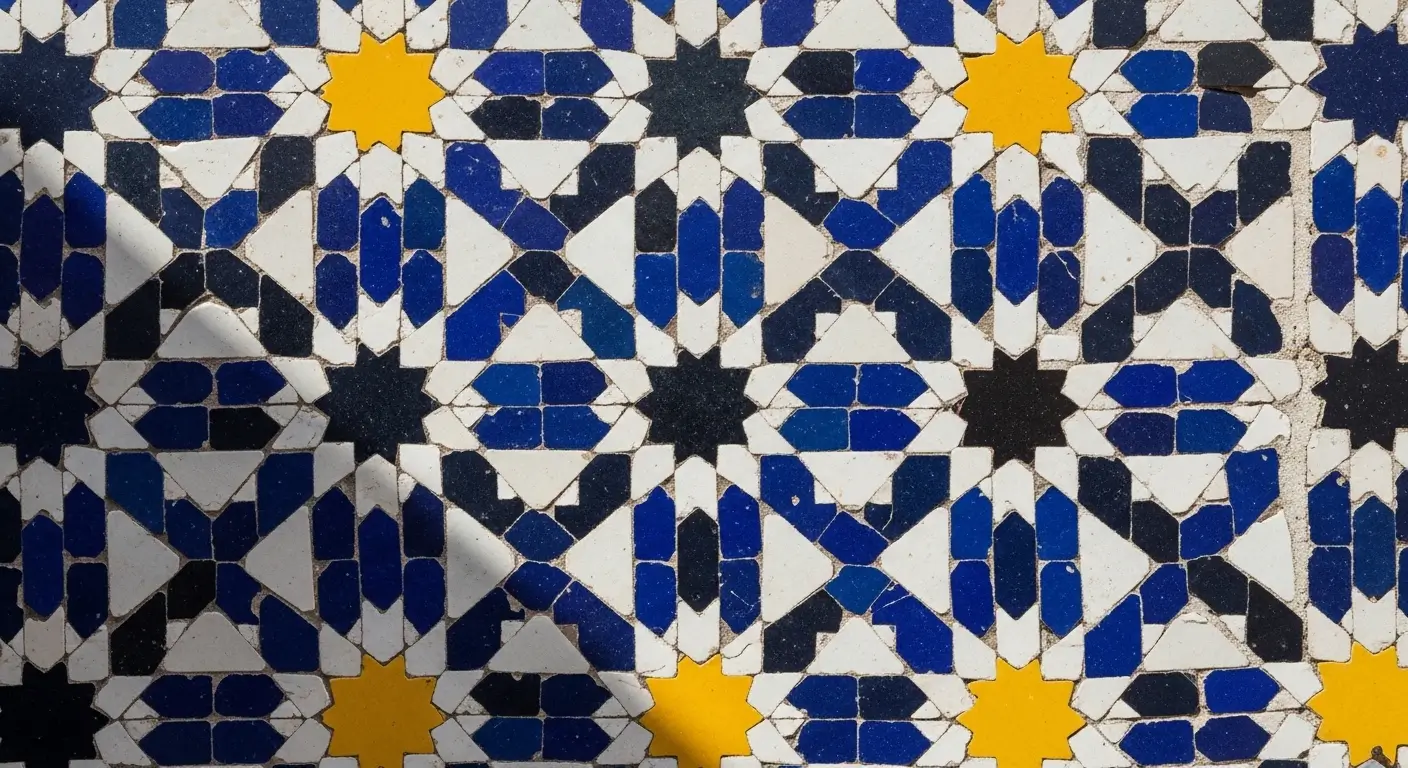
Moroccan mosaic art is not a decorative trend. It is a living craft that has shaped the walls, floors, and identity of Morocco for over a thousand years.
If you have ever stopped in front of a fountain in Fes, walked through the courtyard of a riad in Marrakech, or run your hand along the walls of a medersa, you have experienced it firsthand. That geometric explosion of color and precision is zellige — and it belongs to Morocco like nothing else does.
This guide covers everything: the full history, how it is made, what the patterns mean, which cities produce it, and how you can use it in your home or build a business around it.
Table of Contents
What Is Moroccan Mosaic Art? The Definitive Definition
Moroccan mosaic art, known as zellige (also spelled zellij or zillij), refers to the ancient craft of creating intricate decorative surfaces from small, individually hand-chiseled glazed terracotta tiles fitted together into geometric patterns.
This is not painted tile. This is not machine-made ceramic. Every piece is cut by hand, shaped by memory, and assembled into compositions that have no fixed end point — the patterns can theoretically extend forever.
The Three Spellings — All Correct
| Spelling | Used Where |
|---|---|
| Zellige | French-speaking contexts, most international usage |
| Zellij | Arabic transliteration, academic writing |
| Zillij | Darija and regional Moroccan usage |
All three refer to the same craft. When Moroccans search for this art form, they use all three interchangeably — and any serious guide on moroccan mosaic art should acknowledge all of them from the start.
What Makes Zellige Different from Other Tiles
- Hand-cut: each piece is shaped individually with a special hammer
- Geometric only: Islamic artistic tradition avoids depicting living things, so the entire visual language is abstract and mathematical
- Face-down assembly: the pattern is built in reverse, face down on the floor, then flipped — meaning the craftsman cannot see the result until it is complete
- Irreversible: once the cement sets, the composition is permanent
- Alive: small surface irregularities and color variations are marks of authenticity, not defects
Quick Terminology Reference
| Term | Meaning |
|---|---|
| Maalem | Master craftsman — the highest skill level |
| Menqach | The sharp adze-like hammer used to cut tiles |
| Tessellation | The mathematical principle of repeating shapes without gaps |
| Azulejo | Spanish and Portuguese word sharing the same Arabic root as zellige |
| Dar | Traditional Moroccan home where zellige is commonly used |
Moroccan mosaic art is the only major tilework tradition in the world where the craft survived virtually unchanged for over ten centuries in a single country. After the 15th century, zellige declined everywhere in the Islamic world — except Morocco, where it is still made today using the same tools and techniques as the Merinid era.
The Full History of Moroccan Mosaic Art — By Dynasty, Not Just By Century
Most articles about moroccan mosaic art say “it dates back to the 10th century” and stop there. That tells you almost nothing. Here is what the full timeline actually looks like.
Origins: The 10th Century — From Roman Inspiration to Moroccan Identity
Zellige was born in Morocco in the 10th century. Early craftsmen were inspired by the Greco-Roman mosaic tradition they encountered — but instead of cutting expensive polished marble (tesserae), they used fragments of colored glazed earthenware.
- Much easier to cut than marble
- Clay was locally abundant
- Glazing technology (using tin oxide to create opaque colored surfaces) had been mastered by Persian potters
- Early zellige used only white and brown tones
- The word “zellige” shares its Arabic root with the Spanish word azulejo — both mean “little polished stone”
11th–12th Century — The Geometric Language Emerges
This is when moroccan mosaic art became recognizably itself:
- Star polygon patterns appear for the first time — the visual fingerprint of zellige
- The art spreads through the Maghreb and into Andalusia
- Islamic geometric principles formalize: no living forms, only infinite repeating geometry
- Zellige becomes associated with royalty, spiritual spaces, and power
The Almohad Dynasty (12th Century) — Royal Patronage
- Zellige receives official architectural patronage under the Almohads
- Moves from private homes to monumental public buildings: mosques, madrasas, palaces
- Geometric complexity increases, guided by Islamic mathematical theory
- Morocco begins to develop its own distinct zellige identity, separate from other Islamic mosaic traditions
The Merinid Dynasty (13th–15th Century) — The Golden Age
This is the era that defined moroccan mosaic art as the world knows it today.
- Fes and Marrakech become the twin capitals of zellige production
- Construction of landmark madrasas: Bou Inania, El Attarin, Ben Youssef
- Interlacing strapwork patterns become standard
- The craft becomes the definitive marker of Moroccan architectural refinement
- Zellige panels are exported across the Islamic world
Saadian & Alaouite Periods (16th–20th Century) — Evolution Without Abandonment
While zellige declined in every other country, Morocco continued to develop it:
| Innovation | Period |
|---|---|
| New colors introduced: bright red, yellow, dark blue | Saadian era |
| Rosette compositions grow in scale and complexity | 17th–18th century |
| Cylindrical pillars covered in full tilework | 19th century |
| Bab Bou Jeloud gate in Fes built with signature blue-green zellige | Early 20th century |
| Zellige appears in hotels, hammams, private residences | Modern era |
Moroccan Mosaic Art Today
- Still a defining feature of Moroccan architecture — from royal palaces to neighborhood hammams
- Fes remains the global capital of zellige production
- International demand from luxury hotels, private villas, and designers worldwide
- The craft is alive but under pressure — a crisis explored in full in Section 4
How Zellige Is Made — The Complete Maalem Workflow
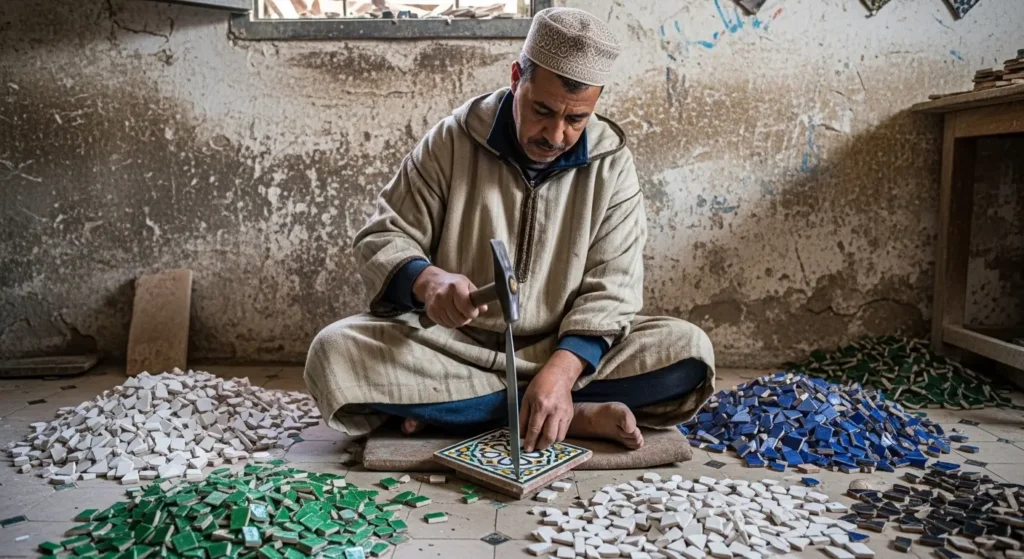
Understanding the making process is essential for anyone who wants to buy, commission, or simply appreciate moroccan mosaic art at the level it deserves. This is not a simple craft. It is one of the most technically demanding traditional arts in the world.
The Five Specialists Inside a Zellige Workshop
Moroccan mosaic art is not made by one person. A traditional workshop involves a division of highly specialized labor:
| Role | Responsibility |
|---|---|
| The Designer | Creates the geometric composition — often entirely from memory |
| The Potter | Mixes clay, forms tiles, fires them in a kiln |
| The Cutter | Uses the menqach to hand-chisel each tile into its exact shape |
| The Finisher | Bevels the edges so tiles sit tight against each other |
| The Layout Artist | Assembles the final composition face-down before cementing |
Step 1: Clay Preparation
- Raw clay is sourced from the Fes region — valued for exceptional strength and plasticity
- Clay is mixed, spread to uniform thickness, and cut into approximately 10cm squares
- Squares are sun-dried, then loaded into a kiln for the first (bisque) firing
Step 2: Glazing
- Only the front face of each square is dipped into colored glaze
- Each color requires a separate batch and a separate kiln firing
- Traditional colors: cobalt blue, green, black, white, saffron yellow, terracotta brown
- The opaque colored glaze is created using tin oxide — a technique over a thousand years old
Step 3: Cutting — The Heart of the Craft
This is where moroccan mosaic art separates itself from everything else:
- The cutter draws the required geometric shape on the glazed face with a brush
- He strikes along the line with the menqach (sharp hammer) in a single precise blow
- He bevels the edges with a smaller hammer for a tight fit
- Shapes (stars, hexagons, triangles, crosses, diamonds) are memorized by master cutters — not traced from templates
In Tétouan, tiles are cut before baking, not after. This produces harder enamel but slightly less vibrant color and looser tile fitting than the Fes method.
Step 4: Pattern Assembly (The Face-Down Method)
- The layout artist draws the final design on the floor
- Tiles are placed face-down on a paper pattern in the correct arrangement
- This step is completely irreversible — once placed, the composition is fixed
- The cutter cannot see the colored face while assembling — he works from memory and experience alone
Step 5: Cementing and Curing
- A metal frame is placed around the completed arrangement
- A slurry of cement and natural binders is poured over the back of the tiles
- It is pressed carefully into every joint
- Left to harden until completely stone-hard
Step 6: Reveal, Polish, and Deliver
- The entire panel is lifted upright — the colorful face is seen for the first time
- The surface is polished with water and cloth
- The finished panel is shipped to its destination: a fountain, a floor, a wall, a table top
This entire process — from raw clay to polished panel — is what makes authentic moroccan mosaic art impossible to replicate with machines while preserving what matters most: the controlled imperfection that only a human hand can produce.
The Maalem — Who He Is, How He Trains, and Why the Craft Is at Risk
The maalem is the beating heart of moroccan mosaic art. Without him, there is no zellige — only imitation.
What Makes a Maalem
A maalem is not simply a tile cutter. He is:
- An expert mason who understands architecture and structure
- A geometric mathematician who carries hundreds of pattern forms in his memory
- A cultural custodian who carries a thousand years of embodied knowledge
- A teacher responsible for passing the craft to the next generation
The Training Path
| Stage | Details |
|---|---|
| Start of training | Between ages 6 and 14 |
| Apprenticeship length | Approximately 10 years |
| Years to Maalem status | Many additional years beyond apprenticeship |
| Traditional setting | Family workshops — father to son |
| Modern setting | 58 artisan schools across Morocco |
The craft cannot be learned from a book or a video. The geometric shapes, the pressure of the menqach, the angle of the bevel — all of this is transmitted in person, by doing, over years.
The Crisis: A Craft Without Successors
This is the hardest truth about moroccan mosaic art right now:
- Interest in zellige apprenticeships has been declining sharply
- At one artisan school in Fes with 400 enrolled students, only 7 were studying zellige making
- Young Moroccans are drawn toward better-paying, less physically demanding work
- The average Maalem took a decade to train — there is no shortcut
- When a Maalem retires without passing on his knowledge, that knowledge is gone permanently
What Can Be Done
- Choose authentic zellige for home renovations — every purchase supports a Maalem’s livelihood
- Support artisan schools in Fes, Marrakech, and other cities
- Commission Maalems directly rather than buying imitation products
- Advocate for UNESCO recognition of zellige as an Intangible Cultural Heritage
- Share the story — every time moroccan mosaic art is properly attributed, the culture that created it gains visibility
Zellige Patterns, Colors & Their Symbolism
Moroccan mosaic art is not random decoration. Every pattern follows precise mathematical laws, and every color carries meaning.
The Mathematics Behind Every Pattern
- Zellige is governed by tessellation: geometric shapes that cover a surface completely without gaps or overlaps
- Patterns are infinitely extensible — in theory, the design never has to end
- This mathematical infinity is a deliberate expression of a philosophical idea: the infinite nature of the divine
- Scholars from mathematics, engineering, and computer science have studied zellige patterns and found them to anticipate concepts that Western mathematicians only formalized centuries later
The reason geometry became the dominant language of moroccan mosaic art is theological: Islamic artistic tradition avoids depicting living beings, so the visual energy that might have gone into portraiture or figurative painting was instead channeled entirely into geometric perfection.
The Main Pattern Families
| Pattern Family | Description | Common Use |
|---|---|---|
| Star Polygons | 8, 12, or 16-pointed stars radiating from a center | Feature panels, fountains |
| Interlacing Strapwork | Bands that weave over and under each other | Wall borders, dados |
| Rosette Compositions | Stars expanding outward in concentric layers | Large floors, ceilings |
| Checkerboard Grounds | Simple alternating tile backgrounds | Framing complex compositions |
| Cross and Diamond Grids | Repeating crosses and diamond fields | Floor coverings, large walls |
The Traditional Color Palette and Its Meaning
| Color | Symbolic Meaning |
|---|---|
| Cobalt Blue | Water, sky, spiritual protection, the divine |
| Green | Islam, paradise, nature, blessing |
| White | Purity, light, clarity, openness |
| Black | Strength, depth, grounding, contrast |
| Saffron / Yellow | Royalty, prestige, warmth, solar energy |
| Brown / Terracotta | The earth, roots, Morocco’s landscape and clay |
The traditional palette maps directly onto the four classical elements:
- Earth → brown and terracotta
- Water → blue
- Air → white
- Fire → yellow and saffron
How Patterns Are Named and Remembered
- Pattern names are regional and oral — many have no written record
- The same composition may have a different name in Fes, Marrakech, and Tétouan
- Maalems memorize these names and forms from childhood
- This oral transmission is part of what makes moroccan mosaic art uniquely fragile — and uniquely human
Modern Pattern Innovations
- Contemporary designers are adapting zellige geometry to glass mosaic, large-format tiles, and even digital surfaces
- Glass zellige introduces a wider color range and reflective properties the traditional craft cannot achieve
- Important distinction: a “zellige-inspired” product made by machine is not the same as authentic moroccan mosaic art made by a Maalem
Moroccan Mosaic Art Across the Country — Regional Differences by City
One of the most overlooked facts about moroccan mosaic art is that it is not uniform across the country. Each major city has its own tradition, its own technique, and in some cases its own visual identity.
Fes — The Capital of Zellige
Fes is the undisputed center of moroccan mosaic art production. When experts, collectors, and architects around the world specify authentic zellige, they almost always mean Fes zellige.
The Fes Technique:
- Tiles are cut after baking
- This produces the most vibrant colors and the tightest tile joints of any production method
- Workshops are concentrated in the ancient medina
- Many workshops have been in the same family for generations
Must-See Zellige in Fes:
- Medersa El Attarin — considered among the finest zellige panels ever made
- Nejjarine Fountain — the iconic public fountain
- Medersa Bou Inania — a Merinid-era masterpiece
The Zellige de Fès Certification: The Zellige de Fès mark is an official designation guaranteeing that the product was handmade by artisans in Fes using natural clay from the region, traditional techniques, and mineral glazes. Look for it when purchasing.
Marrakech — The Palace Tradition
- Follows the Fes technique but with distinct stylistic influences
- Home to some of the most ambitious large-scale zellige installations in history
- Higher tourist demand means larger commercial production — quality varies widely
- Must-see: Bahia Palace, Medersa Ben Youssef, El Badi Palace
Tétouan — The Northern School
Tétouan is the most technically distinct zellige tradition in Morocco:
| Feature | Tétouan | Fes |
|---|---|---|
| Cutting method | Before baking | After baking |
| Enamel hardness | Higher | Standard |
| Color vibrancy | Lower | Higher |
| Tile joint tightness | Looser | Tighter |
| Visual character | More muted, precise | Bold, vivid |
Tétouan’s tradition was strongly shaped by Andalusian refugees who brought their own mosaic heritage with them. The result is a zellige style that feels subtly different — and is recognizable to an informed eye.
Meknes — The Royal City
- Follows the Fes style closely
- Some of the most spectacular royal zellige in Morocco is here
- Must-see: the Tomb of Moulay Ismail — a masterpiece of Alaouite-era moroccan mosaic art
Salé — The Workshop City
- An important production hub serving the Rabat-Salé metropolitan area
- Follows Fes standards
- Increasingly significant for commercial and export-scale orders
Chefchaouen — The Blue City
- Famous for its blue-washed walls and painted surface decoration
- Not a zellige production center, but a relevant reference for Moroccan tile culture
- The blue of Chefchaouen is paint, not zellige — an important distinction for buyers and designers
Where to See, Buy, and Commission Authentic Moroccan Mosaic Art
The 10 Greatest Zellige Installations in Morocco
These are the benchmarks. Any Moroccan who wants to truly understand moroccan mosaic art should see at least one of these in person:
- Medersa El Attarin (Fes) — floor-to-ceiling panels widely considered among the finest ever made
- Nejjarine Fountain (Fes) — the most photographed zellige fountain in the country
- Medersa Bou Inania (Fes) — Merinid grandeur at its height
- Bahia Palace (Marrakech) — extraordinary courtyard and reception room zellige
- Medersa Ben Youssef (Marrakech) — the largest medersa in Morocco
- Tomb of Moulay Ismail (Meknes) — the finest Alaouite-era royal zellige
- Mahkama du Pacha (Casablanca) — a major 20th-century installation
- Royal Palace gates (Rabat and Fes) — ceremonial entrance zellige at scale
- Kasbah Telouet (High Atlas) — rarely visited, extraordinary late-era zellige
- Any medina riad in Fes — zellige in its natural everyday habitat
How to Tell Authentic Zellige from an Imitation
This matters enormously — for buyers, homeowners, and anyone who cares about what they are actually purchasing.
Signs of Authentic Moroccan Mosaic Art:
- Slight surface irregularities — each tile was cut by hand, so no two are perfectly identical
- Color variation between neighboring tiles of the same color (natural clay and glaze variation)
- Visible cut marks on the back of each tile
- A rough plaster back, not a smooth industrial adhesive backing
- Zellige de Fès certification label from verified retailers
Signs of a Mass-Produced Imitation:
- Perfectly uniform, machine-smooth surface
- Identical tiles with zero variation in color or size
- A smooth, industrial backing
- Significantly lower price per m²
- “Zellige-style” language rather than “authentic zellige”
How to Commission a Maalem for Your Home
This is the right way to bring moroccan mosaic art into a renovation project:
- Visit medina workshops in Fes or Marrakech — view completed work and portfolio
- Agree on the design: pattern family, color palette, dimensions
- Discuss lead times: custom zellige typically takes 4–8 weeks
- Arrange installation: zellige requires a specialist installer, often the Maalem himself or his team
- Plan maintenance: periodic resealing of grout, no acidic cleaning products
Where to Buy Zellige Tiles in Morocco
| Source | Best For | Notes |
|---|---|---|
| Fes medina workshops | Custom and bulk authentic tiles | Best quality-to-price ratio |
| Marrakech souks | Smaller quantities, decorative pieces | More tourist-oriented pricing |
| Certified online suppliers | International buyers, convenience | Verify Zellige de Fès certification |
| Artisan school cooperatives | Supporting the craft directly | Often sells smaller format pieces |
Moroccan Mosaic Art in Modern Homes — A Practical Design Guide
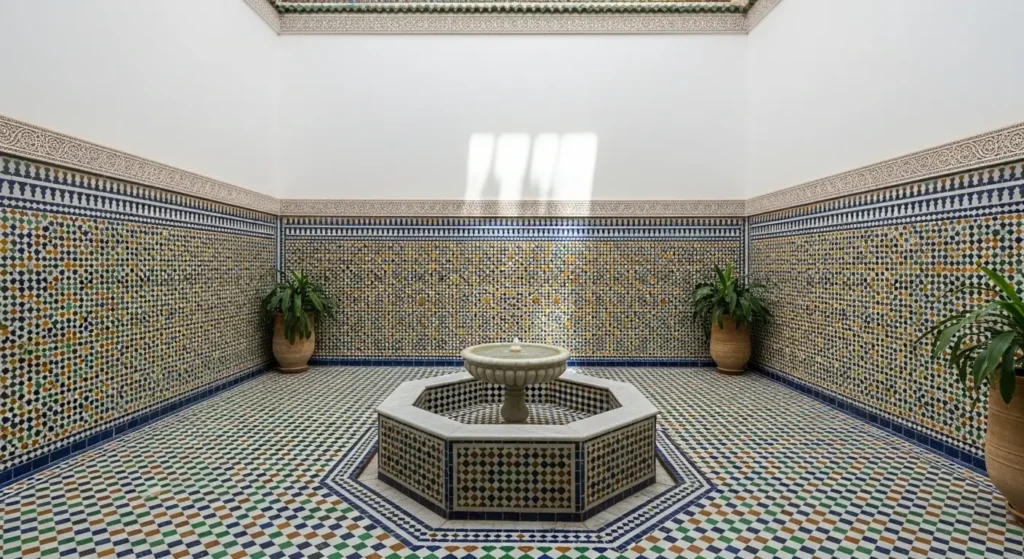
Zellige is not just for palaces and medersas. It belongs in homes — and increasingly, it is being used in new and creative ways.
Traditional Applications
- Riad courtyards: floor and lower wall zellige framing a central fountain — the classic
- Hammams: full-wall and floor installations in bathhouses
- Dar reception rooms: zellige dado panels (the lower portion of the wall) in formal spaces
- Mosques and mausoleums: the original and most prestigious context
Contemporary Applications in Moroccan Homes
| Location | Application | Notes |
|---|---|---|
| Kitchen | Backsplash behind the stove or sink | Most popular entry point today |
| Bathroom | Shower surrounds, floor, vanity back | Water-resistant, easy to clean |
| Swimming pool | Surround and interior lining | Zellige’s durability makes it ideal for water exposure |
| Living room | Feature wall or fireplace surround | Bold visual impact |
| Entrance | Floor medallion or full floor | First impression statement |
| Terrace | Outdoor flooring | Weather-resistant when properly sealed |
| Furniture | Table tops, bench inlays | Custom craft pieces |
Mixing Zellige with Modern Interiors
Moroccan mosaic art does not require a traditional setting to look right. It can work beautifully in minimalist and contemporary spaces when used thoughtfully:
- Single-color zellige fields: one color, one simple pattern — pairs perfectly with white walls, concrete, and natural wood
- Bold multicolor traditional compositions: for those who want the full visual impact of the craft
- Accent borders only: a zellige border in an otherwise plain-tile space adds texture without overwhelming
- Grout color matters enormously: white grout emphasizes individual tiles; grey grout lets the pattern read as a surface
Practical Considerations
| Factor | What to Know |
|---|---|
| Cost | Higher than ceramic tile but lasts generations with proper care |
| Installation | Requires a specialist — not a standard tile fitter |
| Maintenance | Seal grout regularly, no acidic cleaners, repair chips early |
| Sourcing | Buy directly from Fes or Marrakech workshops for the best ratio of quality to price |
| Lead time | Custom zellige: 4–8 weeks; stock items: available immediately |
Zellige as a Business — The Export and Trade Guide
Morocco exports moroccan mosaic art to luxury interior design projects around the world. If you are a craftsman, an entrepreneur, or an artisan looking to grow, this section is for you.
Where Moroccan Mosaic Art Is Exported
- Europe: France, Spain, UK, Belgium, Germany — the largest markets
- North America: USA and Canada — growing demand from luxury renovations
- Gulf States: UAE, Saudi Arabia, Qatar — high-spend hotel and villa projects
- Australia and New Zealand: smaller but high-value market
The demand is driven by three trends:
- Global growth in luxury interior design that values authentic handcraft
- Mainstream adoption of “Moroccan aesthetic” in hotels, restaurants, and spas worldwide
- A consumer backlash against mass-produced materials in favor of provenance and story
How the Export Supply Chain Works
| Stage | Details |
|---|---|
| Production | Fes workshops produce the majority of export-grade zellige |
| Minimum orders | Typically from 100 m² for custom wholesale |
| Lead times | 4–8 weeks standard, 8–12 weeks for custom designs |
| Export agents | Based in Fes and Casablanca — handle logistics and customs |
| Pricing model | Per m², with significant retail markup abroad |
The Zellige de Fès Certification — What It Means for Exporters
- Official designation guaranteeing authentic handcraft from Fes
- Uses natural clay from the region, traditional techniques, mineral glazes
- Increasingly required by high-end international buyers as proof of authenticity
- Producers in Fes can apply through official artisan channels
- Displaying the mark commands a price premium in international markets
Business Opportunities for Moroccan Entrepreneurs
- Direct-to-consumer e-commerce: sell authentic moroccan mosaic art internationally without a middleman — margin is significantly higher
- Design consultancy: combine zellige sourcing with installation services for high-end residential clients
- Custom project studio: serve international architects and interior designers who specify authentic zellige by name
- Workshop tourism: zellige-making classes for visitors — growing segment in Fes and Marrakech
- Restoration specialists: aging zellige in historic riads and hotels constantly needs repair and restoration
Challenges to Be Aware Of
- Machine-made competition: imitation “zellige-style” tiles from Spain and China undercut on price — your advantage is authenticity and certification
- Counterfeit products: some sellers market machine-cut tile as authentic moroccan mosaic art — this damages the entire market
- Logistics for small producers: customs documentation and shipping for small orders can be disproportionately complex
- Price pressure: international buyers often push for lower prices — resist compromising on authentic production methods
Preservation, Threat, and Cultural Pride
Moroccan mosaic art survived the fall of dynasties, centuries of wars, colonial rule, and globalization. The threat it faces today is quieter — but no less serious.
The Threats Facing Zellige
- Disappearing apprentices: the number of young Moroccans entering zellige training has fallen sharply
- Machine-made competition: cheap imitations undermine the economic case for authentic production
- Urbanization: young people in Fes and Marrakech have more options than their grandparents did — and zellige apprenticeship is physically demanding, slow to pay, and requires years before any mastery is achieved
- Knowledge loss: when a Maalem retires without successors, the specific patterns, techniques, and shortcuts he carried in his memory are gone permanently — they were never written down
What the Moroccan Government Is Doing
- 58 artisan schools across Morocco now offer formal zellige training
- Government cultural heritage programs support craft preservation
- Geographic indication protections (similar to wine appellations) are being developed for Moroccan crafts, including zellige
- The Zellige de Fès certification is part of this official protection framework
International Recognition
- Growing international scholarly attention to zellige — from mathematicians, art historians, and design researchers
- International architects and luxury hotel groups increasingly specify authentic moroccan mosaic art by name
- Advocacy for UNESCO Intangible Cultural Heritage recognition is ongoing
- Global design media now regularly credits Morocco specifically when featuring zellige — something that was not always the case
What Every Moroccan Can Do
This is not an abstract problem. The future of moroccan mosaic art depends on decisions made by Moroccans — not by UNESCO committees or foreign collectors.
| Action | Impact |
|---|---|
| Choose authentic zellige for your renovation | Directly funds a Maalem’s livelihood |
| Commission Maalems rather than buying mass-produced alternatives | Supports the craft economy |
| Talk about zellige with international visitors | Builds the international market for authentic work |
| Support artisan school programs in your city | Builds the next generation of Maalems |
| Share this story online — in Arabic, Darija, and French | Expands the audience for authentic moroccan mosaic art |
Moroccan mosaic art is not a museum exhibit. It is not a tourist attraction. It is a living practice maintained by skilled people in family workshops in Fes, Marrakech, Meknes, Salé, and Tétouan — right now, today, by hand.
Every authentic zellige panel that goes into a home, a hotel, or a fountain is proof that a thousand years of accumulated knowledge is still worth passing on.
4 thoughts on “Moroccan Mosaic Art: The Complete Guide to Zellige”