
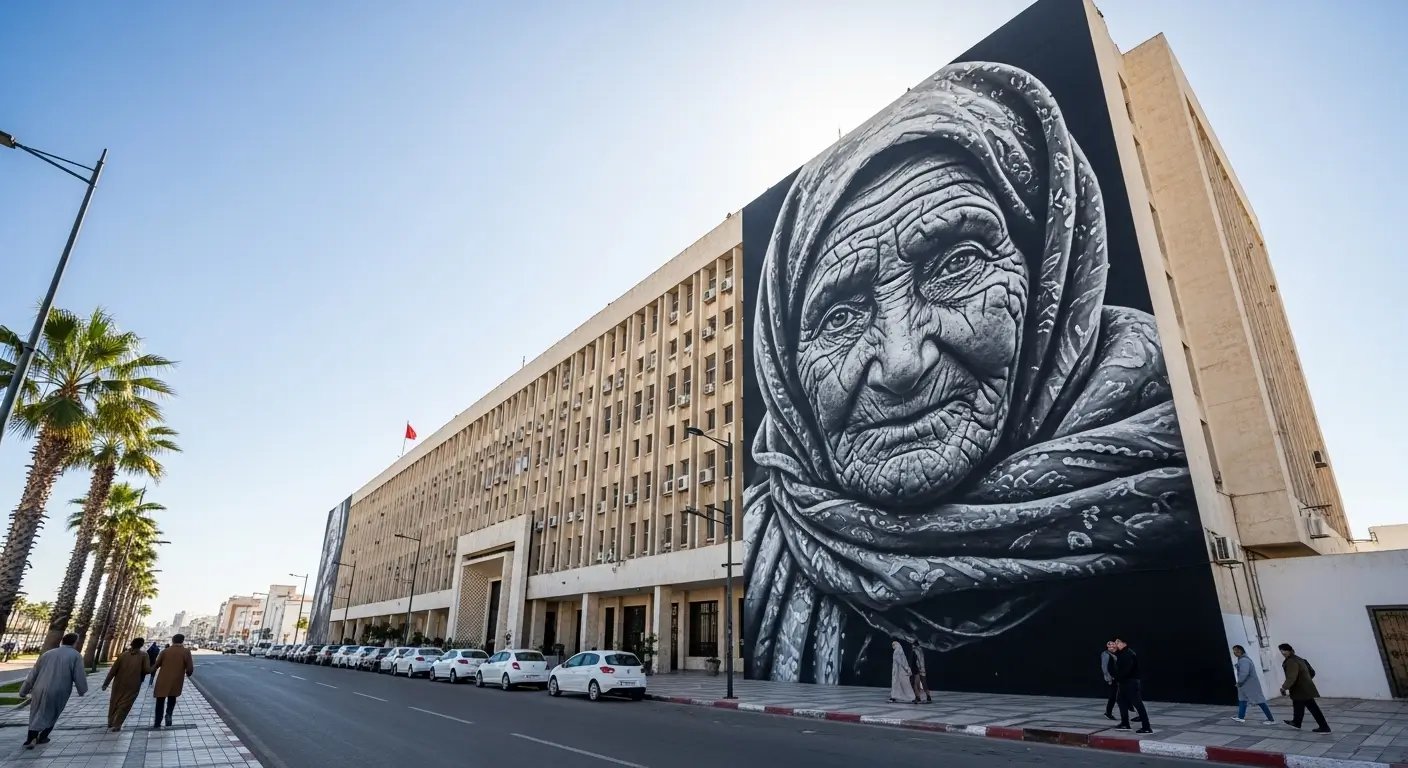
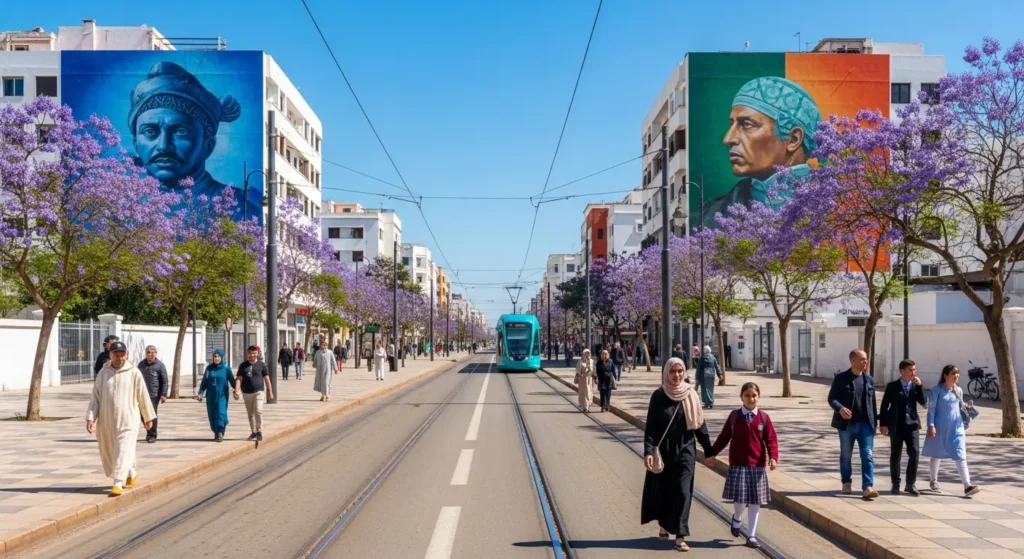
Walk out of Rabat Ville train station and something unexpected stops you in your tracks — a massive, photorealistic face gazing down from an entire building wall. No museum. No entrance fee. Just raw artistic power painted on concrete, free for anyone passing by.
Most people come to Rabat for the kasbahs, the medina, and the Hassan Tower. What they don’t expect is to find one of the most impressive street art in Rabat scenes in all of Africa. The Moroccan capital has quietly transformed itself into a world-class open-air gallery, with dozens of large-format murals spread across its neighborhoods, tram lines, and historic alleys.
This guide covers everything you need: the festival behind it all, the most iconic murals, the Moroccan artists shaping the scene, where exactly to find the art, and how to make the most of your visit — whether you are a local exploring your city or a traveler who almost skipped Rabat entirely.
Table of Contents
The JIDAR Festival — The Heart of Street Art in Rabat
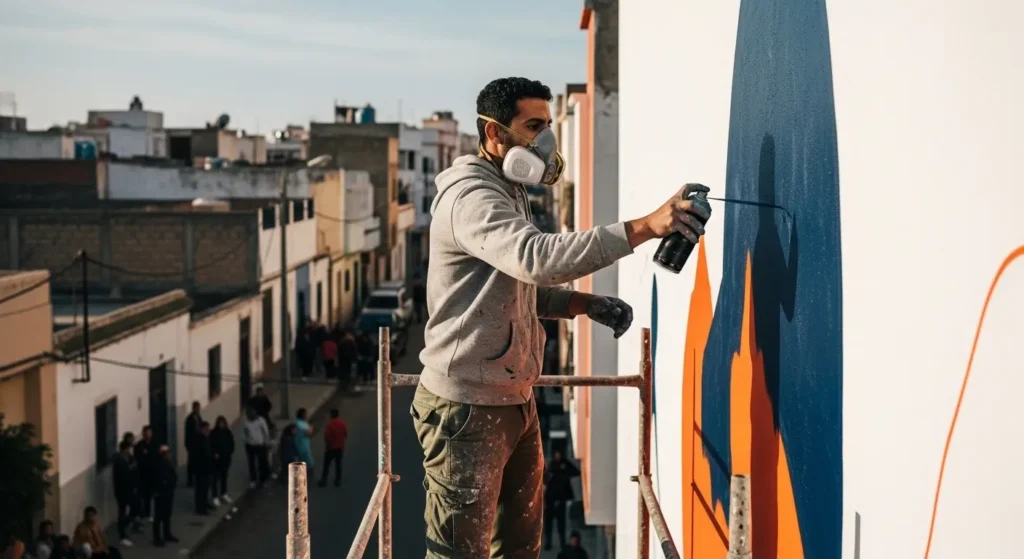
No single event has shaped the street art scene in Rabat more than JIDAR. If you want to understand why Rabat’s walls look the way they do, JIDAR is where you start.
What Does JIDAR Mean?
The name comes directly from the Arabic word جدار, which simply means wall. It is an honest, straightforward name for a festival that is exactly what it says: an annual celebration that turns Rabat’s walls into art.
Who Created JIDAR and Why?
JIDAR was founded by Salah Malouli, artistic director of EAC-L’Boulvart — which stands for Education Artistique et Culturelle. This non-profit organization has been promoting urban arts in Morocco for over two decades, running workshops, concerts, and cultural events long before murals became mainstream.
Malouli launched the festival with a clear mission:
- Transform Rabat’s public walls into an accessible gallery for everyone
- Give local and international artists a legitimate, large-scale canvas
- Encourage Moroccan youth to engage with street art in an open, sanctioned way
- Build a lasting cultural legacy on the city’s architecture
The festival has since grown into one of the most respected urban art events in Africa and the Arab world.
How the JIDAR Festival Works
JIDAR is not a weekend event — it typically runs for about 10 to 12 days each spring, usually in April. Here is how it unfolds:
| Phase | What Happens |
|---|---|
| Artist selection | A curated mix of Moroccan and international muralists are invited by EAC-L’Boulvart |
| Wall allocation | Buildings and facades across the city are assigned to specific artists |
| Live creation | Artists paint their murals in full public view — anyone can watch |
| JIDAR Talks | Public conversations with artists about their process, career, and urban art’s role in society |
| Collective Wall | A collaborative mural program for emerging Moroccan artists (see below) |
| OUT/IN STREET ART | A parallel program that creates a dialogue between outdoor murals and indoor gallery exhibitions |
The entire festival is free and open to the public. You do not need a ticket to watch artists at work or to walk among the murals.
The Collective Wall — A Platform for Emerging Moroccan Artists
One of the most important initiatives within the festival is the Collective Wall. This is a mentorship-based program that:
- Pre-selects a group of emerging Moroccan mural artists
- Pairs them with experienced muralists for guidance
- Has them co-create a large-format mural together over several days
- Creates a space for skills exchange and creative growth
If you are a young Moroccan artist interested in muralism, the Collective Wall is the most direct pathway into the organized street art scene in Rabat.
JIDAR Talks — Art That Starts a Conversation
Beyond the murals, JIDAR hosts public artist talks that are open to all. These sessions cover:
- How artists develop their creative process
- The relationship between street art, muralism, and gallery art
- The social and cultural dimensions of painting in public spaces
- Career paths for artists working in urban contexts
These talks are especially valuable for students, creatives, and anyone curious about the ideas behind the art they see on Rabat’s walls.
The History and Origins of Street Art in Rabat
The street art scene in Rabat did not appear overnight. It grew out of a broader cultural shift across Morocco that took years to build momentum.
Before the Murals: Graffiti’s Early Days
Street art in Morocco first found its footing in Casablanca, Morocco’s commercial capital, in the early years of the millennium. A generation of young artists — inspired by graffiti movements in Europe and North America — began working on Casablanca’s walls, including a landmark transformation of Les Abattoirs de Casablanca by young street artists and graffiti writers.
The defining moment for the organized scene came with the Sbagha Bagha festival in Casablanca. The name means “he colored it” in Darija, the Moroccan dialect of Arabic. This festival gave Morocco its first professionally organized murals and proved that the public — both residents and institutions — was ready to embrace large-scale urban art.
Rabat took note. What began in Casablanca’s streets eventually found an even stronger institutional home in the capital.
Why Rabat Became the Capital of Street Art in Morocco
Several factors made Rabat the ideal city for the street art scene to flourish:
- Government and institutional backing: As the administrative capital, Rabat had the infrastructure and official support needed to scale the art movement
- EAC-L’Boulvart’s long-term groundwork: Two decades of promoting urban culture created the foundation for JIDAR to launch
- Architectural opportunity: Rabat’s wide avenues, blank building facades, and mix of Art Deco and contemporary construction provided ideal large-scale canvases
- A city ready for reimagination: Rabat’s reputation as a quiet administrative city made the contrast with bold street art all the more powerful
Today, Casablanca and Rabat are considered complementary poles of the Moroccan street art world. Casablanca brings a grassroots, spontaneous energy. Rabat brings institutional scale and international reach.
The Cultural Tension That Defines Moroccan Street Art
Unlike street art movements in Europe, which grew out of political protest and economic frustration, street art in Rabat operates within a very different cultural framework:
- There is no strong tradition of subversive public messaging in Morocco
- Artists are not encouraged to draw attention to political or social grievances on public walls
- The focus is almost entirely on artistic value — technique, beauty, visual storytelling
- Legal, commissioned murals dominate; unauthorized work is rare and unwelcome
This does not make Moroccan street art less meaningful — it simply channels creative energy differently. Artists here navigate a constant, interesting tension: honoring traditional Moroccan cultural codes while expressing a fully contemporary, globally connected artistic voice.
The murals on Rabat’s walls are proof that this tension produces extraordinary results.
The Challenge of Impermanence
Not every mural lasts forever. Some of the challenges the scene faces include:
- Walls being painted over by landlords or new developments
- Flyposting and informal advertising covering murals, especially in Casablanca
- Weathering and time degrading older works
Despite these obstacles, both artists and organizers approach impermanence as part of working in public space — a price worth paying for the visibility and accessibility that street art uniquely offers.
The Most Iconic Murals: Street Art in Rabat You Cannot Miss
The street art in Rabat covers multiple neighborhoods and dozens of walls. These are the works that every visitor — local or international — should seek out.
“Najma” by Hendrik Beikirch (ECB)
Location: Caisse de Dépôt et de Gestion building, Avenue Moulay Hassan
This is arguably the most technically impressive single mural in all of North Africa. German artist Hendrik Beikirch — who signs his work as ECB — painted a towering, hyper-realistic black-and-white portrait of Najma, a farmer from Morocco’s Ourika Valley.
What makes this work extraordinary:
- Beikirch uses a technique similar to a dot-matrix printer, building the image through thousands of carefully placed marks
- The result looks indistinguishable from a giant photograph
- Every facial line, expression, and emotion of a working woman from rural Morocco is visible from the street below
- The mural is part of Beikirch’s Tracing Morocco project, which spotlights Moroccan tradespeople whose ways of life are changing in a modernizing world
This is street art as portraiture, and portraiture as social statement.
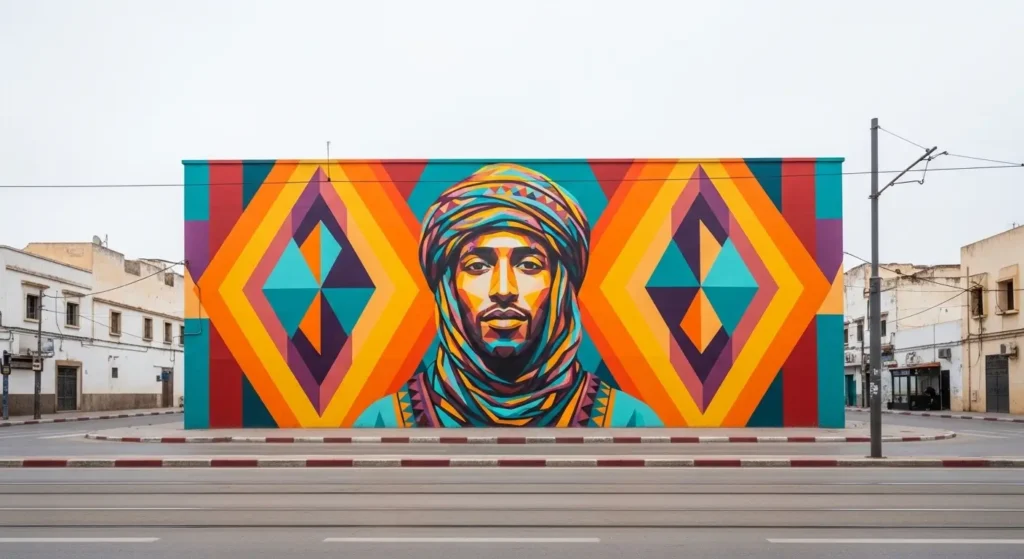
The Sahara Prince by Okuda San Miguel
Location: Avenue Al Alaouiyine (building-sized)
Spanish artist Okuda San Miguel is known for his signature style: bold, geometric, kaleidoscopic shapes that build recognizable human and animal forms. His Sahara Prince mural in Rabat is one of his finest works anywhere in the world.
- Colourful geometric shapes construct the face of a desert prince
- Repeating patterns fill his metres-high headscarf
- A peaceful bird appears beside him
- The work explores the tension between Morocco’s desert roots and its contemporary urban life
Okuda has multiple installations across Morocco — Rabat alone holds more than one of his works.
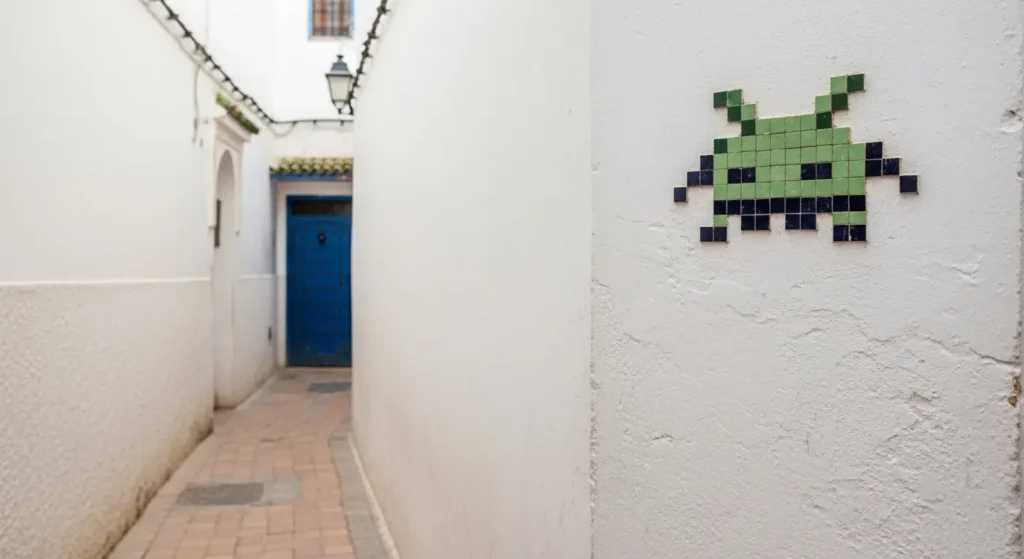
Space Invader’s 20+ Mosaic Tiles
Location: Throughout the city — near St Pierre Cathedral, inside the medina, around Bab Oudaia, and at the carpet souk
French artist Space Invader visited Rabat and left behind more than 20 mosaic tile “invasions” — small, intricate tile works inspired by classic arcade game graphics, installed on walls at unexpected heights throughout the city.
What makes the Rabat pieces special:
| Mural | Location | Detail |
|---|---|---|
| Space Invader in a red Fez | Medina | Traditional Moroccan hat on the pixel figure |
| Space Invader on an Aladdin lamp | Medina | Steam cloud forms the alien figure |
| Space Invader as carpet motif | Carpet souk | Installed directly where carpets are sold |
| Belly dancer piece | Rue Zirara, near Bab Oudaia | Whitewashed wall in the old city |
Finding all 20+ tiles is a game within a game — a self-guided urban treasure hunt.
Geometric Illusion by Mur0ne
Location: Intersection of Avenue d’Egypte and Avenue Jazirat Al Arabe
Spanish artist Mur0ne is a master of architectural trickery. At this busy junction, he painted a mural that challenges viewers to determine what is actually part of the building versus what is painted.
- Stairs appear to lead into the wall
- Windows seem to open onto impossible spaces
- The longer you look, the more the real and the painted blur together
This is one of the best murals in Rabat for photographs — and for the philosophical pleasure of not being entirely sure what you are looking at.
“Dahbia” by Tarek Benaoum
Location: National Library of Morocco (Tram stop: Bibliothèque Nationale)
Paris-based artist Tarek Benaoum chose the most appropriate building in Rabat for a text-based work: the national library. His mural Dahbia features Native American, Arabic, Amazigh, and Latin scripts circling together in an endless loop — a visual statement about language, identity, and the shared humanity of written expression.
Pixel Pancho Mural
Location: Junction of Rue Al Mourabitine and Avenue Moulay Ismail
Italian artist Pixel Pancho brings his signature blend of robotics and mythology to Rabat. His work at this junction merges mechanical forms with organic, almost dreamlike imagery — machines that seem to breathe, metal figures that feel ancient.
The Latest JIDAR Additions
The most recent edition of the festival added four new murals to Rabat’s permanent collection:
| Artist | Nationality | Location |
|---|---|---|
| Rosh Roshdi | Moroccan | Avenue Al Ghazali × Avenue Hassan II, Agdal Riad |
| Rita Nosko | Moroccan | Avenue Belhassan El Ouazzani × Avenue Ahmed Reda Gdira, El Youssoufia |
| Mizmiz | Moroccan | Avenue Fatouaka × Rue Ouzguita, El Youssoufia |
| Reda RDS | Moroccan | Maternité Souissi, Avenue Ibn Rochd, Agdal Riad |
All four are now part of the permanent street art landscape of Rabat — free to visit at any time.
Moroccan Artists at the Center of the Scene
Much of the global coverage of street art in Rabat focuses on international names. This section fixes that imbalance. The soul of this scene is Moroccan — and these are the artists carrying it.
Why This Matters
International artists bring global visibility, but it is Moroccan artists who give the street art scene in Rabat its authentic voice. With each edition of JIDAR, the proportion of Moroccan artists in the lineup grows — a deliberate and important shift.
Artist Profiles
MACHIMA One of the most recognizable names in Moroccan street art. MACHIMA’s work blends traditional Moroccan visual culture with contemporary mural techniques — bold compositions that incorporate Arabic script, intricate geometric patterns, and references to Moroccan identity. The mural Lady of Colors is considered one of the defining works of the Moroccan scene.
Iramo Samir Samir’s work is rooted in everyday Moroccan life. His mural Women in Rabat, created during an early edition of JIDAR, depicts Moroccan women with dignity, realism, and emotional depth. His work To the Moon and Back — showing a smiling Moroccan mother carrying her child — captures the unbreakable bond between parent and child with remarkable warmth.
Mizmiz Known for his distinctive graphic style and viral animations, Mizmiz is a recurring presence at JIDAR. His work sits at the intersection of illustration, graphic design, and large-format muralism — immediately recognizable, always surprising.
Reda RDS Reda brings a hybrid approach: graffiti lettering tradition merged with architectural sensitivity. His work responds to the buildings it inhabits — the mural and its surface feel like a single object.
Rosh Roshdi One of the most promising voices in the new generation of Moroccan muralists, Rosh marked a significant milestone with his latest JIDAR commission in Agdal Riad — a mural that signals both technical maturity and a distinctive personal vision.
Rita Nosko Rita’s work is quietly powerful — delicate scenes that celebrate the beauty of ordinary daily life in Morocco. Against the backdrop of bold, large-format works by others, her poetic approach stands out precisely because of its restraint.
Omar Lhamzi Lhamzi represents the newest wave of Moroccan street art. His surrealist murals are full of references to skating culture and video games — a generation’s identity painted on the walls of the capital.
Imane Droby One of the most visible female voices in Moroccan muralism, Droby has established herself as a serious force in the JIDAR scene with work that is both visually striking and culturally grounded.
The Independent Scene Beyond JIDAR
JIDAR is not the only game in town. Independent street art can be found throughout Rabat’s medina and residential neighborhoods — smaller works, stencils, and paste-ups by artists working outside the festival structure. Exploring the medina’s narrower alleys often reveals pieces that never made it onto any official map.
Women in Rabat’s Street Art Scene
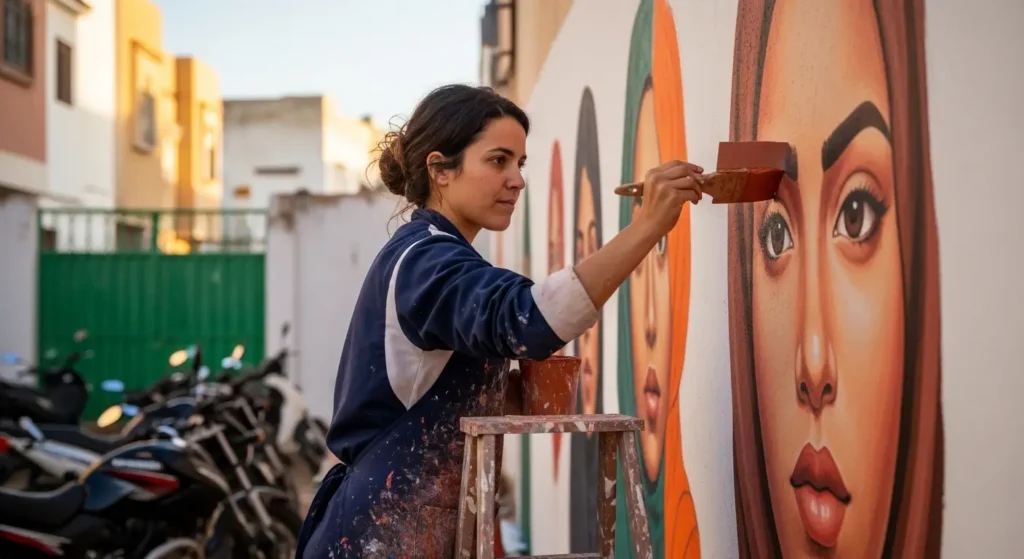
The story of street art in Rabat cannot be told without acknowledging the women who are shaping it — and the extra barriers they navigate to do so.
The Honest Challenge
Street art is a physically demanding, publicly visible practice. For women in Morocco, this brings particular challenges. As one artist in the scene put it directly: street art “is difficult for everyone, but even more so for women. You have to double the effort to make your mark.”
Working on large scaffolding in full public view, in neighborhoods where a woman painting a wall is an unusual sight — this takes a specific kind of resolve that deserves recognition.
Female Artists Making Their Mark
Imane Droby has become one of the clearest examples of what perseverance in this space produces. Her JIDAR work is technically accomplished and conceptually rich — proof that the barriers did not stop her, and that the scene is better for her presence in it.
GLEO (Colombian artist Natalia Gallego Sánchez) is a regular international presence in Rabat whose work celebrates feminine power and beauty through large-format portraits. Her murals in Rabat are among the most emotionally resonant on any wall in the city.
Rita Nosko brings a gentler but equally powerful feminine perspective — scenes of everyday grace that feel like a counterpoint to the more aggressive aesthetics that dominate street art globally.
Murals That Celebrate Moroccan Women
The street art in Rabat includes several works specifically devoted to the role and presence of women in Moroccan society:
- Women in Rabat by Iramo Samir: a landmark mural that portrays Moroccan women as they are — working, living, present — not as ornament or symbol
- Women’s empowerment mural in a central district: a tribute to feminine strength that blends traditional Moroccan aesthetic elements with contemporary design
- Multiple murals by GLEO featuring large-scale female portraits that command entire building facades
These works are a conversation with Moroccan culture — honoring what is traditional while pushing gently at what is possible.
Neighborhood-by-Neighborhood: Where to Find Street Art in Rabat
The street art in Rabat is spread across multiple neighborhoods. Here is a complete zone-by-zone guide, organized as a self-guided walking and tram tour.
How to Start Your Tour
Starting point: Rabat Ville train station Estimated total time: 3 to 4 hours for the full circuit Cost: Free Best time to start: Morning, for the best natural light on photographs Essential tool: Download the Rabat tram map before you go
Zone 1 — City Center (Avenue Moulay Hassan & Avenue Moulay Ismail)
This is the densest zone for street art in Rabat and the best place to start.
What to look for:
- Najma by Hendrik Beikirch (Caisse de Dépôt building, Ave Moulay Hassan)
- Pixel Pancho’s mural (junction of Rue Al Mourabitine and Ave Moulay Ismail)
- Okuda’s Sahara Prince (Ave Al Alaouiyine)
- Space Invader mosaic tiles near St Pierre Cathedral
How to navigate: Leave the train station, walk northeast along Avenue Moulay Hassan. The city center murals are within comfortable walking distance of each other.
Zone 2 — Old Medina and Bab Oudaia
This zone offers the most atmospheric experience of street art in Rabat, where contemporary murals meet centuries-old architecture.
What to look for:
- Space Invader wearing a traditional red Fez (medina walls)
- Space Invader emerging from an Aladdin-style lamp (medina)
- Space Invader as a carpet motif (carpet souk)
- Belly dancer piece on the whitewashed wall of Rue Zirara, near Bab Oudaia
Tip: Combine this zone with a visit to the Kasbah des Oudaias — the street art and the historic fortress are within easy walking distance.
Zone 3 — Agdal Riad
Tram directions: Take the tram from the city center toward Agdal
What to look for:
- Rosh Roshdi’s mural (Ave Al Ghazali × Ave Hassan II)
- Reda RDS mural (Maternité Souissi, Ave Ibn Rochd)
This neighborhood has become one of the most exciting zones for new street art in Rabat, with the latest JIDAR commissions located here.
Zone 4 — El Youssoufia
El Youssoufia is a working-class neighborhood that has been transformed by JIDAR’s community-minded approach to placing art in areas where residents — not just tourists — interact with it daily.
What to look for:
- Rita Nosko’s mural (Ave Belhassan El Ouazzani × Ave Ahmed Reda Gdira)
- Mizmiz mural (Ave Fatouaka × Rue Ouzguita)
Why this zone matters: Street art in these neighborhoods is not decorative backdrop — it is a genuine engagement with the communities that live there.
Zone 5 — National Library Area
Tram stop: Bibliothèque Nationale
What to look for:
- Tarek Benaoum’s Dahbia mural (on the National Library building itself)
Combine this stop with the library building, which is architecturally notable in its own right.
How to Experience Street Art in Rabat — Practical Guide
When to Visit
| Timing | What to Expect |
|---|---|
| During JIDAR (spring, April) | Maximum freshness of new murals; live mural creation you can watch; JIDAR Talks; festival atmosphere |
| Any other time of year | Permanent murals always accessible; quieter streets make photography easier |
| Morning light | Best for photographing most murals, especially those on south-facing walls |
| Late afternoon | Golden light is ideal for the large-format portraits (Najma, GLEO works) |
Logistics at a Glance
- Cost: Completely free — all murals are in public space, no entry, no ticket
- Transport: Rabat’s tram network connects most zones; key stops include Rabat Ville, Bibliothèque Nationale, and Agdal
- Combine with: Hassan Tower, Kasbah des Oudaias, the medina souks, and the Andalusian gardens for a full day in Rabat
- Getting lost: Encouraged — some of the best street art in Rabat hides on walls you find by wandering
Photography Tips
If you want to capture the best images of street art in Rabat, keep these points in mind:
- For large-format portraits (Najma, GLEO works): step as far back as possible and shoot in the early morning when the wall is in soft shadow
- For geometric works (Mur0ne, Okuda): midday light works well because it flattens shadows and reveals the full colour range
- For Space Invader tiles: the mosaics are often small and high up — use your phone’s portrait mode or a zoom lens
- For social content: The 3D interactive mural that invites viewer participation is the best spot for human-in-frame photography
- For video: Walk the Zone 1 circuit in one continuous shot — the density of murals makes for compelling visual content
Best Murals for Social Media Content
| Mural | Why It Works Online |
|---|---|
| Okuda’s Sahara Prince | Colour saturation and geometric complexity perform extremely well in feeds |
| Space Invader tiles | Treasure-hunt format encourages Stories and Reels content |
| Najma by Beikirch | The scale and realism generate immediate emotional response |
| Mur0ne geometric illusion | “Can you tell what’s real?” posts generate high engagement |
| Interactive 3D mural | Human presence in the frame makes it personal and shareable |
How to Get Involved as an Artist
If you are a Moroccan artist interested in the street art scene in Rabat, here are your entry points:
- JIDAR’s Collective Wall: The primary mentorship pathway for emerging Moroccan muralists — watch EAC-L’Boulvart’s official channels for applications each year
- JIDAR Talks: Free and open to the public — attend to meet artists and learn about the scene from the inside
- EAC-L’Boulvart workshops: The organization runs ongoing programs throughout the year beyond the festival itself
- The independent scene: Start creating, document your work, build your portfolio — the community notices
FAQ — Everything You Wanted to Know About Street Art in Rabat
What is the street art festival in Rabat called? The festival is called JIDAR — from the Arabic word for “wall.” It is an annual event that brings together Moroccan and international artists to paint large-format murals across the city.
When does the JIDAR festival take place? JIDAR takes place annually, typically in April during spring. Each edition lasts approximately 10 to 12 days.
Is street art legal in Morocco? Yes. Institutionally supported and government-approved muralism dominates the scene in Rabat. JIDAR works in direct partnership with city authorities and building owners. Unauthorized graffiti does exist but is not the driving force of the scene here.
Where is the best street art in Rabat? The highest concentration of street art in Rabat is in the city center around Avenue Moulay Hassan and Avenue Moulay Ismail. Additional major works are found in the medina, in Agdal Riad, El Youssoufia, and near the National Library.
Who are the most famous Moroccan street artists? The most recognized Moroccan street artists include MACHIMA, Iramo Samir, Mizmiz, Reda RDS, Rosh Roshdi, Rita Nosko, Omar Lhamzi, and Imane Droby.
How do I attend the JIDAR festival? JIDAR is entirely free and open to the public. Simply show up during the festival dates — no ticket, no registration. You can watch artists paint live, attend JIDAR Talks, and explore new murals as they are created.
Où voir le street art à Rabat? Les principales zones sont : le centre-ville (Avenue Moulay Hassan, Avenue Moulay Ismail), la médina et autour de Bab Oudaia, le quartier d’Agdal Riad, El Youssoufia, et aux alentours de la Bibliothèque Nationale.
How many murals are there in Rabat? The number grows with every JIDAR edition. The city currently has over 28 mapped, large-format murals — plus dozens of smaller works including Space Invader’s 20+ mosaic tiles scattered throughout the city.
Why Street Art in Rabat Belongs on Every Moroccan’s Radar
Rabat has always been Morocco’s political capital. It is now also becoming its cultural one.
The street art in Rabat is not a tourist attraction grafted onto the city for visitors. It is a living, growing creative movement built by Moroccan artists, sustained by Moroccan institutions, and enjoyed most deeply by the people who walk past it every day on their commute, their school run, or their afternoon walk through the medina.
Every mural on these walls is a statement: that public space belongs to everyone, that beauty has no paywall, and that Moroccan culture is not only ancient — it is also being made right now, on the sides of buildings, by a new generation with paint in their hands and something to say.
Here is what to do next:
- Plan your mural walk using the zone-by-zone guide above — start at Rabat Ville station and follow the route
- Follow Moroccan artists like Mizmiz, Rita Nosko, and Rosh Roshdi on social media to stay connected to the scene
- Mark your calendar for JIDAR — attending during the festival transforms the experience from sightseeing into participation
- Share what you find — every photograph of street art in Rabat shared online is a small act of support for the artists who created it
1 thought on “Street Art in Rabat: The Complete Guide to Morocco’s Open-Air Gallery”